
Making things happen quickly and efficientrly is a key skill for TTLs. There are lots of ways to do this, and one method s to think through our processes and remove as many inefficient steps as possible. Doing that will get our patient to CT or theatre as quickly and as safely as possible.
One of the simplest ways to do this is to avoid delays is switching monitoring systems before transfer.
The Problem
Patients often arrive and are then immediately connected to wall-mounted monitors by well meaning members of the team. After all this is what we usually do in most of the patient who rock up in resus. We take them off the paramedics (portable) monitor and place them on our wall mounted (not-portable) monitors…….why? It’s pretty obvious to all of us that the patients is going to be going somewhere else pretty soon, so why do we attach them to immovable objects?
When it’s then time to move:
- Leads need to be swapped
- Monitoring needs to be re-established
- Equipment needs to be reorganised
All of this takes time and yet nearly all of it is avoidable.
The TTL Intervention
Set this up early as part of your team brief:
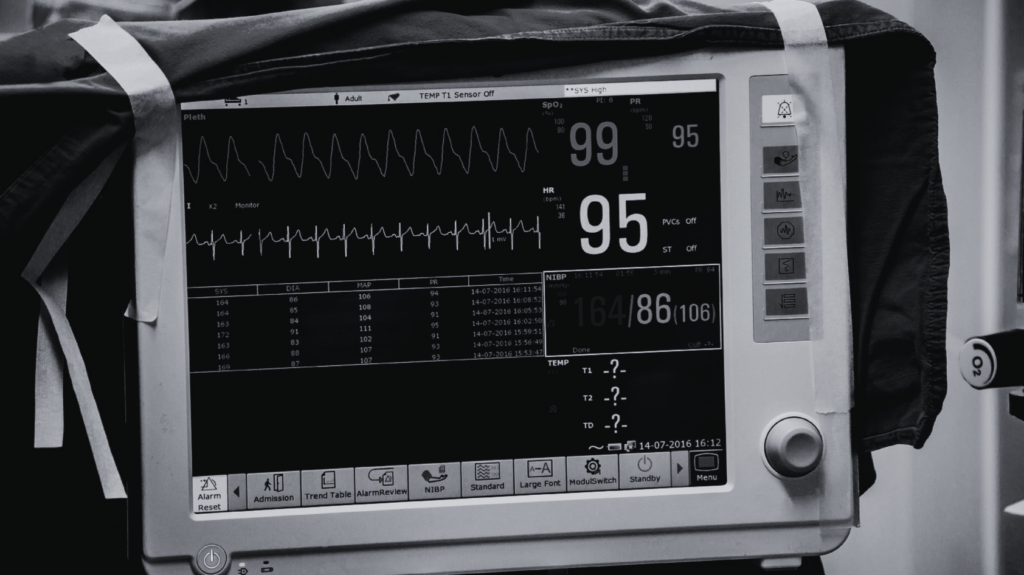
- Please place the patient directly onto a portable monitor on arrival
- Ensure it is:
- Fully charged
- Plugged in while in resus
- Positioned next to the patient
This removes an entire step from the transfer process.
When It’s Time to Move
- Unplug the monitor
- Place it on the bed
- Go
Why This Matters
Trauma care is time-critical, but there are rarely any single interventions that make a huge difference. What you are usually looking for is lots of small gains that add up into big ones (marginal gain theory).
- We want to avoid delays to CT diagnosis
- We need to avoid delays to theatre for haemorrhage control
- It makes the team look and feel inefficient
Small inefficiencies accumulate and this is such a simple intervention that it seems odd that we don’t always do it.
Check a few more things.
While you’re briefing the team think about a few other things as well as all of these elements can reduce your ability to move rapidly to the CT/Theatre.
- Check the oxygen supply on the bed
- Ensure adequate cylinder volume for transfer
- Make sure all the other transfer kit is available as we talked about in TTL tips 5.
Many departments have a departure checklist and I think that’s a great idea, but in a well trained team all the steps on that departure checklist will have been anticipated before the checklist is actually used.
Summary
- Plan for transfer from the moment the patient arrives
- Use portable monitoring from the start
- Remove unnecessary steps that waste time and increase complexity/risk
vb
S
Further reading
Simon Carley, “Marginal gains, Matt Parker, F1 and the ED. St.Emlyn’s,” in St.Emlyn’s, March 19, 2014, https://www.stemlynsblog.org/ed-need-matt-parker-st-emlyns/.

Really enjoying this TTL tips series.
One practical monitoring consideration I might suggest is the placement of continuous ECG leads on arrival in the trauma bay, particularly in critically injured patients. Standard lead placement (RA/LA in the deltopectoral region and RL/LL on the lateral chest wall) can impede sterile chest preparation and potentially delay time-critical interventions such as thoracostomy or subclavian venous access.
Where significant thoracic intervention is anticipated, an alternative approach may be to place the RA/LA leads over the right and left deltoid regions, and the RL/LL leads on the right and left upper quadrants of the abdomen. This preserves access to the chest wall while maintaining continuous cardiac monitoring.
In trauma resuscitation, minutes matter—and when minutes matter, seconds count.