
Most clinical staff working on Emergency Department (ED) rotas operate within a contracted maximum of one weekend in three. Resident doctors, Specialty and Specialist (SAS) grades, and doctors in training all sit within this limit. Consultants are technically subject to the same ceiling. But the RCEM Workforce Census 2024 suggests the average in England is closer to one weekend in six. Although Agenda for Change (AfC) contracts have no equivalent restriction, the proportion of AfC staff currently on clinical rotas is small.
The implication of weekend ratios in a setting where weekend demand is comparable to weekday demand (Meacock R, et al.) is not always apparent. And the structural mismatch between weekend demand and weekend ED capacity is not a new problem. Simon Carley named the recruitment cost in 2012 and followed up later that year calling for the specialty to learn from industry about rotas and work patterns: annualised hours, sabbaticals, progressive shift patterns. The rota redesign thread he opened then has never fully been answered.
Iain Beardsell flagged in 2017 that less than full time working was already shrinking Whole Time Equivalent (WTE) growth in ways the workforce strategy had not accounted for. I argued in 2025 that standardised less than full time job planning would be one of the ingredients of any genuine recovery. The conversation has run for more than a decade and the answer has been visible for most of it. What I am attempting here is the arithmetic frame that explains why the obvious answer keeps losing.
Full time establishment
An ED with twelve 1.0 WTE (or full time) consultants can staff Monday to Friday with twelve consultants. But when working one weekend in six, only two consultants are available to the rota. The same principle applies to a full time resident or SAS rota of twelve. All twelve staff members are available Monday to Friday. But when working one weekend in three, only four are available to the rota. This is the core of the structural weekday/ weekend disparity built into every full time ED contract.
Within a fixed full time headcount, weekend cover is determined by the weekend ratio, and there are only two levers. The first is asking clinical staff to work more weekends. But the workforce census shows EDs are already at or below the 1:3 ceiling in practice, often for reasonable wellbeing reasons. So this lever is largely exhausted. The second is increasing the number of bodies on the rota. But on full time contracts this results in a weekday surplus problem. Some trusts attempt a third approach with longer shifts. This trades the weekend ratio problem for harder within-day demand matching, more mandated breaks, and the folly of presuming end-of-shift productivity matches start-of-shift effort.
Each additional full time staff member adds Direct Clinical Care (DCC) capacity across five weekdays alongside their weekend share. But most EDs cannot cost justify the weekday capacity that goes with appropriate weekend capacity. The model inevitably accepts depleted weekend capacity, commonly requiring locum top up.
Part time establishment
Less than full time (LTFT, or part time) on the other hand dissolves this constraint. Two 0.5 WTE clinical staff contribute the same weekend availability as two 1.0 WTEs, but with the weekday capacity of one. Scaled to the example above, an ED can still staff Monday to Friday with twelve resident or SAS staff. But with 24 staff members in total, they now have eight available to the weekend rota.
Portfolio working does the same job for those whose non-clinical activity sits within the establishment but outside the rota. This model accepts the contracted ratio by reconciling part time working with weekend demand. And yet the case for part time working keeps losing. Let’s dig into why that is.
An accounting problem, not an arithmetic one
Workforce papers proposing 0.4, 0.6 or 0.8 WTE posts tend to get challenged on the per head premium, additional fixed costs and supervisory implications. Although the locum line keeps growing in parallel, it is treated as a recurring surprise rather than the inevitable consequence of the establishment decision that produced it.
This is not a failure of arithmetic, but one of accounting visibility. It is worth understanding how the accounting works.
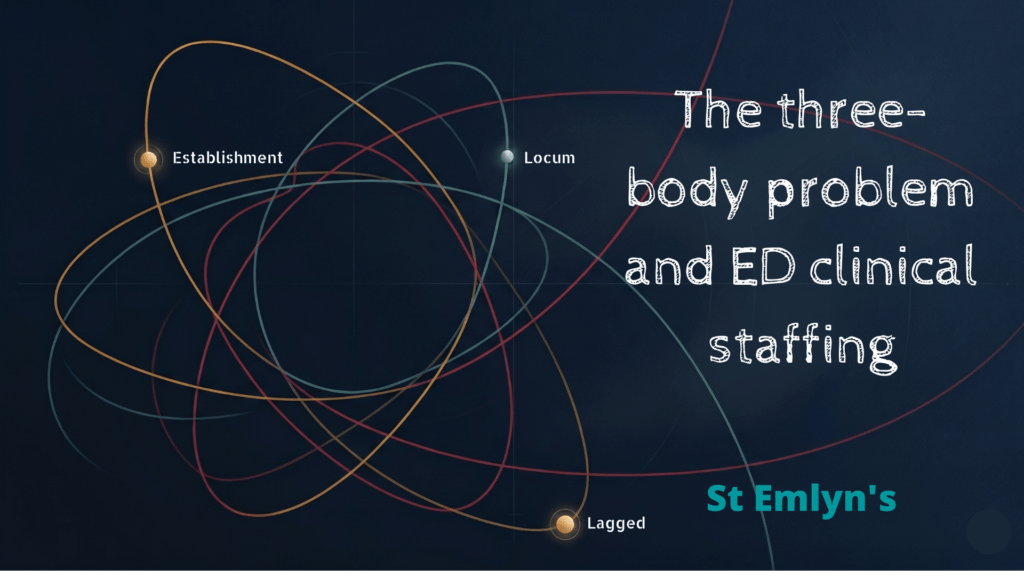
The decision to staff an ED after hours sits on three different ledgers at once. Each owned by a different person and scrutinised on a different timescale. From any single position the accounting looks like the three-body problem: a celestial phenomenon where three orbits interact but resist prediction.
The physics of a three-body problem has no analytical solution because the bodies genuinely interact in non-linear ways. But the three ledgers controlling your staffing decisions only look insoluble because the accounting convention has split a single decision into three orbits that need not be apart. Reunite them in one frame and the arithmetic returns.
The three ledgers
The establishment ledger
New substantive contracts appear here. Owned by the workforce decision maker, scrutinised by finance and locked in for years. The per head premium of LTFT working is fully visible, attributed and argued over. Two 0.5 WTE clinicians do cost more than one 1.0 WTE clinician: study leave, appraisal, revalidation, mandatory training and on call commitments attach to the person, not the contract fraction. The premium is real, and on the establishment ledger this additional cost is clearly visible.
The locum ledger
The cost of not making the establishment investment shows up here. Often in a different cost code, owned by a different person. Commonly normalised as overspend rather than traced back to the workforce decision that produced it. After hours locum rates run substantially above the marginal substantive cost for the same hours, and off cap they run at multiples.
The RCEM 2024 census found that locums deliver between 7% and 13% of consultant DCC shifts across English regions. These shifts cluster disproportionately on the weekend, evening and night periods where rates are highest. The headline percentage therefore understates the financial weight, because the locum cover concentrates on exactly the hours where the price differential is largest.
This is the financial signature of decisions made on the establishment ledger without sight of this one. The decision maker blocking the substantive post may genuinely not carry the locum spend on their budget, and is optimising rationally within the information they have.
The lagged ledger
Attrition, sickness, complaints, errors and litigation. These are temporally distant costs that live on budgets no one in the establishment conversation is looking at. NHS Resolution exposure sits outside the trust entirely. Attrition cost gets absorbed into operational lines two years later, never traced back to the decision that produced it.
The litigation piece deserves particular weight because it is also the safety argument. Legal exposure tracks decision quality, and decision quality tracks the availability of senior decision makers at the point of patient contact. A consultant rota delivering one in six weekends is by definition providing less senior decision making to weekend attendances.
The litigation cost is therefore the downstream signal of decisions made without enough senior input. That makes the lagged ledger the safety ledger as well. It strengthens the case for keeping these numbers in any business case rather than stripping them under finance challenge.
One decision, three ledgers
These three ledgers describe the same decision. The accounting convention that keeps them apart is not a feature of reality, it is a feature of how we have organised the books. The manager who blocks a 0.4 WTE post and then signs off the locum overspend a year later is not being inconsistent. They are doing exactly what the ledger architecture demands of them.
Why this matters, the business case
The business case is the one document where ledgers normally scrutinised separately can legitimately be added together. It is a structural intervention disguised as an administrative artefact. Done properly, it forces the comparison into a single frame: total cost of after hours cover under each model, including establishment, locum displacement and lagged externalities, with explicit ranges where the numbers are uncertain.
I’d argue the discipline that matters is retaining the uncertain lagged numbers under finance challenge. Stripping these costs to make the case look tighter hands the argument back to the silo logic the case was built to disrupt. The stronger move is to keep the lagged numbers, anchor them in published evidence, and present a do nothing scenario that models locum trajectory, attrition and litigation exposure honestly. The comparison then makes itself.
The missing integration model
The Getting It Right First Time (GIRFT) Urgent and Emergency Care (UEC) staffing calculator answers a defined question well: given attendance volume and acuity, how many staff are needed to meet demand. RCEM workforce guidance does similar work on senior decision maker requirements, with safe staffing benchmarks anchored in evidence. These tools provide the volume and safety anchors that any local business case should sit on top of.
What they do not yet provide is the second order integration. These resources tell us when and how many bodies need to be on shift. They do not tell us how those bodies should be employed (substantive or locum, full time or part time) to deliver the most economical rota across the week, or the lagged costs of getting it wrong modelled into the comparison. That is the work that has not been built, and individual EDs will continue constructing the scaffolding from scratch until it is.
I acknowledge this blog cannot fill that gap. What it can do is name the structure that keeps the cost case losing despite being correct, point to where the existing tools end, and set out the methodological discipline that any future integration will need. The arithmetic has been right for years. What we have been missing is a way to stop having the same conversation, on the same line, and losing it for the same reason.
