
This is the eleventh in a series of blog posts on new research in emergency toxicology. The last post was about smoking cessation and can be found here. We deal with all sorts of poisons in Virchester, so be prepared for anything.
Almost half of the drug-related deaths in the UK involve an opioid. Heroin is usually the cause. However, with recent disruptions to the global heroin supply chain, we can expect to see more synthetic opioid (e.g. nitazene) overdoses in the coming years.
In emergency medicine, we are generally very good at treating opioid poisoning. The toxidrome is predictable, and we have a tried-and-tested antidote (naloxone) to crack out for the more severe cases.
What we are less good at, in my experience, is preventing these patients from overdosing again. They are usually admitted under acute medicine with the hope that they will receive some form of drug counselling during their stay. Often, however, they abscond from the ward before this can happen. Most hospitals have “frequent flyers” known to substance misuse services, and their faces are depressingly familiar in ED.
How can we do better? One solution is to provide some form of counselling in ED. I try do this when I can, but time is a precious resource on the shop floor, and these are not conversations that can be done quickly. There is also the issue of stigma. Many opioid users have had awful experiences with ED staff. Re-building a positive relationship can be very difficult.
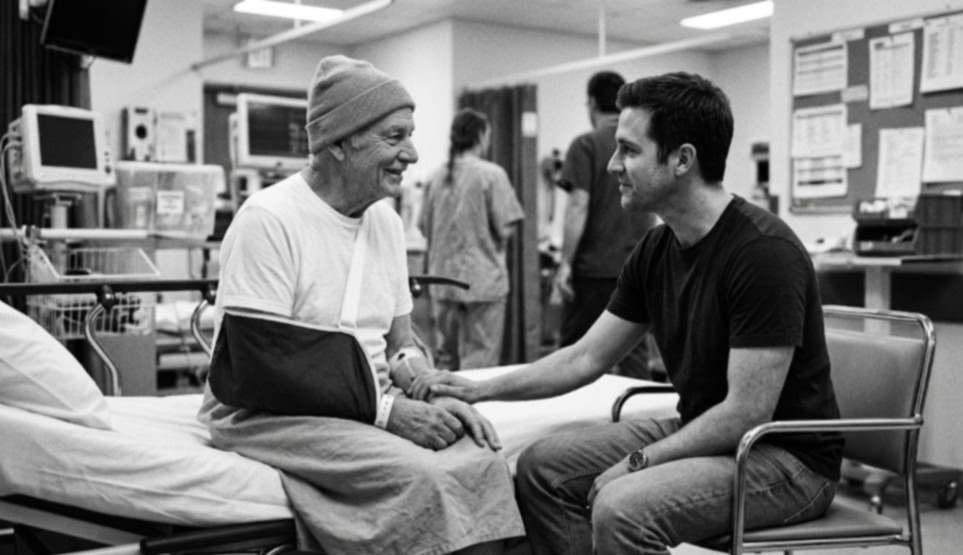
A study recently published in Annals of Emergency Medicine trialled an alternative approach: peer counselling in ED. The researchers wanted to see if a bedside intervention from an individual with life experience of substance use could improve long-term outcomes after opioid overdose.
Abstract
Background & Objectives: To examine whether participation in the New Jersey Opioid Overdose Recovery Program (OORP), an emergency department-based peer recovery support service, was associated with drug treatment initiation and other postdischarge outcomes.
Treitler P, […], Cooperman NA. Treatment Initiation and Outcomes Associated With Receipt of Emergency Department-Based Peer Support Following Opioid Overdose.
Methods: This retrospective cohort study used the 2015 to 2020 New Jersey Medicaid claims linked to OORP evaluation data. Outcomes during 180-day follow-up were compared between opioid overdoses among OORP participants and a propensity score-matched group of overdoses among nonparticipants. Outcomes included any medication for opioid use disorder initiation (primary), percentage of days covered with medication for opioid use disorder, psychosocial treatment initiation and engagement, repeat opioid and any drug overdose, and all-cause and opioid-related acute care utilization. Outcomes were assessed using linear regression (for medication for opioid use disorder percentage of days covered and psychosocial treatment engagement) and Cox proportional hazards (for all other outcomes) models.
Results: A total of 7,109 overdose events among 5,475 patients were included (62.2% men; 28.1% Black, 8.0% Hispanic, 56.1% White; mean age: 40.1 years). OORP participants (N=1,383 events) initiated medication for opioid use disorder at higher rates than nonparticipants (15% versus 12%; hazard ratio [HR]=2.31, 95% confidence interval [CI] 1.55 to 3.45). OORP participation was also associated with greater medication for opioid use disorder percentage of days covered (3.56 percentage points, 95% CI 0.72 to 6.47), psychosocial treatment initiation (HR=1.73, 95% CI 1.13 to 2.65), and psychosocial treatment engagement (11.97 percentage points, 95% CI 7.23 to 16.73), and lower risk of all-cause acute care utilization (HR=0.83; 95% CI 0.72 to 0.97). The association of the program with repeat overdose and opioid-related ED or inpatient visits was not statistically significant.
Conclusions: Peer recovery support service can support treatment linkages following ED-treated opioid overdose. Additional efforts are needed to retain patients in medication for opioid use disorder long-term, to reduce their risk for repeat overdose.
Annals of Emergency Medicine. 2025, August 6th.
What was the study design?
This was a retrospective cohort study. Data were extracted from a large number of patient encounters (n=4298) at fifty-three New Jersey hospitals between 2016 and 2020.
This period was significant because in 2016, New Jersey introduced a statewide peer support service for opioid misuse. As part of this program, support workers with lived experience of opioid dependence visit patients being treated for overdose in ED. Their role is to deliver motivational “bedside interventions,” then refer for substitution therapy (e.g. methadone) and eight weeks of team-based recovery support.
The philosophy underpinning this scheme is that overdose is a ‘reachable moment’ for opioid users, and ED an ideal place to engage them.
Can you tell me about the patients?
The researchers included adults (18-64 years) treated for nonfatal opioid overdose who were not already on substitution therapy. These patients were identified from electronic records using ICD-10 and revenue codes.
Only a minority of the patients (n=1,383) participated in the peer support scheme. The researchers compared their data to a larger number (n=2,915) who did not receive this intervention.
The two groups were intentionally “matched” on a wide array of variables, including demographics, medical comorbidity, and healthcare service use. The final sample were predominantly middle-aged (~40 years) and male (~62%) with more patients coded as ‘Black’ (~28%) than would be expected from New Jersey census data. Roughly one third had previously overdosed on opioids and/or visited ED for opioid-related problems.
What outcome measures were used?
The primary outcome in this study was engagement with opioid substitution therapy.
There were many secondary outcomes, including initiation of psychosocial treatment, repeat overdose, and further presentation(s) to ED.
What were the main results?
Patients receiving peer support after overdose were more likely to receive substitution therapies: 15% versus 12%, with a 95% confidence interval for the between-groups difference of 1-5%. They were also more likely (16% vs. 11%; 95% CI 2-6%) to engage with psychosocial treatment. These confidence intervals do not “cross zero” and so meet conventional thresholds for statistical significance.
No significant differences were found between groups with regard to repeat opioid overdose or use of ED.
The authors additionally reported their results as hazard ratios. I find these misleading – as do others! – and so have not reproduced them here. The absolute figures described above, with confidence intervals, demonstrate the clinical and statistical significance of the study findings well enough.
What should we take away from this study?
There is clearly room to improve our aftercare for opioid overdoses, and this paper explores a potential “bridge” between ED and recovery services. A large, multi-centre sample was used, which is helpful.
However: this is a retrospective observational study. It is difficult to draw conclusions about an intervention from this methodology. The authors used a technique discussed before on St Emlyn’s (propensity score matching) to reduce allocation bias – but, as acknowledged in the Discussion, they were not able to “match” patients for the most important variable in this study, which was ‘readiness to change.’ It is unsurprising to me that individuals who declined peer support in ED were less likely to engage with services in the community.
Another “gap” in the design was the absence of any data on acuity. These overdoses are highly variable: some only require observation, and others require intensive treatment in ED. The latter may create more of a ‘reachable moment,’ similar to the experience of “rock bottom” in alcohol dependence. A stronger effect of peer support may have been found in a sub-group analysis of the more severe cases.
It is also worth – briefly! – discussing the primary outcome in this study. The researchers used engagement with substitution therapy as proof of efficacy. But this is not a patient-oriented outcome and although it is a useful step towards recovery, it is not evidence of recovery. A substantial number of the patients we treat for opioid overdose in Virchester have a long-term methadone prescription, and I can recall a few who have come in opiotoxic because of methadone.
Should this study change our practice?
Not yet.
There are lived experience recovery organisations (LEROs) in the UK (e.g. ACORN in the North West) but to my knowledge, they do not see people in ED. This paper should not by itself change that. It should instead be used as evidence (albeit low-quality) for investment in prospective research on peer support.
Ideally, the methodology used in future studies would be informed by patient perspectives – which may be critical of the “medical” outcomes discussed above…
Greg Yates
Further Reading
- Treitler P, Lloyd K, Cantor J, Chakravarty S, Crystal S, Kline A, Morton C, Powell KG, Borys S, Cooperman NA. Treatment Initiation and Outcomes Associated With Receipt of Emergency Department-Based Peer Support Following Opioid Overdose. Annals of Emergency Medicine. 2025 Aug 6.
- Stadel BV, Colman E, Sahlroot T. Misleading use of risk ratios. The Lancet. 2005 Apr 9;365(9467):1306-7.
