

This is the tenth in a series of blog posts on new research in emergency toxicology. The last post was about paracetamol poisoning and can be found here. We deal with all sorts of poisons here in Virchester, so be prepared for anything.
A couple of years ago, we covered a randomised trial on smoking cessation (COSTED) in emergency care. Our conclusion was that although the study intervention was effective, its role in the department remains unclear. To quote Dr Beardsell:
‘We could ask about (and measure) blood pressure and cholesterol levels, for example. We could screen for sexually transmitted diseases […]. All of these could make a real difference to the public health of the population, but are our departments really set up for this?’
Agreed.
I also remember having mixed views about this trial. The intervention required a dedicated smoking advisor to come into ED, see the patient face-to-face, show them how to use an e-cigarette, and refer them to local cessation services. This took considerable time (~30 minutes) and the patients were bribed with a £30 shopping voucher. The resources to roll this out on a larger scale would be colossal – and all for a number-needed-to-quit of 32? Hardly seems like a fair use of resources when our elderly are dying on corridors.
However, the treatment effect in the COSTED trial may have been diluted by its “standard care” group. As is often the case in medical trials, their care was not standard at all. Technically, their “treatment” was a leaflet directing them to NHS smoking cessation services. But this was accompanied by an extensive assessment from a smoking advisor (involving carbon monoxide testing!) which can in itself be an effective intervention. This is much more than I would be able to provide any of my patients in ED, and perhaps helps to explain the high of cessation (7.2%) in the control group.
So: where do we go from here? I want to help my patients to quit smoking, but I would need to see some stronger data to convince me that ED is the right place for this.
Helpfully, a meta-analysis was just published in the EMJ on this very topic. The aim of this study was to assess the overall effectiveness of ED-initiated smoking cessation across multiple randomised controlled trials.
Abstract
Background & Objectives: Emergency departments (EDs) offer a valuable opportunity to intervene to support people to quit smoking. We sought to determine the effectiveness of smoking cessation interventions delivered in the ED setting on rates of abstinence at the longest follow‐up.
Pope I, […], Notley C. Emergency department interventions for smoking cessation: a systematic review and meta-analysis
Methods: We undertook a systematic review according to the Preferred Reporting Items for Systematic Reviews and Meta-Analyses guidelines considering only randomised controlled trials (RCTs), based in the ED, where the goal of the intervention was smoking cessation and follow-up was at least 3 months. We systematically searched electronically published literature and trial registries from inception to May 2025. We pooled data using a Mantel-Haenszel random-effects model for behavioural interventions without pharmacotherapy, and using a fixed-effects model for interventions incorporating nicotine replacement therapy (NRT), with results reported as risk ratios (RR) and 95% CIs. The primary outcome was smoking cessation using the strictest available measure, biochemically validated where possible. Risk of bias was assessed using the Cochrane risk of bias tool. Certainty of overall evidence was assessed using GRADE (Grading of Recommendations, Assessment, Development and Evaluation).
Results: Nineteen RCTs met inclusion criteria, of which 17 were deemed suitable for incorporating into meta-analyses. Participants randomised to receive a smoking cessation intervention involving NRT in the ED were significantly more likely to achieve abstinence (RR 1.55, 95% CI 1.27 to 1.89, p<0.0001, 6 RCTs, n=3528, I2=46%). Trials involving behavioural support alone delivered in the ED had an RR of quitting compared with controls of 1.18 (95% CI 0.85 to 1.64, p=0.32, 11 RCTs, N=4711, I2=37%). Of the 17 studies included in the meta-analyses, 14 were at high risk of bias, 1 at low risk and 2 where the risk was unclear. One study incorporated e-cigarettes and was not incorporated in the meta-analysis but demonstrated evidence of effectiveness.
Conclusions: There is moderate certainty evidence that smoking cessation interventions incorporating pharmacotherapy delivered in the ED are effective in supporting smoking cessation.
EMJ. 2026 Jan.
What was the study design?
This was a systematic review and meta-analysis. The usual databases (MEDLINE, EMBASE, PsycINFO etc.) were trawled using multiple search engines and no date or language filters. The inclusion criteria were broad: any trial involving ED patients, a smoking cessation intervention, and outcome assessment >3 months post-randomisation.
I had to work quite hard to see a keyword strategy (located here) but they look sensible to me – just combinations of synonyms for smoking, smoking cessation, emergency care, and randomised controlled trials. Supplementary search strategies were used to find papers that slipped through the net.
The review protocol was pre-registered through the Center for Open Science, which is great to see. Pre-registration of methodology is important for accountability in meta-analyses, which, as a reminder, are considered to be the highest level of medical evidence and are often used to write national guidelines. Although most researchers are trustworthy, there have been studies in which analytical methods were changed after seeing initial findings – either to accommodate pre-existing biases or to generate more “publishable” results. This practice – known as p-hacking – is prevented by pre-registration.
Can you tell me about the sample?
Nineteen randomised trials were included, generating a pooled sample of just over nine thousand ED attendees. Most participants smoked between 10 and 15 cigarettes per day. They were mostly recruited from EDs in North America (n=15) but also Europe (n=3) and Hong Kong (n=1).
Some of the trials included in this review were open to friends, family, guardians, etc., if eligible. Others were restricted to ED patients. The majority of trials (n=16) did not discriminate according to whether there was expressed motivation to quit smoking or not.
What were the interventions?
Eleven studies used a purely behavioural intervention and eight incorporated some form of nicotine replacement therapy (NRT).
Only in one trial (COSTED!) was an e-cigarette provided as NRT. The rest used sprays, patches, gum, or sublingual tablets. This was to be expected, given e-cigarettes only really took off in the 2010s. It is unfortunate, though, because they are demonstrably superior to other forms of NRT.
Behavioural interventions varied widely among trials. For example, one team gave their patients with advice to quit, and a referral to an outpatient service. Another provided hour-long motivational interviews, written materials, and three telephone follow-up sessions!
What was the primary outcome measure?
The outcome of interest was tobacco abstinence after at least a three-month follow-up period.
In line with their pre-registered statistics plan, the authors split trials into two subgroups according to whether NRT was used or not. They represented treatment effect using relative risk, which has been explained on St Emlyn’s before.
For this meta-analysis, the word “risk” is somewhat counter-intuitive. The researchers are asking: what proportion of the “risk” of stopping smoking is seen in the intervention group compared to the control group? A positive result would indicate a good effect of treatment, whereas a negative result would show it to be a hindrance.
Heterogeneity among trials was represented with an I2 statistic, which is standard. Pre-agreed thresholds for ‘moderate’, ‘substantial’, and ‘considerable’ heterogeneity were published on OSF.
What were the main results?
In the six trials using NRT (n = 3528) a relative risk of 1.55 was calculated with a wide 95% confidence interval (1.27-1.89) and ‘moderate’ (I2 = 46%) heterogeneity.
For the eleven trials that did not use NRT (n = 4711), no significant difference was found between pooled intervention and control groups.
Astute readers will notice that the numbers above do not add up. Where did the remaining two trials go?
Apparently, one was excluded because of incomplete data – but the other, which was the COSTED trial, was excluded because it ‘was the only identified study to examine an e-cigarette intervention.’ This surprises me, as the authors’ own data plan on OSF specifies that the interventions included in the meta-analysis ‘could take the form of pharmacotherapy (e.g. nicotine replacement therapy, bupropion, varenicline, e-cigarette, etc.,’ and they must have been aware of COSTED, as it was the lead authors’ own trial!
What did the authors conclude from these results?
The authors concluded that ‘[t]here is moderate certainty evidence that smoking cessation interventions incorporating pharmacotherapy delivered in the ED are effective in supporting smoking cessation.’
What should we take away from this study?
This was, by and large, a well-conducted meta-analysis. The researchers are likely to have found all the relevant trials with their search, and their analysis plan was robust. I agree with their decision to filter out the papers that did not use NRT. There is an abundance of evidence showing that smoking cessation is far less effective without it.
As ever, I find relative risk difficult to interpret. The meta-analysis results show that with NRT, our patients are somewhere between 27% and 89% more likely to give up smoking. So what? I still have no idea whether it is worth the cost.
To translate these results, I took the raw numbers reported by the authors…
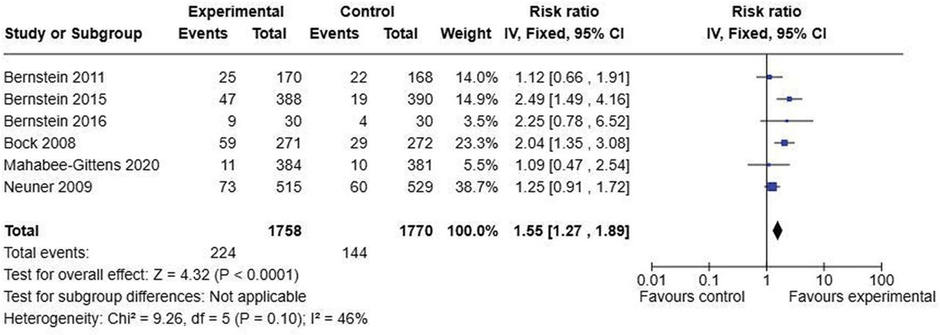
…and did a bit of napkin math to produce a table of my own:
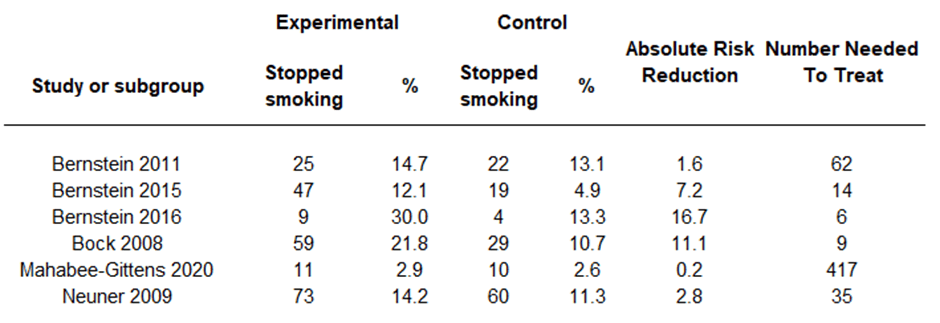
As you can see, the number-needed-to-treat (NNT) varies sharply from six to over four hundred. Would you have guessed this from just looking at relative risk? Probably not.
Clearly, bang-for-buck, some of these interventions are more effective than the others. Not coincidentally, the three trials with the lowest NNT had protocolised follow-up as part of their treatment – e.g. further supportive talks over the phone or via text messaging. Could this be what was missing in the COSTED trial?
I would add that these three trials also had extremely minimal “standard care” arms. The patients were just handed leaflets about quitting smoking and sent on their way. This may also have contributed to their lower NNTs.
Should this study change our practice?
No.
This meta-analysis does not by itself justify introduction of smoking cessation services to ED, but it provides helpful context for COSTED, and clearly identifies a cluster of studies that could be used to inform and improve the next big trial on this topic.
As things stand, I am ambivalent. I am not against ED-based public health interventions in the least, but I am more supportive when they target patients that are sometimes only reached in ED (e.g. homeless populations and, to some extent, young adult men). In these cases, there is a moral imperative for our departments to provide more than emergency care, even if this is not as “cost effective” as our managers might prefer.
I do not feel this way about smokers. There already exist plenty of places they can go to quit their habit – pharmacies, primary care, etc. I would want to see much stronger evidence before ED resources are spent on this kind of service.
Greg Yates
Further Reading
Pope I, Clark LV, Clark A, Ward E, Belderson P, Stirling S, Parrott S, Li J, Coats T, Bauld L, Holland R. Cessation of Smoking Trial in the Emergency Department (COSTED): a multicentre randomised controlled trial. Emergency Medicine Journal. 2024 May 1;41(5):276-82.
Pope I, Gentry S, Livingstone-Banks J, Iqbal H, Rashid S, Corbett C, Notley C. Emergency department interventions for smoking cessation: a systematic review and meta-analysis. Emergency Medicine Journal. 2026 Jan 29.
Butler AR, McRobbie H, Bullen CR, Hajek P, Wu AD, Begh R, Theodoulou A, Notley C, Rigotti NA, Turner T, Fanshawe T. Electronic cigarettes for smoking cessation. Cochrane Database of Systematic Reviews. 2025(10).
Hartmann‐Boyce J, Chepkin SC, Ye W, Bullen C, Lancaster T. Nicotine replacement therapy versus control for smoking cessation. Cochrane database of systematic reviews. 2018(5).
