
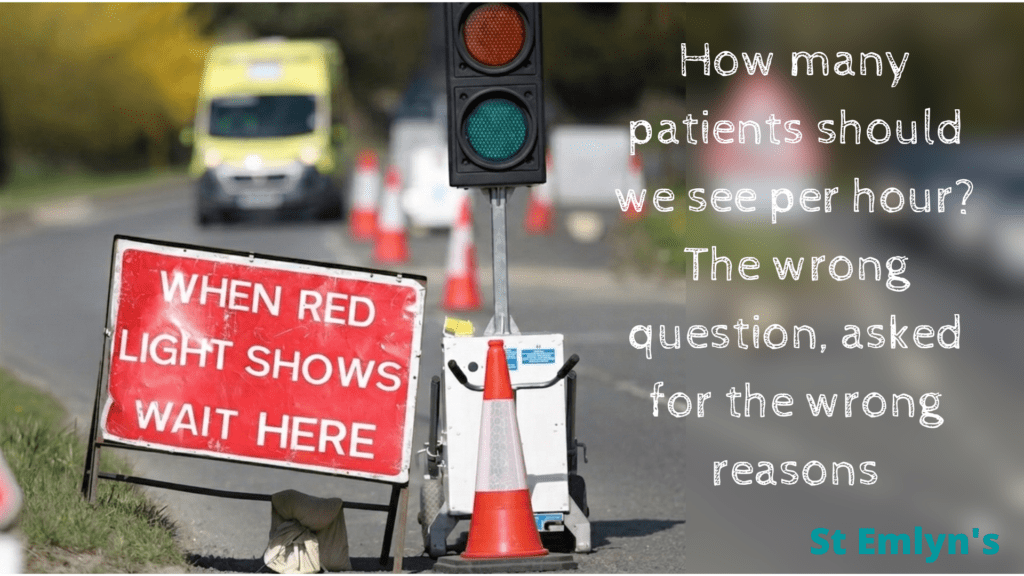
The wrong question, asked for the wrong reasons
A colleague asked me recently how many patients a doctor working in emergency medicine should see per hour. It’s a question I hear often. It’s not a new one either; we explored clinician work rate on St Emlyn’s over a decade ago. It sounds reasonable. It feels measurable. And it is almost entirely the wrong place to start.
Given what conditions?
Perfect conditions, with perfect staffing, systems, resources and space will produce wildly different productivity compared to imperfect conditions where any, or all, of these are compromised. Productivity is a temporal and situational moving target. Reducing it to a single number is not helpful to anyone, except perhaps those who want to performance manage clinicians without addressing the system challenges those clinicians work in.
The better question
The better question is not how many patients should a doctor see per hour. It is what conditions need to be in place for a doctor to see patients at the rate the system requires? That reframes productivity from a performance target imposed on individuals to a set of enabling conditions the organisation must provide.
And those conditions are well understood. They include functional clinical space that isn’t consumed by boarding patients, adequate IT and desk access, diagnostic turnaround times that support clinical flow, appropriate staffing and skill mix, and a supervision model that accounts for the consultant’s role in flow management, teaching and indirect care. Remove any one of these and productivity falls. Remove several and it collapses.
Yet the question almost always skips past the conditions and lands on the clinician.
Why we ask it the wrong way
There is a name for this. The Fundamental Attribution Error is our tendency to attribute outcomes to the character or effort of individuals rather than to the situation in which they are working. The statement: Why are the doctors always so slow? makes a judgement about disposition without asking whether there was sufficient assessment space, whether diagnostics turnover was reasonable, or whether ED had capacity to receive new patients into appropriate spaces.
This bias is not just cognitive. It is structural. NHS incident reporting frameworks capture medication errors, missed diagnoses and falls, all attributable to individual actions. But the crowding that made the error more likely, the corridor environment that made the fall inevitable, the twelve hour boarding that degraded cognitive performance: these are context, never cause. The data that feeds board level decision making is filtered towards dispositional explanations before anyone looks at it.
Cultural narratives reinforce the pattern. The framing of resident doctors as lazy and greedy during industrial action primes the same attribution. If clinicians are dispositionally problematic, then why is productivity falling becomes: because they won’t work hard enough, rather than: because the environment has degraded to the point where hard work produces diminishing returns.
W. Edwards Deming put it simply: “A bad system will beat a good person every time.”
The data already exist
The NHS already has a tool that measures whether the system is good or bad. The OPEL acute framework captures variables with pre-agreed RAG rated thresholds that define what is acceptable, what is pressured and what is unsafe. Majors and resus occupancy, ambulance handover times, median wait to treatment, bed occupancy, twelve hour breaches: all captured, all colour coded, all telling you exactly whether the conditions for productive work exist.

Consider the live OPEL acute framework reports for the two sites in the image. The first site is running majors and resus occupancy at 123%, 12 hour length of stay at 17%, and referred patients in ED at 3%. The second site runs the same at 96%, 2% and 1.27% respectively.
Would you expect the same patient turnover at both sites? Of course not. We can see this in the framework too: the median wait to treatment (the measure for the wait to see the first clinician) is nearly three hours at the first site, but under an hour at the second site. Is this surprising?
The productivity question
The OPEL acute framework answers the productivity question that isn’t being asked. Ignoring the context and focusing on patient turnover is like asking why drivers are slow when the road is down to one lane for roadworks. Nobody blames the driver. Everyone understands the conditions have changed. Yet in emergency medicine, the drivers are challenged rather than the road conditions.
The OPEL acute framework variables are all collected internally but only partially shared publicly. While the data that supports a dispositional explanation are published and scrutinised, the data that would support a situational explanation are not. The system has built a tool that objectively measures whether the environment supports safe care, agreed the thresholds, colour coded them. And then kept the contextual parts behind closed doors while asking frontline staff why they aren’t driving faster.
So should we ask how many patients we should see per hour?
The question is not wrong unless asked for the wrong reasons. But it is almost never the first question.
The first question has entirely to do with your local road conditions. Fix the conditions and productivity follows. Ignore the conditions and no productivity target, however precisely calculated, will change a thing.

Couldn’t agree more. Would also like to throw in as an example: nursing ratios.
The nurse-to-patients ratio in the emergency department has a huge knock-on effect on how ‘productive’ the doctors can be on that shift.