
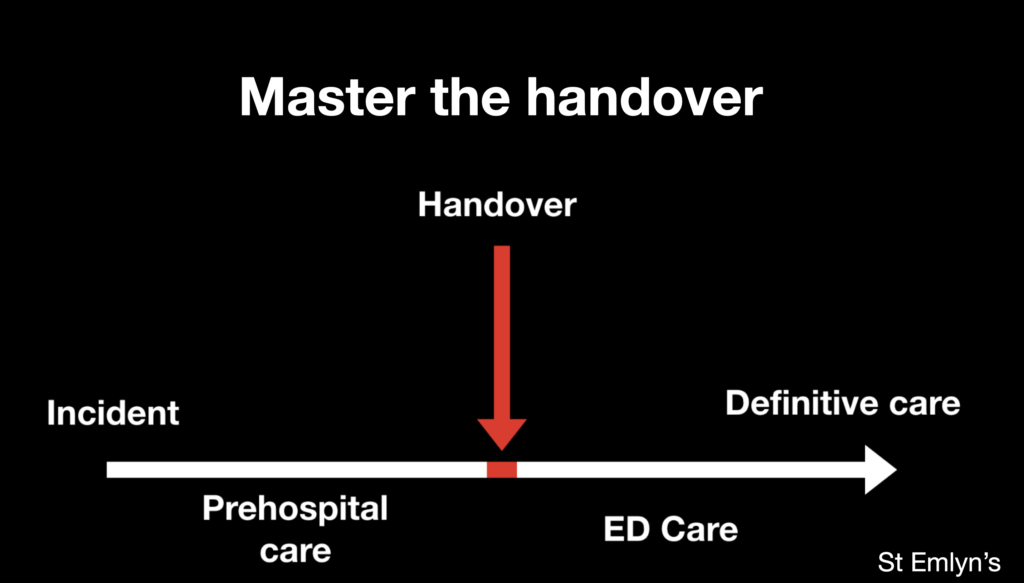
Last month I was at the amazing Incrementum conference in Murcia, Spain. Communication is a theme throughout the conference and that’s no more so than at times when we hadnover care from one team to another. Managing the handover is a key skill for TTLs and you should spend time and effort refining your skills until you and your team do it really well.
This is a bit of longer TTL tips, because it’s important and there is a lot to get through. If you like it, please share widely.
As soon as you know anything about the patient then it is possible to organise yourself, the team and the environment to optimise the handover. Many aspects of the zero-point survey apply here. Even minimal data can allow you to prepare for what is likely to happen and for what is likely tobe needed before the patient comes through the door of resus.
Handover starts before the patient arrives.
Your first information about a patient would likely come through as a standby call to the senior nurse/doctor in the emergency department. It might sound a little like this…..
‘Hello, this is the trauma desk at Virchester Ambulance Service. Can we put you on red standby for a trauma patient’
. These are the details.
- 32 year old male.
- HEMS are on scene and will be bringing the patient in by road.
- Ejected from vehicle following high speed RTC. Possibly unrestrained. Happened roughly 30 mins ago.
- Possible chest, abdo and pelvic injuries
- Palpable central pulse (carotid & femoral).
- BP 70/30 at scene
- Tachycardia 120 bpm
- Resp rate 25
- GCS 13/15
- Had 2 units PRBCs, TXA en-route
- ETA 10 mins
There’s not a huge amount to go on here, but there is a lot that we can predict, share and develop into a shared mental model for the team.
Firstly, this patient is clearly seriously unwell with likely time critical injury and the need for intervention. A trauma team will be needed and should be called immediately.
Next we need to predict what is almost inevitably be required such that we can plan the people, equipment and sequence of likely events upon arrival. For example in this case my TTL (trauma team leader) reflexes might include the following.
- Will need advanced airway management. Tricky induction. Not for amateurs. Ensure senior trauma anaesthetist in attendance.Need drugs/kit check asap
- USS machine needs to be here, switched on, gelled up.
- Second dose TXA needs preparing
- Major Haemorrhage Plan to be activated
- Pelvic binder probably in situ, but if not needs to be here, ready on bed for application on arrival
- My bladder is full
- May be tricky decision about theatre or CT destination here
- Straight onto portable monitoring rather than pendant monitors.
- Need to get transfer kit sorted.
- Need to task primary survey doc and scribe etc.
This list is not exhaustive but is designed to illustrate the range of personal, team and environmental issues that can be predicted and planned for prior to the arrival of the patient. In addition, the global assessment of the predicted patient pathway needs to be shared with the team so that they develop a shared mental model.
This all fits into the principles of the Zero-Point Survey which we’ve published and blogged on before.
For example.

- We are expecting a 32 year old male who has been ejected from a vehicle. We suspect significant torso injury. He is shocked ,with significant hypotension (70 systolic) despite 2 units PRBC.
- On arrival I will check with the HEMS team to see if there are any immediate interventions required. If not we will move the patient onto the ED trolley then pause for less than one minute to take a focused handover.
- We will then move onto primary survey management (add specific tasks to individuals at this stage)
- Our priorities are to identify any primary survey related interventions needed and then to make a rapid decision aboutRSI, CT or Theatre, Major haemorrhage management. If the patient has arrested on arrival we will intubate, do bilateral thoracostomies, give blood and consider thoracotomy (and will prepare and appoint people to do this in advance).
Hands off, Eyes on, Mouth Shut.
There is a certain amount of excitement associated with trauma care. We know that many will have time critical injury and thus there is always a feeling of needing to rush our assessments and interventions. This pressure may be acutely felt at transition points such as handover where it might appear that resuscitation stops. This needs to be challenged. Many of our patients have quite prolonged prehospital times which places the time taken to achieve a brief but effective handover into context. An additional 30-60seconds in the patient journey is almost always insignificant in the wider picture and we therefore advocate that everyone stops to listen when handover takes place.

Unless the patient requires ongoing intervention then everyone stops and listens to the focused handover. Everyone. That way we all hear the same message and same information.
In some situations that is not possible, for example in cardiac arrest patients with ongoing CPR. In those circumstances we plan to bring the patient across, establish BLS, Identify rhythm and enter first cycle before handover is given.
Arrival and patient movement
Of all the areas that we should consider in handover, this is the bit that gets really controversial. In very simple terms we need to move the patient from the ambulance/helicopter to the ED trolley. That sounds incredibly straightforward but it’s tricky to get this bit right.
- The receiving team are desperate to ‘get started’
- The delivering team want to be heard
- You cannot listen to a handover and ‘do stuff’
- Should everyone listen to handover or should it just be the team leader?
- Should we do handover at the ambulance door, or in resus?
There is little or no science here and so I’m going to give you an opinion based on years of practice and a little trial and error of different methods. This is what I do.
- Brief the trauma team about how handover is going to work
- Meet the prehospital team at the door of the ED.
Hello. Who is giving handover?
Are there any IMMEDIATE issues that need addressing (e.g.obstructed airway).
If yes – note this and send word to resus to prepare for this
If no – state that the plan is to move the patient to resus. We will move the patient onto the ED trolley and then pause for a structured hands-off handover
Ask the prehospital team if they have prepared an ATMISThandover.
If yes – great, if no – tell them that’s no problem and that you will take them through it in a Q&A style.
Walk with prehospital team to resus.
Call for hands off, eyes on, ears open.
Take prehospital team for ATMIST structure in less than 60seconds.
A focused script.
For trauma patients we advocate the ATMIST approach to handover as shown below. This is a focused ‘initial’ handover that can be given in less than a minute. It is the starting point for the team such that they can commence the primary survey and continue resuscitation. It is commonly followed up with a more detailed handover of more extensive information to the team leader and scribe once the primary survey is complete.

Closure and review
Handover represents a transition point for patient care between services. As one team hands over then their learning and follow up of the patient often ends too. This is not ideal as they may have unanswered questions about their elements of patient care. It’s good practice for the team leader to find the prehospital team before they leave and thank them for their work. Ideally, they should also be permitted some way of following up what happens to the patient. I do this by giving them my NHS email. If they then email me later from an NHS account I can answer any specific questions they have and can give them a partially anonymised explanation of what we found and did. Other systems have more mature and formal systems to do this, but it’s not something we have managed to achieve in Virchester as yet. I think it’s particularly important to do this in regionalised trauma services as prehospital teams may come from great distances and may not be your ‘usual’ ambulance crews who can pop in for a follow chat on their next shift.
Final thought
For me I think trauma handovers are a barometer of how well your resus runs. If it works well it probably means you have experience, good staff, good relations with other specialities, an understanding of prehospital care and a desire to the best that you can for your patients.
vb
S
References
- Simon Carley, “Handover. Process, practice and controversy. #ICSSOA2018. St Emlyn’s,” in St.Emlyn’s, December 11, 2018, https://www.stemlynsblog.org/handover-process-practice-and-controversy-icssoa2018-st-emlyns/.
- Simon Carley, “Introducing the Trauma Team Leader Tips (TTL Tips) Series,” in St.Emlyn’s, November 26, 2025, https://www.stemlynsblog.org/introducing-the-trauma-team-leader-tips-ttl-tips-series/.
- Iain Beardsell, “IncrEMentuM 2026 – Inspirational Emergency Medicine in Murcia,” in St.Emlyn’s, May 6, 2026, https://www.stemlynsblog.org/incrementum-2026-inspirational-emergency-medicine-in-murcia/.
