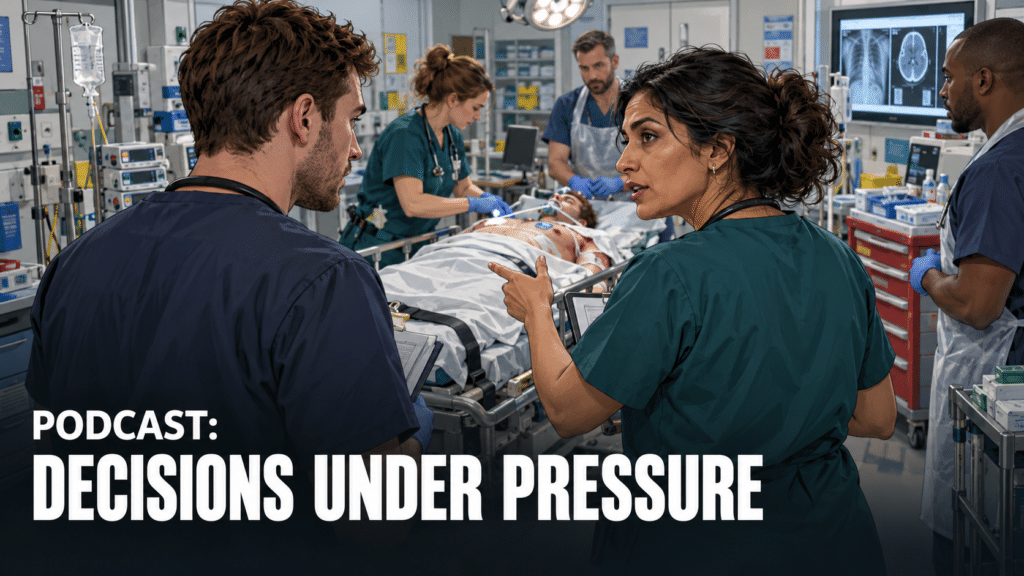
How do you decide when you don't have all the information? Iain Beardsell revisits Tactical Trauma to explore the judgements behind major incident care, triage, eCPR and trauma ECMO.
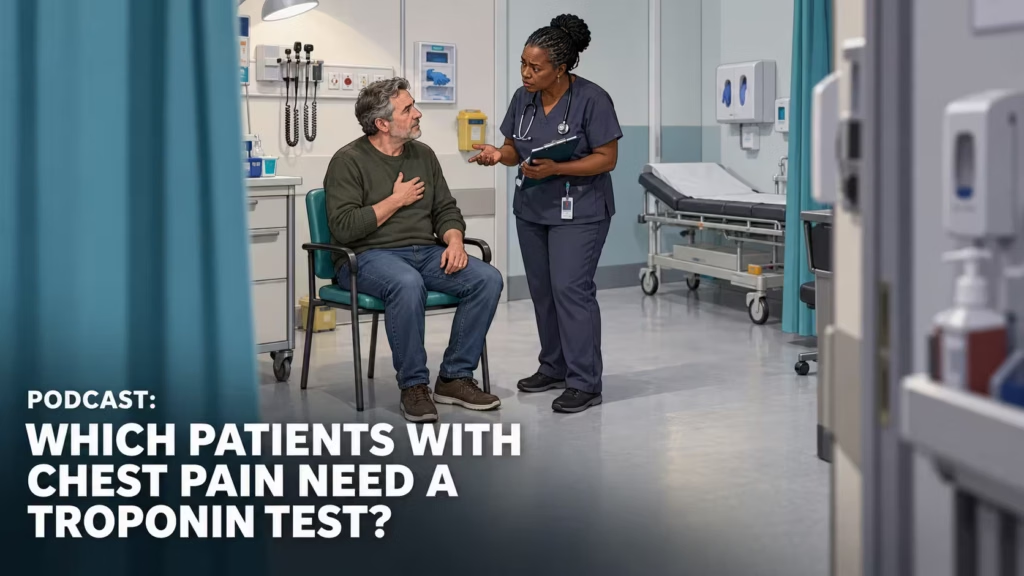
Which patients with chest pain actually need a troponin? Rick Body looks at how much we can trust the history, cardiovascular risk factors and our own clinical judgement before deciding to test.
Recorded at Trauma 2030 at the Royal College of Surgeons in London, the conversation explores what it means to lead exceptional teams in one of the most high-pressure areas of emergency medicine. Anna reflects on six years as Clinical Lead for London HEMS, sharing lessons on leadership, culture, psychological safety, difficult conversations, managing strong personalities, and supporting clinicians to do their best work.
Iain and Simon revisit the RSI trial, trauma team leadership and the realities of corridor care. This January round-up also covers Code Red activation, trauma units and blood pressure targets after spinal cord injury.
In this episode, recorded at Trauma 2030 at the Royal College of Surgeons, I sit down with one of St Emlyn's own, Rich Carden, former emergency physician, now intensive care trainee and PhD graduate in trauma sciences — to explore what shock actually means beyond the blood pressure reading.
In this episode, we talk to Sheldon Cheskes about the evolving science of cardiac arrest, with a focus on refractory and recurrent ventricular fibrillation. We explore the evidence behind double sequential external defibrillation (DSED), how it compares to standard defibrillation, and what the DOSE VF trial has changed in practice. It’s about understanding why defibrillation fails, how vector and energy delivery matter, and when a different approach might improve outcomes.