
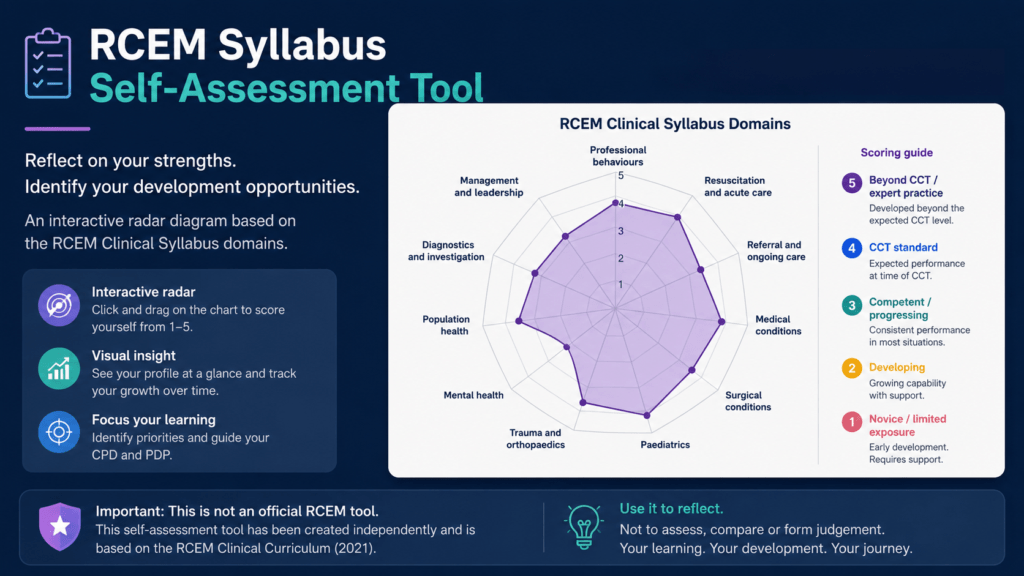
Following on from our RCEM SLO self-assessment tool, we’ve built a second reflective radar tool, this time based on the clinical syllabus domains within the RCEM curriculum. Where the SLO tool focuses on higher-level capabilities such as decision-making, leadership, and quality improvement, this tool looks at something slightly different: the breadth of clinical emergency medicine practice itself. To remind everyone, this is not an official RCEM tool, nor endorsed by RCEM, it’s just our attempt at helping clinicians understand where they are confident and competent.
One of the defining challenges of emergency medicine is that we are expected to be comfortable across an extraordinary range of clinical presentations. From trauma to toxicology, neonates to frailty, cardiology to safeguarding, the scope of practice is both broad and demanding. Few specialties require such range. That breadth is one of the things many of us love about emergency medicine but it is also one of its greatest challenges. It’s also something that can change over time.
In the RCEM curriculum we use an entrustable competency of 4 at CCT. The tool goes to 5 to recognise that clinicians can operate at higher levels with additional training/experience.
Unlike the SLO blog post and radar diagram we published earlier, you do have to input numbers on this one (as there were too many points for the slider to work well).
RCEM Syllabus Self‑Assessment Radar
Score yourself from 1–5 across the RCEM clinical syllabus domains. This is a reflective learning tool, not an assessment. A score of 4 represents expected CCT standard; a score of 5 reflects development beyond CCT level.
My RCEM syllabus profile
The reality is that very few clinicians feel equally confident/competent across every part of the syllabus. Most of us have areas that feel familiar and comfortable, alongside areas where we feel less confident or simply less exposed in day-to-day practice. That’s normal and this tool is designed to help visualise that.
Using the RCEM syllabus domains, you can score yourself from 1 to 5 across each area and generate a radar chart showing your current profile. The value lies not in the numbers, but in the shape.
It can help guide revision, CPD, departmental teaching, or simply personal reflection. It may highlight areas for deliberate practice, prompt conversations with supervisors or colleagues, or help identify where a bit more focused learning could make a real difference.
vb
S
References
- Royal College of Emergency Medicine. RCEM Curriculum [Internet]. London: RCEM; 2021 [cited 2026 Jun 23]. Available from: https://rcemcurriculum.co.uk/
- Royal College of Emergency Medicine. Specialty Learning Outcomes (SLOs) [Internet]. London: RCEM; 2021 [cited 2026 Jun 23]. Available from: https://rcemcurriculum.co.uk/specialty-learning-outcomes-slos/
- Royal College of Emergency Medicine. How to use the curriculum [Internet]. London: RCEM; 2021 [cited 2026 Jun 23]. Available from: https://rcemcurriculum.co.uk/how-to-use-the-curriculum/
- St Emlyn’s. RCEM Curriculum 2021 [Internet]. Manchester: St Emlyn’s; 2021 [cited 2026 Jun 23]. Available from: https://www.stemlynsblog.org/rcem-curriculum-2021/
- Simon Carley, “DFTB26: Doing the Fundamentals Extraordinarily Well,” in St.Emlyn’s, June 23, 2026, https://www.stemlynsblog.org/dftb26-doing-the-fundamentals-extraordinarily-well/.
- Simon Carley, “What does a good emergency physician look like?,” in St.Emlyn’s, June 11, 2026, https://www.stemlynsblog.org/what-does-a-good-emergency-physician-look-like/.
- Simon Carley, “Speciality Learning Outcomes Self-Assessment Radar (based on RCEM curriculum),” in St.Emlyn’s, June 24, 2026, https://www.stemlynsblog.org/speciality-learning-outcomes-self-assessment-radar-based-on-rcem-curriculum/.
