
I’m writing this from the DFTB Conference 2026 in Glasgow, where I’m having a genuinely fantastic few days. DFTB has always felt like a slightly different kind of conference, thoughtful, energetic, practical, and deeply rooted in the realities of looking after children in emergency and acute care settings. There’s a warmth to it, a generosity, and a willingness to talk honestly about the challenges of clinical practice that I’ve always valued. As ever, the conversations between sessions often feel just as important as the talks themselves, and one recurring theme this year has been what excellence in paediatric emergency care really looks like. Not in theory, but in the messy reality of day-to-day practice. It’s day one today and I’ve got one of the keynote talks on the title above (given to me by the organisers, and a really good one for this crowd.
A case that stayed with me
There are some cases that stay with you because they were dramatic. The impossible airway. The traumatic arrest that somehow survives. The diagnosis that arrives just in time. Those cases are memorable because they are extraordinary, and perhaps because they remind us why emergency medicine can feel so intoxicating. They are the stories we tell over coffee, at conferences, and sometimes to ourselves when we are trying to explain why this work matters.
But there is another category of case that lingers for very different reasons. Not because it was dramatic, but because it quietly reveals something uncomfortable about how we think, how we work, and how easily we can get things wrong.

One child with abdominal pain did exactly that for me.
It was, at least on the surface, an entirely familiar presentation. Abdominal pain is bread-and-butter emergency medicine. We see it every day. Some of it is trivial, some serious, much of it somewhere in between. The department was busy, though not unusually so, and this child did not announce themselves as critically unwell. There were no obvious red flags, no dramatic physiological disturbance, nothing to make the case stand out immediately from the dozens of others that fill an emergency department on a normal day.
I assessed the child, took a history, examined them, and, as often happens in a busy clinical environment, began to construct a story in my head. It felt coherent. Plausible. I had a working diagnosis that seemed to fit (constipation). Without consciously deciding to, my thinking had already started to narrow. I was no longer truly exploring what this might be. Instead, I was mostly looking for evidence that supported the story I had already built.
I didscharged the patient, but as they were leaving one of our nurses called him back and checked a blood glucose. The child was in early diabetic ketoacidosis. I wish I could say DKA was high on my differential. It wasn’t. The point being that she did it because it was routine practice for that sort of patient in our department. It was not exceptionalism, it was the fundamentals done well.
That case has stayed with me for years, and not because it involved some extraordinary intervention or remarkable piece of diagnostic brilliance. In truth, it was the opposite. The diagnosis was made because somebody did something simple, something fundamental, and did it well. A basic bedside test. Performed at the right time. By somebody who remained open, observant, and curious when I had already become cognitively comfortable. And the interesting thing is that this vital intervention was not really celebrated or even noticed. beyond the team on that day, and yet perhaps it should be. It was a vital intervention.
That discomfort matters. It should matter. Because I suspect we sometimes misunderstand what excellence in emergency medicine really looks like.
The problem with peaks
Medicine, perhaps inevitably, loves heroics. We admire the clinician who performs at their absolute best under pressure. We celebrate moments of extraordinary performance: the perfect resuscitation, the impossible procedure, the subtle diagnosis that nobody else saw. There is something deeply appealing about those moments, and rightly so. They represent clinical practice at its most visible and dramatic.

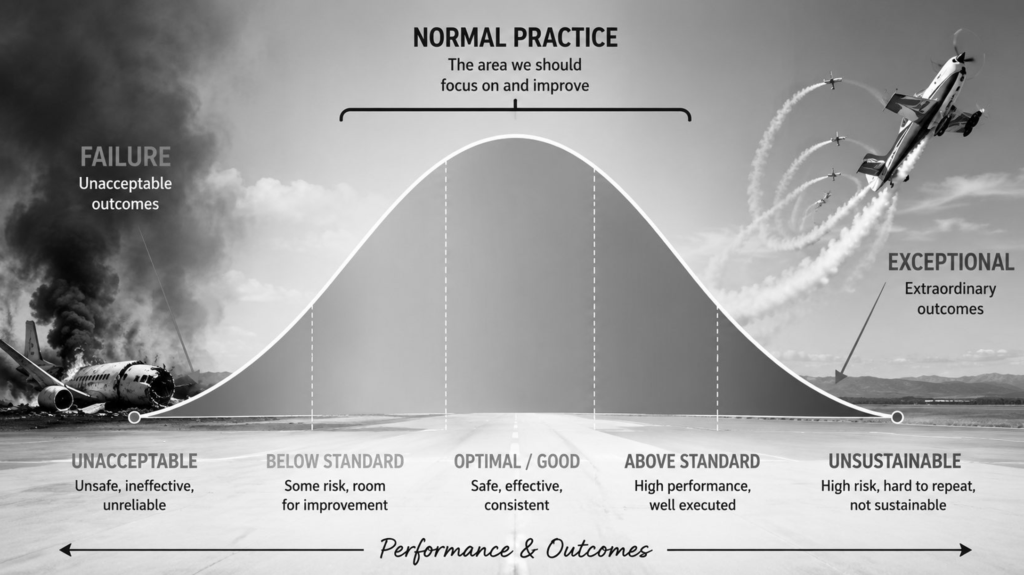
But I wonder whether our fascination with those moments sometimes distorts what excellence really is. We often talk about peak performance as though it is the ultimate goal. The best day. The best shift. The moment where everything clicks and we perform at our absolute highest level.
The problem with peaks, of course, is that they are peaks. They are spikes. They are impressive precisely because they are unusual. They rise sharply, but they are difficult to sustain, and inevitably they come down.
Patients, however, rarely meet us at our peak. They meet us on ordinary days. On Tuesday afternoons when the department is full. When we are tired, distracted, overloaded, and juggling multiple competing priorities. They meet us when cognitive bandwidth is limited and when the real challenge is not producing brilliance but maintaining standards despite pressure.
That, I think, is where quality really lives. Not in peaks but in plateaus. I have found myself increasingly drawn to the idea that perhaps we should stop aspiring to peak performance and instead aim for something less glamorous but far more important: a plateau of good (maybe even excellence). Not occasional brilliance, but consistently high-quality practice. Not spectacular moments, but reliable standards. The kind of clinical performance that remains safe, thoughtful, and effective even when conditions are far from ideal.
That feels much closer to what patients actually need from us. Not heroics but reliability.

Spiky excellence
And yet even that model is incomplete, because there is another truth we do not always acknowledge comfortably in medicine. None of us are equally good at everything.
When I was younger, I suspect I believed, perhaps subconsciously, that seniority meant eventually becoming broadly excellent across all domains. That enough years, enough exposure, and enough experience would gradually smooth out the rough edges until what emerged was a kind of complete clinician: technically strong, diagnostically sharp, emotionally intelligent, calm, wise, and equally comfortable in every clinical situation.
I no longer think that is true. If anything, experience has taught me the opposite. Time doesn’t smooth everything out. It sharpens the contours.
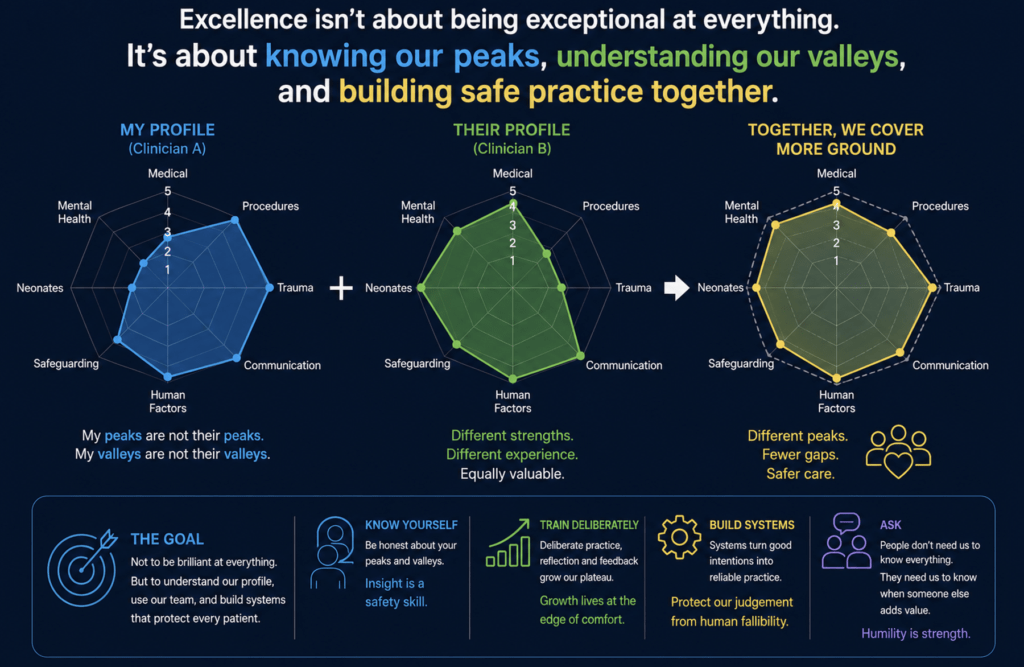
Over time, most of us develop clearer peaks and clearer valleys. Areas where we are genuinely strong, areas where we are competent but unremarkable, and areas where we remain less comfortable than we might like.
I can see that clearly in my own practice. Put me in trauma, resuscitation, procedures, or complex team-based operational environments and I feel relatively at home. Those spaces make sense to me. The pace, complexity, uncertainty, and need for rapid decision-making are environments I understand and, I think, perform reasonably well in.
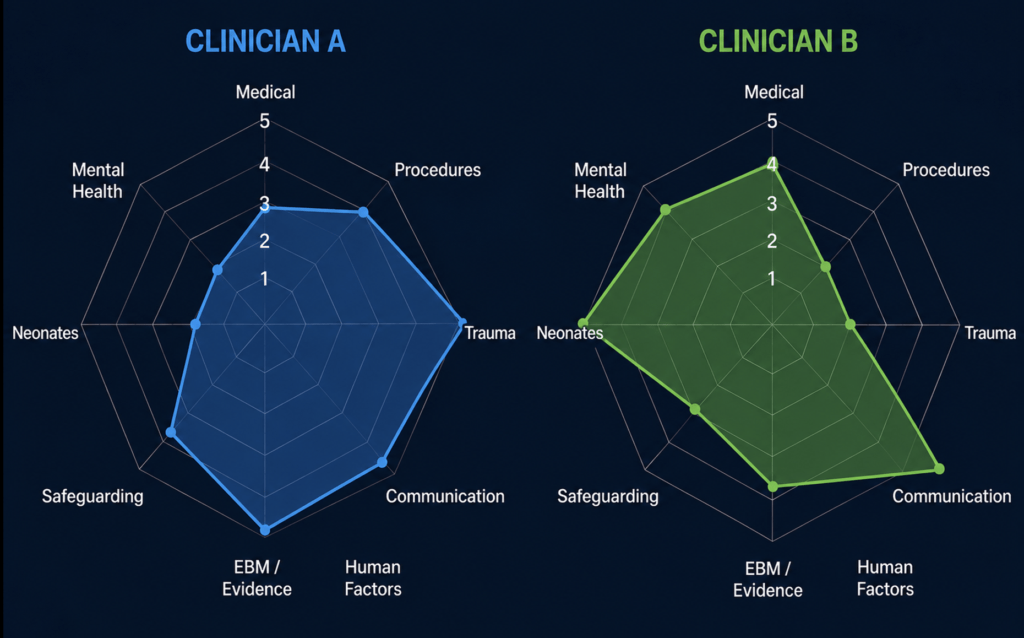
Other areas feel different. Neonates still make me slow down. Complex mental health presentations often require a very different type of thinking and communication. Safeguarding cases demand a level of sensitivity and nuance that can feel uncomfortable precisely because of what is at stake.
I suspect all of us have some version of this profile. The exact shape differs, but the pattern is universal. We all have strengths. We all have weaknesses. We all have blind spots. The dangerous clinician is rarely the one with weaknesses. It is the one who does not recognise them.
That is why self-awareness matters so much. Not as a vague leadership concept, but as a patient safety skill. Understanding your own profile—knowing where you are naturally strong and where you are less comfortable—changes how you think, how you work, and crucially when you pause.
Better together
It also changes how we think about teams. Medicine has traditionally placed enormous value on independence. We admire confidence, decisiveness, and certainty. From very early in training there is often an implicit message that good clinicians know the answer, and that expertise means being the person others turn to when things become difficult. But I am less convinced by that than I used to be. I no longer think patients need us to know everything. What they need is something both simpler and harder.
They need us to recognise when our own expertise is enough and when another perspective would make care safer. They need us to work in teams that are built not around hierarchy or status, but around complementary strengths.
This matters because the best teams are rarely composed of identical people. They are strong precisely because they are different. One clinician may excel in trauma and procedures. Another may have outstanding diagnostic breadth. Someone else may have extraordinary communication skills, or a far better instinct for safeguarding, mental health, or neonatal assessment.
Those differences are not weaknesses in the system, they are the system. When teams work well, the individual spikes overlap and the valleys become smaller. The gaps narrow. Risk reduces. Care improves.
That is what happened with the child in DKA. The diagnosis was not made by a single brilliant clinician having a moment of genius. It emerged because someone in the team noticed something simple, asked a basic question, and acted on it. The system worked not because of heroics, but because of attentiveness, humility, and good fundamentals.
Reliable, not heroic
I still think about that child with DKA from time to time, not because it was the sickest patient I have ever seen, nor because it demanded particularly complex care once the diagnosis became clear. What has stayed with me is how close it came to becoming something else entirely, a story about missed diagnosis, delayed treatment, and harm caused not by ignorance or lack of effort, but by something much more familiar.
Cognitive comfort. The quiet confidence that comes when a case feels as though it makes sense.
Perhaps that is what unsettled me most. The error wasn’t dramatic. There was no reckless decision, no obvious lapse in professionalism, no gross clinical failure. If anything, it was something much more ordinary and therefore much more important. It was the sort of subtle cognitive drift that happens to all of us. The moment where curiosity narrows just a little too soon, where exploration gives way to confirmation, and where we stop asking what else this might be.
The more years I spend in emergency medicine, the less convinced I am that excellence is really about extraordinary performance. Of course there are moments where exceptional technical skill, sharp decision-making, or calm leadership make all the difference. We need those things, and we should value them. But those moments are relatively rare. They are visible, memorable, and easy to celebrate precisely because they stand out.
Most of emergency medicine is far less glamorous. It is made up of hundreds of small decisions, small observations, and small interactions. A careful history. A subtle examination finding. A parent whose concern doesn’t quite fit the reassuring physiology. A nurse with a sense that something isn’t right. A colleague asking a question that forces us to pause and think again.
This is where care is often won or lost. Not in the spectacular but in the ordinary. That feels especially true in paediatric emergency medicine. Children often do not read textbooks. They compensate brilliantly until they don’t. Serious illness can hide behind common symptoms, and subtle deterioration is easy to miss if we stop looking carefully. The clues are often quieter than we would like. They live in behaviour, interaction, parental concern, and the things that feel slightly different from normal rather than obviously catastrophic.
Which is why reliable practice matters so much. Not perfect practice but reliable practice.
The kind of practice built on good habits, thoughtful systems, humility, and self-awareness. The kind of practice that recognises we are all human, all fallible, and all uneven in our capabilities. The kind of practice that makes room for uncertainty and values collaboration over ego.
Perhaps maturity in medicine is not really about becoming flawless. Perhaps it is about becoming more aware, more aware of our own cognitive biases, more aware of our own strengths and weaknesses, and more aware of how much safer we are when we remain open to challenge and willing to learn.
I no longer think patients need us to be heroic very often. They do not need us to perform at our peak every day. That is neither realistic nor sustainable. What they need is something much harder which is to be our reliable best, on a plateau of good, rather than a brief flash of brilliance between valleys of poor care. They need clinicians who remain curious in common presentations, who respect the basics, who understand their own limitations, and who know when another perspective might matter.
In the end, I suspect extraordinary care is rarely about extraordinary interventions. More often, it is something quieter than that. It is what happens when ordinary clinicians, on ordinary shifts, in ordinary moments, do ordinary things extraordinarily well.
vb
S
