
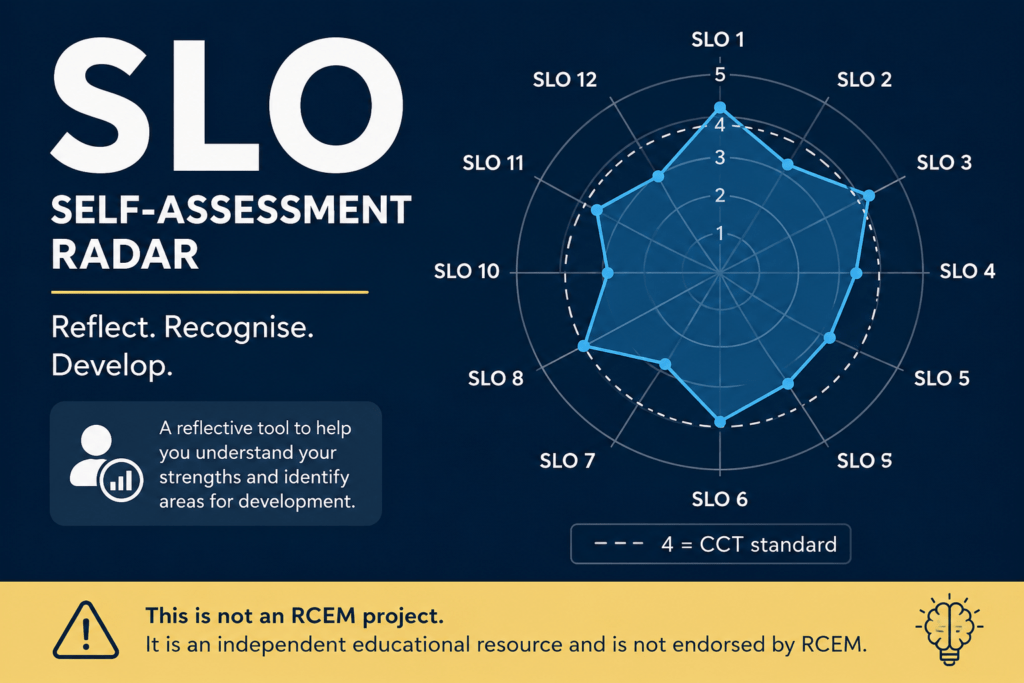
We’ve built a simple reflective tool based on the 12 RCEM Specialty Learning Outcomes to help clinicians think about their own development and performance. It’s not an official RCEM tool, just something we have done on St Emlyn’s and based on the 2021 curriculum. You can assess yourself and then print off for your records/portfolio.
The idea comes from a concept I’ve been exploring around spiky excellence. Most of us like to think that, over time, we become increasingly rounded clinicians, equally capable across every domain of emergency medicine, but that’s not true.
Just drag and drop the diagram sliders to score yourself.
RCEM SLO Self‑Assessment Radar
This reflective tool is based on the RCEM Specialty Learning Outcomes. Drag each point on the radar chart to score yourself from 1–5. A score of 4 represents expected CCT / day‑1 consultant level. A score of 5 represents performance beyond CCT, usually through additional experience, focused training, specialist interest or leadership.
This is not an official RCEM assessment tool and is not endorsed by RCEM. It is designed to help you think about your own peaks, valleys and development priorities.
Scoring guide
Drag each dot inwards or outwards. Scores snap to 1–5. The dashed ring shows 4 = CCT standard.
Your profile summary
Current scores
Reflection prompts
What is one peak you can use to help others? What is one valley you will deliberately work on? Where should you ask earlier? What one small system could make your practice safer next week?
In reality, most of us develop profiles that are far more uneven. Some areas become clear strengths. Others remain areas of relative discomfort or simply need more deliberate effort. What matters is understanding your own shape.
Using the 12 RCEM SLOs, this tool allows you to score yourself from 1 to 5 across each domain and generate a radar chart of your current profile. This is not an assessment tool nor it it a tool for ARCP or appraisal. It’s more of a tool for reflection. The value isn’t in the score itself, it’s in the shape.
Where are your peaks?
Where are your valleys?
Where do you feel confident?
Where do you feel less comfortable?
Used individually or as part of a conversation with supervisors, trainees, or colleagues, this tool can help identify strengths, highlight development needs, and support more focused reflection.
vb
S
References
- Simon Carley, “What does a good emergency physician look like?,” in St.Emlyn’s, June 11, 2026, https://www.stemlynsblog.org/what-does-a-good-emergency-physician-look-like/.
- Royal College of Emergency Medicine. RCEM Curriculum [Internet]. London: RCEM; 2021 [cited 2026 Jun 23]. Available from: https://rcemcurriculum.co.uk/
- Royal College of Emergency Medicine. Specialty Learning Outcomes (SLOs) [Internet]. London: RCEM; 2021 [cited 2026 Jun 23]. Available from: https://rcemcurriculum.co.uk/specialty-learning-outcomes-slos/
- Royal College of Emergency Medicine. How to use the curriculum [Internet]. London: RCEM; 2021 [cited 2026 Jun 23]. Available from: https://rcemcurriculum.co.uk/how-to-use-the-curriculum/
- St Emlyn’s. RCEM Curriculum 2021 [Internet]. Manchester: St Emlyn’s; 2021 [cited 2026 Jun 23]. Available from: https://www.stemlynsblog.org/rcem-curriculum-2021/
- Simon Carley, “DFTB26: Doing the Fundamentals Extraordinarily Well,” in St.Emlyn’s, June 23, 2026, https://www.stemlynsblog.org/dftb26-doing-the-fundamentals-extraordinarily-well/.
- Simon Carley, “RCEM Syllabus Self-Assessment Tool: Map Your Emergency Medicine Profile,” in St.Emlyn’s, June 24, 2026, https://www.stemlynsblog.org/rcem-syllabus-self-assessment-tool-map-your-emergency-medicine-profile/.
