
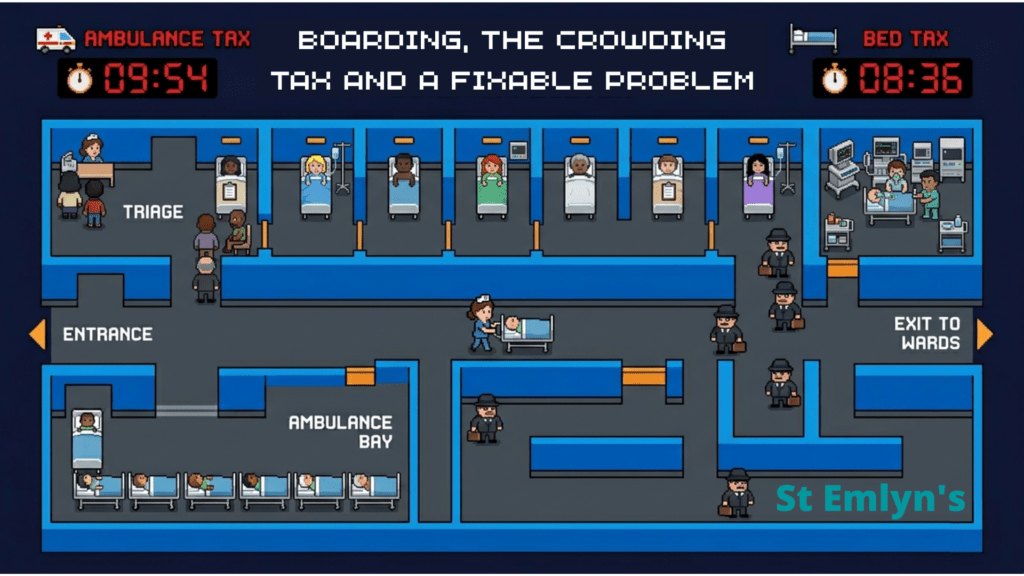
The featured image above is not a metaphor we have reached for. It is a metaphor we have been living inside. It is a game we play that turns out not to be a game. The obstacles are real, the clock is real and so are the patients.
Howlett, Cameron and Wood’s analysis of medical boarding across the three EDs of Bristol, North Somerset and South Gloucestershire (BNSSG) is the second kind. On the surface it is a careful piece of regional research. But read with attention, it is also a quiet indictment of a system that has learned to live with harm it was once shocked by.
The paper is open access in EMJ and worth reading in full, before reading this post.
The question
The authors set out to measure how medical boarding in the ED affects patients at two levels:
- The first is the downstream impact. Does waiting longer for a ward bed in ED make them more likely to die, more likely to come back, or more likely to stay in hospital longer once they get admitted?
- The second is the upstream impact. When boarders fill ED cubicles and the ED gets crowded. Does that then slow down ambulance response times, ambulance handovers, and the time patients who don’t require admission (non-admitted) spend in the ED?
The contribution of the paper is to put numbers on both halves of that question using a single, linked, regional dataset.
What they did
This was a retrospective study using routine data from three EDs in BNSSG, collected between July 2023 and May 2025. The cohorts were large: nearly 50,000 medical admissions, over 200,000 non-admitted ED attendances, 88,000 ambulance handovers and 146,000 ambulance responses.
The methods are more careful than is typical for this literature. The authors used statistical models that accounted for patients who attended more than once, which avoided double-counting. They controlled for patient age, sex, deprivation, time of day, comorbidity and prior ED attendances.
And they also included No Criteria to Reside (NCtR) patients, which counts patients on wards who are medically ready to leave but cannot for whatever reason. This allowed them to separate boarding caused by ED dynamics, from boarding caused by exit block elsewhere in the hospital.
Crowding was measured as the number of medical boarders in the ED at the time of any given event, expressed as a percentage of the ED’s bedded capacity so EDs of different sizes could be compared. Boarding in ED was defined as the time between the decision to admit (rather than ED arrival) and the physical admission to an inpatient bed.
Patients who boarded for more than 24 hours were excluded, on the grounds that those cases reflect social care delays rather than acute medical issues. I will come back to this exclusion.
What they found
Medical patients accounted for two thirds of ED admissions but 81% of total boarding time. The mean boarding delay for medical patients was 6.2 hours, compared with 2.9 hours for everyone else. That single statistic justifies focusing on the medical cohort. It also reframes the public conversation about ED crowding.
The framing shifts from ‘too many patients’ toward ‘too few exits for a specific subset of them’. For these and other patients in the system, the cost of boarding appears as a crowding tax.
By crowding tax I mean the upstream and downstream harm imposed by crowding. Such as the Category 2 ambulance call that takes longer. The non-admitted patient languishing in the waiting room. The patient who dies prematurely after discharge from hospital. These are the patients who pay the crowding tax, and the Howlett paper is the most thorough quantification of it we have.
The upstream crowding tax
Each additional five medical boarders in a typical 25-cubicle ED were associated with:
- An extra 7.9 minutes of Category 2 ambulance response time, and an extra 51.9 minutes of Category 3 response time
- An extra 9.9 minutes of ambulance handover time
- An extra 11.7 minutes in the ED for non-admitted patients
Category 1 ambulances, the most critical, were barely affected. The authors interpret this as evidence that the system protects the sickest. I would frame that finding differently (see below).
Figure 1 in the paper, worth studying below, shows that these relationships are not linear. The first quarter of bedded capacity given over to boarders is absorbed relatively painlessly. Beyond that, the curves bend upward, suggesting the system has a tipping point (I’ll come back to why this is important).
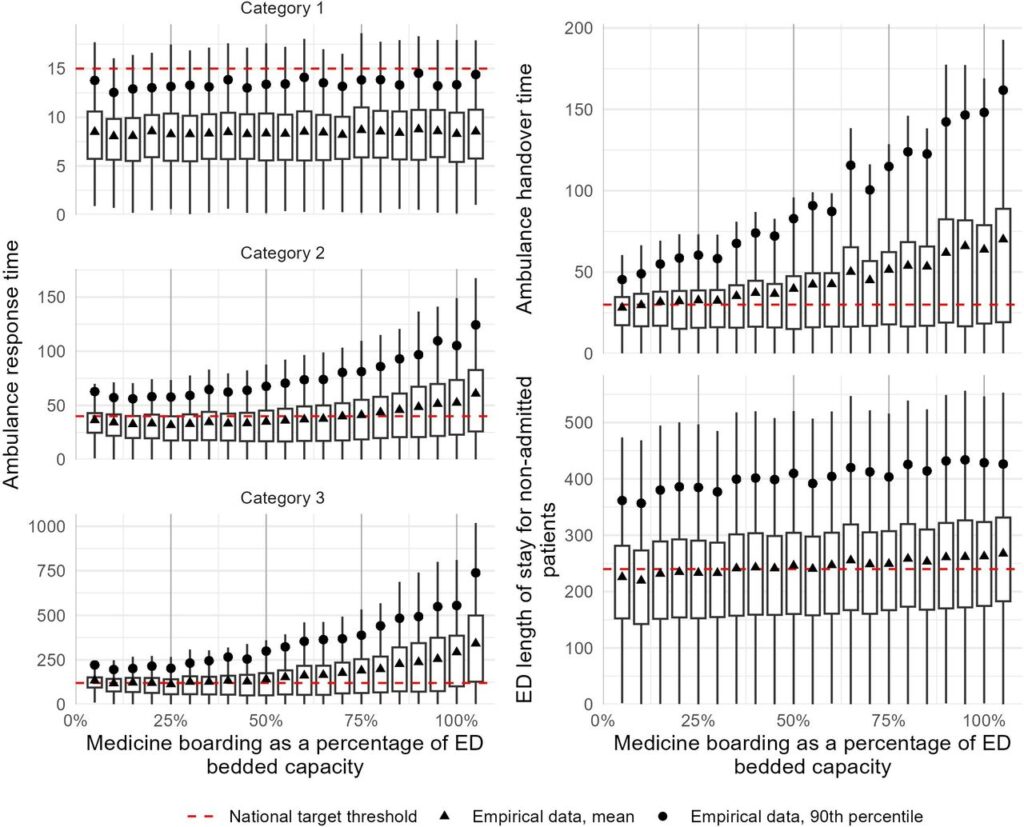
Figure 1. For crowding-related/indirect impacts, boxplots describing the distribution of outcome values (standardised for confounders and all in minutes) for different levels of medical boarding, as a percentage of emergency department (ED) bedded capacity. The box height represents the IQR, and whiskers are ±1.5 IQR (Emerg Med J. 2026 Feb)
The downstream crowding tax
For the boarders themselves, each additional four hours of boarding were associated with:
- 8.6 hours of additional inpatient length of stay
- A 3.8% increase in the odds of re-admission within 30 days
- An 8.4% increase in the odds of death within 30 days
The number needed to harm for 30-day mortality, comparing boarders above and below four hours post decision to admit, was 69. In a cohort where 59% of medical admissions waited longer than four hours, that translates to roughly eight excess deaths per 1000 admissions, or 11% of all deaths observed.
Have we seen this figure before?
This figure does not sit alone. Jones et al, in March 2022, reported a number needed to harm of 72 for ED stays exceeding eight hours, using national Hospital Episode Statistics (HES) data. The Office for National Statistics (ONS), in January 2025, linked Census, HES, and death registration data for 6.7 million ED attendees in England. Compared to two hours in ED, the odds of 30-day post-discharge death were 1.1 times higher at three hours, 1.6 times higher at six hours, and 2.1 times higher at twelve hours.
These three studies do not all measure the same thing. Howlett times boarding from decision to admit. Jones and the ONS both time the entire ED stay from arrival to departure, though Jones looked only at admitted patients and the ONS at all non-immediate attendances. By the time a patient in Howlett’s study has boarded for four hours, they have typically already been in the ED for over seven hours. The fact that all three converge on the same dose-response relationship despite measuring different exposures in different cohorts is a strength, not a weakness, of the underlying signal.
They also span nearly a decade of NHS operating conditions. Jones used data from 2016 to 2018, before the pandemic. ONS used 2021 to 2022 data from the recovery period. And Howlett’s data, from July 2023 to May 2025, is the most contemporary available.
The harm relationship has held across all three periods, which suggests it is structural to how the system handles boarding rather than an artefact of any particular operational moment.
How good is it
The methodology is, by the standards of this literature, strong. The cohort is large. The findings are internally consistent. The cross-checking against two independent estimates of harm, from different methodologies and different datasets, is reassuring. There are three caveats worth raising:
- The 24-hour exclusion removes 2.7% of admissions. The authors justify this as a different patient group. That is defensible but cuts both ways. Patients who waited over 24 hours are still subject to delay-related harm, and excluding them probably understates the true effect. The published numbers are likely conservative.
- The dataset did not contain the National Early Warning Score or Rockwood Frailty Score. For a mortality outcome, that is a real limitation. Comorbidity scores capture how sick a patient usually is, but not how sick they are right now. The authors acknowledge this honestly.
- The Category 1 finding is presented as reassuring. I read it differently: Category 1 patients are barely affected, while Category 2 and 3 patients accumulate dramatic delays. That is not a system protecting the sickest. It is a system rationing response by pushing risk down the priority list, which means patients with deteriorating Category 2 conditions pay for the system’s inability to add real capacity.
The scale of NCtR
Tucked into Table 1 is a statistic that deserves more attention than it has received. The authors also expressed NCtR as a percentage of the ED’s bedded capacity. The median value, 366.7%, means that when a medical patient was being admitted from the ED in this dataset, the hospital was typically holding a population of NCtR patients 3.7 times the size of the ED itself. The upper quarter of observations ran to 8.8 times.
That figure is striking, and worth solving on its own merits. It is also worth being careful what to infer from it. The temptation is to read it as evidence that boarding cannot be addressed until social care, intermediate care and community capacity have been fixed. The author’s view, which I will come back to in the practice section, is that this is incorrect.
NCtR and boarding coexist, but they are not strictly dependent. The boarding loop can be broken from inside the acute trust, regardless of what is happening upstream.
What the NCtR figure does tell us is that blaming ED clinicians, AMU teams or site managers for boarding is unfair. It also gets in the way of solutions that are actually within reach. The ED is the visible pressure point of a much larger system. It is not where the problem began. And the people working in it cannot be held responsible for fixing it on their own.
What it means for practice
For clinical readers
The headline is the NNH of 69. This is not abstract risk. It says, in any month where an ED boards 200 medical patients beyond four hours, three of those patients will die who would otherwise have lived. The ONS finding tells us the harm starts long before the boarding clock does. Risk begins to climb at around two hours of total ED time.
The four-hour operational standards many of us still organise our work around were never set as clinical safety thresholds. The harm is well underway by the time they are breached. The harm is not metaphorical and it is not new. What is new is that we now have three independent datasets pointing at the same answer.
Anyone arguing in 2026 that the link between boarding and mortality is unproven is no longer engaging with the evidence.
For executive and operational readers
The same paper supports a different sum. Each four hours of boarding is associated with 8.6 hours of extra inpatient stay. Across the 49,000 admissions in this study over 22 months, that is roughly 16,000 to 17,000 avoidable bed-days a year for an ICS serving roughly one million people. In plain terms, that is around 45 medical beds permanently filled because of boarding. The cost runs from £5m to £7m a year per ICS, before you count knock-on effects on elective work and ambulances.
This is the financial scale of the crowding tax, made visible in the only currency executives can act on. Bed-days are the lever managers can pull. Mortality is the floor that any solution has to clear. An intervention that saves bed-days without reducing deaths is not a real intervention. It is risk being moved somewhere harder to see.
These two figures describe the same harm but each in a different language. I would urge anyone preparing this paper for a board meeting to refuse the temptation to use one in place of the other.
A note on what to do next
Faced with a number like 16,000 avoidable bed-days, the temptation is either to look for a transformational fix, or to wait until social care and community capacity are sorted. Speaking with one of the authors, his view is that neither move is absolutely necessary. The lever sits inside the acute trust, and that is the boarding decision itself.
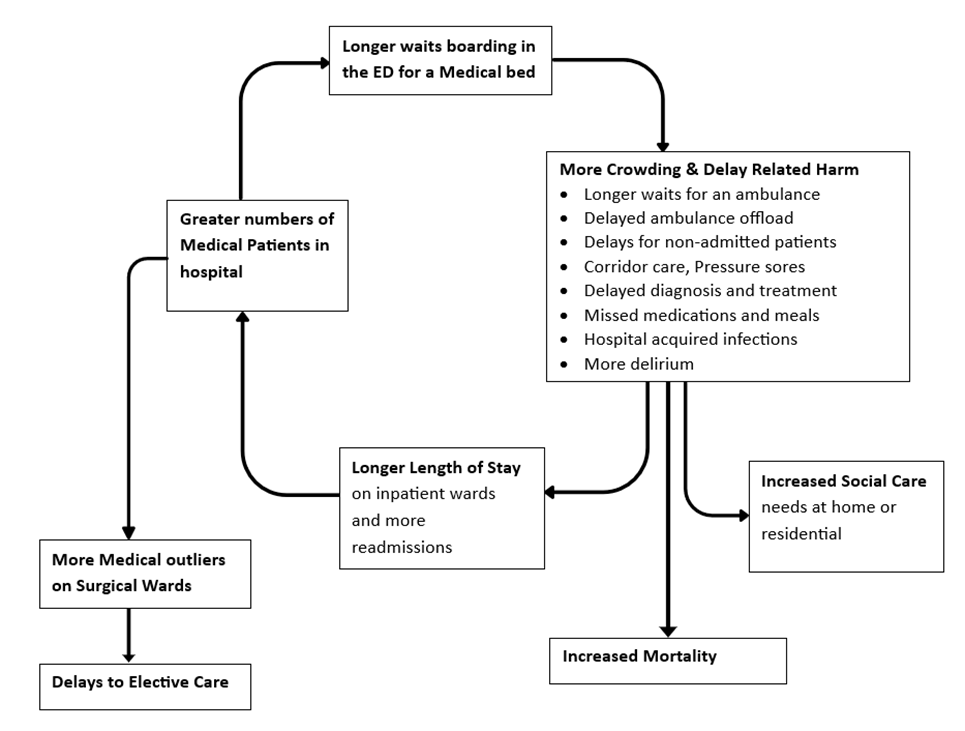
The argument runs as follows, and the paper’s vicious cycle diagram (included below with the author’s permission) captures it visually. Boarding extends inpatient length of stay through the mechanism the paper measures (8.6 hours of extra length of stay (LOS) per four hours of boarding). Extended LOS fills wards. Full wards sustain boarding. Over and over.
The loop is self-sustaining, but it is also breakable because each step has the same lever. This is fundamentally a self-organised criticality problem. The system drifts toward its tipping point and stays there, each additional boarder adding another grain on the pile. The intervention is not required to solve the problem in any final sense. It only needs to keep the pile below the critical angle, day by day, indefinitely. That is what running an ED effectively looks like.
A worked example
Take a typical acute trust admitting around 1000 medical patients a month from the ED, and running with 25 medical boarders at any given time. Commit to clearing one extra boarder at 4pm each day for three weeks, using normal escalation practices. By the end of the month, the trust has admitted around 1020 patients rather than 1000. That is a 2% increase, well below normal month-to-month variation. The wards don’t even notice. But by the end of the three weeks, the system is running with no significant boarding, and the LOS, ED, and ambulance benefits the paper measures begin to flow.
Three things make this work. First, the bottleneck is not ward throughput, it is discharge speed, and the LOS reduction more than compensates for the slightly higher admission rate. Second, the intervention is operationally legible at the level it needs to happen: the site manager, the bed manager, the SDEC team. Third, it reframes boarding from a crisis to be tolerated to a behaviour that can be ended, which mobilises a different professional response.
There is something subversive in the modesty of this. The system has spent years arguing that boarding cannot be solved without external intervention. The empirical answer is in the paper. The operational answer is in the author’s RCEM blog. Both say the same thing. Boarding can be solved from within: by deciding to stop doing it.
The bottom line
Howlett et al have given us a regional dataset that quantifies, with unusual care, what frontline clinicians have been describing for years. Boarding medical patients in ED causes measurable harm, with those and other patients in the system paying the crowding tax. The harm is dose-dependent, gets worse the more crowded the ED, and is almost certainly understated by this paper’s conservative choices.
The clinical case for action has been made repeatedly and is increasingly hard to argue with. The operational case, in bed-days and pounds, is now sitting in the same paper for executives who need it in that language. The Crowding Tax has a measurable price, a measurable harm and a measurable intervention. The path to action is undramatic but real.
What we should not do, in 2026, is treat this as another data point in a debate that is already settled. The question is no longer whether boarding harms patients. The question is what we are prepared to do about it, on whose ward, today.
References
- Howlett N, et al. Medical patient boarding in the emergency department as a source of crowding and delay-related harm, impacting patient outcomes and the efficiency of urgent and emergency care. Emerg Med J. 2026 Feb. doi: 10.1136/emermed-2025-214983.
- Jones S, et al. Association between delays to patient admission from the emergency department and all-cause 30-day mortality. Emerg Med J. 2022 Mar;39(3):168-173
- Office for National Statistics. Association between time spent in emergency care and 30-day post-discharge mortality, England: March 2021 to April 2022. January 2025
- Howlett N, et al. Blog: Boarding Medical Patients in the ED is the Key, and it’s a Fixable Problem. Royal College of Emergency Medicine; March 2026
