
Background
The potentially helpful effects of adrenaline in cardiac arrest are increasing aortic pressure and therefore coronary perfusion pressure. Therefore complete occlusion of the thoracic aorta should theoretically do the same thing, only better and without the side effect of cerebral vasoconstriction. Instead of relying on pharmacology to redistribute blood flow, REBOA mechanically forces the limited cardiac output generated by CPR towards the heart and brain. Some have even described it as “mechanical adrenaline”.
Over the last decade, a growing number of case reports, case series, physiology models and feasibility studies have suggested improvements in end tidal CO₂, coronary perfusion pressure, cerebral perfusion and rates of return of spontaneous circulation.
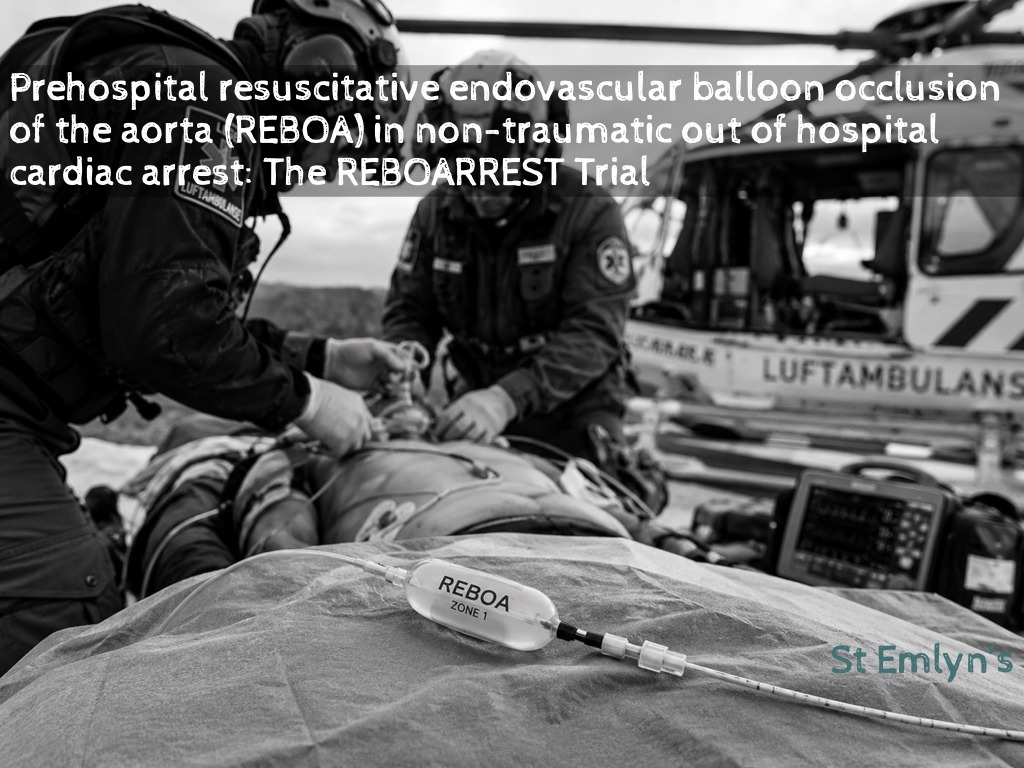
The REBOARREST trial is the first randomised controlled trial to investigate whether prehospital REBOA improves outcomes in non-traumatic out-of-hospital cardiac arrest. As always, we encourage you to read the paper yourself.
The Abstract
Background – Most patients with out-of-hospital cardiac arrest do not achieve sustained return of spontaneous circulation (ROSC). Resuscitative endovascular balloon occlusion of the aorta (REBOA) may increase blood pressure proximal to the ballon. If this technique is used during advanced life support (ALS), and occlusion is performed in the thoracic aorta, it may augment aortic pressure and coronary perfusion pressure. We investigated whether prehospital REBOA as an adjunct to ALS increased the rate of ROSC.
Methods – REBOARREST was a pragmatic, parallel-group, multicentre, randomised controlled trial conducted at 12 sites in Norway, Denmark, and Italy. Adult patients (18–80 years) with non-traumatic out-of-hospital cardiac arrest were randomly assigned (1:1) to either a control group that received ALS or to an intervention group that received ALS combined with REBOA as an adjunct. Fulfilment of eligibility criteria was determined by the physician on scene and sealed envelopes were used to allocate patients. The statistician that performed the analyses was blinded for group allocation. The primary outcome was sustained ROSC, defined as lasting ≥ 20 min, assessed in the intention-to-treat population.
Results – From June 7, 2021, to June 28, 2025, 200 patients were randomly assigned to the study groups. Due to lack of consent 21 patients dropped out of the trial, hence data from 179 patients are presented, 88 in the intervention group and 91 in the control group. Most patients were male (76%), with median age of 68 years (IQR 58–74). Median time from arrest to randomisation was 33 min (IQR 23–39) in the intervention group and 29 min (IQR 23–38) in the control group. Twenty-five of 88 patients (28%) in the intervention group and 24 of 91 patients (26%) in the control group achieved sustained ROSC (adjusted risk difference 1.8% [-11, 15, 95% CI], p = 0.78). Adverse events were registered in 19 patients.
Conclusions – Among patients with non-traumatic out-of-hospital cardiac arrest, a strategy of prehospital deployment of REBOA as an adjunct to ALS was feasible but did not significantly improve rates of sustained ROSC compared to ALS alone. Deployment of prehospital REBOA is safe and manageable in a two-person team with low procedure time.
Brede, J.R., Farbu, B.H., Gamberini, L. et al. Prehospital resuscitative endovascular balloon occlusion of the aorta in non-traumatic out-of-hospital cardiac arrest (REBOARREST): an international, multicentre, open label, pragmatic, randomised, controlled trial. Crit Care (2026).
What kind of study is this?
This is a pragmatic, multicentre, international randomised controlled trial conducted across 12 physician-led pre-hospital services in Norway, Denmark and Italy.
Patients were randomised to receive:
- Standard advanced life support alone
- Standard advanced life support plus REBOA
Randomisation was performed after initiation of advanced life support using sealed envelopes. The trial was necessarily unblinded but the study statistician remained blinded to allocation. The primary outcome was sustained ROSC lasting at least 20 minutes.
This was a pragmatic trial. The investigators were not testing REBOA under ideal laboratory conditions. They were testing whether REBOA could improve outcomes when deployed by real prehospital teams responding to real cardiac arrests across a mixed urban and rural population.
Tell me about the patients
The patients were typical of the cohort that physician led pre-hospital teams encounter when dispatched to cardiac arrest.
Key features included:
- Median age 68 years
- 76% male
- 94% witnessed arrests
- 91% bystander CPR
- Approximately half with an initial shockable rhythm
- Predominantly presumed cardiac aetiology (over 90%)
At first glance these are actually quite favourable arrest characteristics. These are not unwitnessed arrests found hours later. These are patients who, at least theoretically, still have a chance of meaningful recovery.
Median time from arrest to randomisation was approximately 30 minutes.
However, one number immediately jumps off the page. Median time from arrest to aortic occlusion was 47 minutes. That number becomes very important when interpreting the results.
What were the measured outcomes in this study?
The primary outcome was:
- Sustained ROSC lasting at least 20 minutes
Secondary outcomes included:
- Modified Rankin Scale 0-3 at 30 days
- Left ventricular ejection fraction
- End tidal CO₂ following balloon inflation
- Organ function following hospital admission
- Survival outcomes
What are the main results?
Primary outcome
Sustained ROSC:
- REBOA: 28%
- Control: 26%
Survival
Thirty-day survival:
- REBOA: 7%
- Control: 7%
Neurological outcome
Modified Rankin Scale 0-3 at 30 days:
- REBOA: 6%
- Control: 3%
Not statistically significant.
Overall, the trial was neutral across every clinically important outcome.
What about the limitations?
There are several considerations worth discussing, but in my view one stands above all the others.
Was REBOA deployed too late?
As we saw earlier, median arrest-to-occlusion time was 47 minutes. At that point many patients will have:
- Severe metabolic failure
- Prolonged myocardial ischaemia
- Established reperfusion injury
- Significant neurological injury
The authors identify this as the major limitation of the study and I agree with them.
The physiology may be correct, and it may be he timing which is wrong. This becomes even more relevant when we consider that approximately half of the study population were reached by helicopter services operating across large rural geographical areas. The intervention may have arrived too late to meaningfully influence outcome.
If REBOA is potentially a useful treatment in non-traumatic cardiac arrest, then to find out we will need to test it in systems with a speed of response much more prompt than physician delivered HEMS, but will the seniority and expertise to deliver a complex intervention (and clinical research). I can think of some teams in the UK who could do this (you know who you are!), but it would be challenging to deliver and govern at scale.
Did enough patients actually receive the intervention?
This is an important point. 42% of patients randomised to REBOA never underwent aortic occlusion. Reasons included:
- ROSC before balloon inflation
- Technical failure
- Procedure abandonment
Only 51 of 88 patients ultimately received aortic occlusion.
This is not a criticism of the investigators. In fact, it is exactly what happens in real-world practice. However, it means the trial is testing a strategy of REBOA rather than the physiological effect of aortic occlusion itself. With numbers this small, whilst this is sound research methodology, I’m not sure that intention-to-treat analysis gives the most helpful perspective. (Sidenote, but interesting, there are a couple of suggestions that Bayesian analysis might suit this type of research better. See this article which is a Bayesian post-hoc analysis of pre-hospital TXA for TBI using Bayesian methodology)
Was the study underpowered?
Possibly. The trial was powered around the assumption that REBOA might double ROSC rates. The investigators openly acknowledge that this was an ambitious assumption. A smaller but clinically important treatment effect could therefore have been missed. That said, even if such an effect exists, it is unlikely to be large.
Is there anything else to look at?
End tidal CO₂
End tidal CO₂ increased significantly following aortic occlusion. That is exactly what physiology predicts. Aortic occlusion should:
- Increase central blood flow
- Increase pulmonary blood flow
- Improve coronary perfusion
- Improve cerebral perfusion
The rise in EtCO₂ suggests that REBOA is actually doing what we expect it to do – physiologically at least.
The as-treated analysis
Now things become slightly more interesting. The intention-to-treat analysis was clearly negative. However, one of the as-treated sensitivity analyses demonstrated a statistically significant improvement in sustained ROSC, with an adjusted risk difference of 16%.
The authors quite rightly caution against over-interpreting this finding, but the same caution should probably be applied to interpreting the results of a REBOA trial where nearly half of the intervention group (42%) did not receive the intervention.
The procedural time and success
The median time from randomisation to aortic occlusion was 14 minutes (IQR 11-16). I’m surprised by this, because compared to the ECPR literature it is the similar or slightly longer (ARREST: 7 mins, PRAGUE-OHCA: 12 mins, CHEER3: 16 mins). The process to cannulate for ECPR involves accessing and dilating two separate vessels, whereas REBOA just needs arterial access and no dilation.
The procedural failure rate in REBOARREST was 22%, which is almost 1 in 4 patients who were randomised to the interventions, and are included in the intervention arm, but the intervention was unsuccessful.
The occlusion technique
Different devices were used across the centres, with Italy using the ER-REBOA catheter (Prytime, USA) and the remaining countries using the REBOA Medical balloon (REBOA Medical AS, Norway). Only the ER-REBOA had the ability to monitor aortic pressure. The study protocol instructed to inflate the Prytime catheter with 15mL 0.9% NaCl, and the REBOA Medical catheter with 8mL 0.9% NaCl. The challenge here is that neither technique measured whether occlusion had been achieved by confirming a loss of distal pulsatility using invasive pressure measurement. In this trial there was no requirement for any invasive pressure measurement. Having used REBOA in a very similar cohort including measuring aortic and femoral invasive pressures, I am cautious about this technique, as we have found larger than expected aortic diameters in the normovolaemic and older non-traumatic medical cohort. There is a chance that in some of the patients in whom a REBOA balloon was inflated, complete occlusion was never achieved
Should we change practice based on this study?
REBOARREST does not demonstrate a benefit from prehospital REBOA in non-traumatic out-of-hospital cardiac arrest.
The study does convincingly demonstrate that:
- Femoral arterial access is achievable
- REBOA can be performed safely
- Aortic occlusion can be delivered by a two-person prehospital team
- The procedure can be implemented across multiple countries and systems
What remains unanswered is whether REBOA is being deployed early enough to influence outcome. Aortic occlusion at 47 minutes may simply be too late – I suggest that the only resuscitative intervention which moves the survival needle at that duration of cardiac arrest is ECPR.
If there is a future role of REBOA in non-traumatic cardiac arrest, perhaps it is not as a stand-alone intervention during conventional advanced life support. Perhaps it is as part of a broader physiology-guided cardiac arrest strategy which also incorporates ECPR. I am imagining REBOA being deployed very early, by more widely and quickly available (less specialist) teams than HEMS, to temporarily improve perfusion from CPR, functioning as a bridge to extracorporeal support, rather than as a definitive intervention in its own right. Hypothetically the combination could improve neurological survival from ECPR, or extend the ECPR candidacy window, or both.
Summary
REBOARREST is the first randomised controlled trial of prehospital REBOA in non-traumatic out-of-hospital cardiac arrest. Despite a compelling physiological rationale, the trial found no improvement in ROSC, survival or neurological outcome compared with standard advanced life support. However, the study raises an important question: was REBOA actually deployed early enough to have a chance of working? Median time from arrest to aortic occlusion was 47 minutes, a point at which severe metabolic, myocardial and neurological injury are already established. Interestingly, REBOA produced exactly the physiological effects we would expect, with significant increases in end tidal CO₂ following occlusion, and an as-treated analysis suggested a potential improvement in ROSC. The trial also demonstrated that REBOA can be delivered safely by a two-person prehospital team across multiple international systems. For me, REBOARREST does not definitively show that REBOA cannot work in cardiac arrest, but I think it does show that it’s not an effective intervention when deployed by HEMS teams with significant periods of time to reach the patient from collapse. Rather, it suggests that if it is to work, it probably needs to be deployed earlier, and perhaps as part of a broader physiology-guided cardiac arrest strategy incorporating ECPR rather than as a stand-alone intervention.
Best wishes, Hutch
Further reading
- Hutin A, Levy Y, Lidouren F, Kohlhauer M, Carli P, Ghaleh B, Lamhaut L, Tissier R. Resuscitative endovascular balloon occlusion of the aorta vs epinephrine in the treatment of non-traumatic cardiac arrest in swine. Ann Intensive Care. 2021 May 17;11(1):81
- Brede JR, Skulberg AK, Rehn M, Thorsen K, Klepstad P, Tylleskär I, Farbu B, Dale J, Nordseth T, Wiseth R, Krüger AJ. REBOARREST, resuscitative endovascular balloon occlusion of the aorta in non-traumatic out-of-hospital cardiac arrest: a study protocol for a randomised, parallel group, clinical multicentre trial. Trials. 2021 Jul 31;22(1):511.
