
This is the twelfth in a series of blog posts on new research in emergency toxicology. The last post was about peer support for opioid abuse and can be found here. We deal with all sorts of poisons in Virchester, so be prepared for anything.
(This is a guest post from Dr Jack Lyon, an EM registar at Virchester with a keen interest in pre-hospital care. Thanks Jack!)
Its 0100hrs and you are part of the medical team at a music festival.
You hear over the radio that security is dealing with a 28-year-old old male who is combative, agitated and sweaty.
His friends say that he has taken some drugs this evening, although they are not sure which. Your assistance is urgently needed!
To those who regularly work in event or pre-hospital medicine, this vignette will ring true to you…
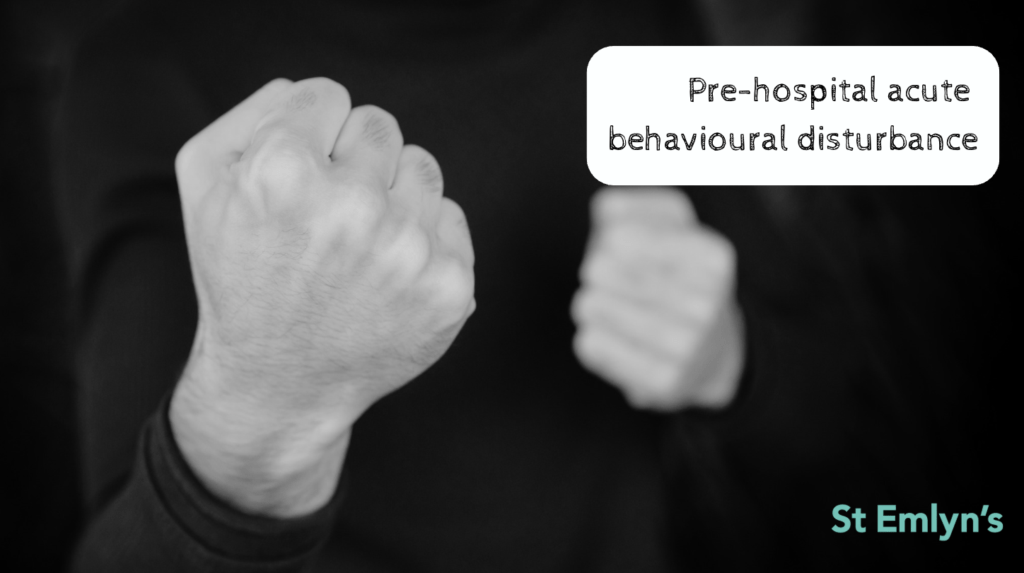
Acute behavioural disturbance (ABD) is a challenging presentation. It regularly comes up on St Emlyn’s. These cases are complex, and assertive management is required to prevent the situation from deteriorating. For some patients, this might be simple verbal de-escalation. For others, restraint and sedation may be required.
The choice of sedative agent has been long discussed for hospital settings, and there are some high-quality trials to inform our practice, as well as RCEM guidelines. The optimal drug choice for pre-hospital clinicians is less clear. Helpfully, a literature review on this topic was recently published in the EMJ.
Abstract
Objectives: Acute behavioural disturbance (ABD), formally known as excited delirium, is an under-recognised clinical picture often characterised by abnormal physiology and extreme agitation. The condition is potentially dangerous for both patients and practitioners, particularly in the prehospital setting. Our objective was to systematically review the evidence for management of ABD within the prehospital environment.
Smith F, […], Morton S. Prehospital management of acute behavioural disturbance: managing severe agitation in the prehospital setting – a systematic literature review.
Methods: A systematic literature search (PROSPERO CRD42023447238) of PubMed, Cochrane trials, Cochrane reviews, Embase, Web of Knowledge, Google Scholar and MEDLINE was performed from inception until February 2025. Any study that examined the management of ABD prehospitally was included. Randomised controlled trials, observational cohort studies and case series that were written in English were included. Methodological quality of included studies was interpreted using the ROBINS-I (Risk Of Bias In Non-randomised Studies – of Interventions) and GRADE (Grading of Recommendations Assessment, Development and Evaluation) approach.
Results: From 6091 studies, 42 were included; none were high quality and 6 were moderate quality. Ketamine demonstrated the most effective sedation (range 79–98% of all patients included achieving adequate sedation as defined in the studies), although doses and methods of administration varied significantly. Midazolam generally showed a higher number of side effects than other drugs studied. Droperidol was not found to have a higher mortality than others, and no effect was seen on the QT interval.
Conclusions: Ketamine was found to be the most studied drug for treatment of ABD in the prehospital setting and is likely the most effective method of sedation at a dose of 5 mg/kg intramuscularly. Midazolam appears to have a higher risk of side effects, particularly respiratory-related, in comparison to other sedative agents. Conclusions are limited by the quality of evidence currently available and additional research is required to establish the most effective mode of administration and dose for this population group, as well as better definition of the presenting condition and outcome measures.
Emergency Medicine Journal. 2026, February 27th.
What was the study design?
This is a systematic literature review without meta-analysis. The authors adhered to PRIMSA guidelines and pre-registered with PROSPERO (CRD42023447238).
The aim was to find studies that investigated the management of ABD in the pre-hospital setting. They included RCTs, observational studies, and case series. 6091 papers were initially identified, with 42 meeting inclusion criteria.
The GRADE and ROBINS-I methods were used to assess quality. None scored a “high” rating. 6 were “moderate,” 31 were “low,” and 5 were “very low” quality.
Can you tell me about the patients?
The authors do not describe any patient demographics or clinical characteristics. It should be noted that there is no globally recognised definition for ABD or “effective sedation,” and this is reflected in the heterogeneity of their sample.
What was given in these studies?
Studies described the use of several different pharmacological agents to manage ABD. These included ketamine, droperidol, midazolam, haloperidol, olanzapine, and other unspecified anti-psychotics or benzodiazepines. Intramuscular (IM), intravenous (IV) and intranasal (IN) routes were used.
The majority of papers (n=30) included the use of ketamine. Nine studies included midazolam and six included droperidol. Two studies included the use of non-pharmacological techniques and physical restraint.
A wide variation in doses was reported across the papers, with studies looking at ketamine showing the widest variation. IM doses were predominantly 4-5mg/kg (2.97-11.5mg/kg). If a non-weight-based IM strategy was utilised, doses ranged from 150-400mg. IV doses ranged from 0.5-2.79mg/kg. For midazolam, a smaller variation was reported with IM doses 2.5-10mg, IV 1-10mg and IN 2.5-10mg. IM droperidol doses varied between 2.5-15mg and IV doses 2.5-5mg.
What outcome measures were used?
The authors compared multiple outcomes across studies, including time to satisfactory sedation, adverse effects, need for repeat medication, injuries to staff, and length of stay in ED.
What were the main results?
Ketamine appeared to be the most effective method of sedation, with adequate sedation being achieved in 79-98% of patients. Additional rescue sedation was required 0.4-62.8% of the time.
Midazolam appeared less effective, with adequate sedation 8.3-80% of the time and 10.9-75% requiring additional sedation.
Droperidol was effective 11.7-76% of the time, with the lowest average need for rescue doses (10-11%). Haloperidol was effective 65-100% of the time, with 13-45.1% requiring further sedation.
I’d recommend you review the supplementary evidence table (S4) to see all the adverse effects reported with each medication. Deaths were reported in all medications, though we cannot certainly attribute the medication to this. The requirement for intubation for patients who received only ketamine was 434/4389 (9.9%). In midazolam, this was 14/171 (8/1%) and in droperidol 7/461 (1.5%). Reasons for intubation are not standardised or clear.
What did the authors conclude from the results?
“Ketamine was found to be the most studied drug for treatment of ABD in the pre-hospital setting and is likely the most effective method of sedation at a dose of 5mg/kg intramuscularly. However, side effects can still occur and should be prepared for by clinicians.”
What should we take away from this study?
This literature review has identified a wide range of papers reporting multiple ABD sedation strategies across a significant number of patients. The authors have acknowledged the many limitations in their sample, and the heterogeneity seen in definitions of ABD, treatments, and outcome measures.
Ketamine appears to have been most effective drug for promptly achieving adequate sedation. Most studies in the review used 4mg/kg or a similar dose, which reflects what we would give in Virchester hospitals. The preservation of airway reflexes and respiratory drive provides a theoretical benefit over benzodiazepines, yet the intubation rate is highest (9.9%) in this group. Previous studies have reported a wide variety in the incidence of intubation with pre-hospital ketamine sedation. Whether this is directly attributable to the drug is difficult to deduce. It is suggested that the co-ingestion of other agents that may have precipitated the ABD might be responsible. Unfamiliarity with ketamine and its resultant effects may also contribute to intubation rates.
Midazolam appears less attractive, with more adverse events, slower onset times, and an increased need for re-administration. This fits with clinical experience: many of us will have experienced the unpredictable and variable response patients can have to midazolam. Unfortunately, the papers comparing ketamine and midazolam do not report time to adequate sedation.
Droperidol could hold some promise. It has showed reasonable success at first dose with the lowest rescue dose and intubation requirements. Droperidol previously fell out of favour due to a black box warning regarding the possibility of inducing QT prolongation and tDP. This is not supported by more recent data.
Should this study change our practice?
Not really.
The limiting factor for any intervention in the pre-hospital environment is always going to be the availability of appropriately trained resources to deliver it.
Up here in Virchester, our pre-hospital Advanced Paramedic colleagues carry midazolam for rapid tranquilisation following authorisation from a doctor. Our enhanced pre-hospital care (EPHC) colleagues additionally carry ketamine. The JRCALC (Joint Royal Colleges Ambulance Liaison Committee) would need to introduce ketamine into the skillset of more pre-hospital clinicians if they wanted to widen its use. Importantly, those administering ketamine would need to be appropriately skilled and resourced to handle the potential adverse events, such as intubation. There is a great episode on EMCrit where this risk is discussed: the “litmus test” for ketamine is the question, “would you otherwise intubate this patient to gain control?” Certainly something to think about.
I concur with the authors that the review lays groundwork for a future, prospective study on the pre-hospital use of ketamine, midazolam, and droperidol. Ideally, this would be an RCT. We can only wait…
Jack Lyon ( + Greg Yates)
Further Reading
- Cole JB, Moore JC, Nystrom PC, Orozco BS, Stellpflug SJ, Kornas RL, Fryza BJ, Steinberg LW, O’Brien-Lambert A, Bache-Wiig P, Engebretsen KM. A prospective study of ketamine versus haloperidol for severe prehospital agitation. Clinical Toxicology. 2016 Aug 8;54(7):556-62.
- Isbister GK, Calver LA, Page CB, Stokes B, Bryant JL, Downes MA. Randomized controlled trial of intramuscular droperidol versus midazolam for violence and acute behavioral disturbance: the DORM study. Annals of emergency medicine. 2010 Oct 1;56(4):392-401.
- Smith F, Todd J, Avery P, Morton S. Prehospital management of acute behavioural disturbance: managing severe agitation in the prehospital setting–a systematic literature review. Emergency Medicine Journal. 2026 Feb 27.
