
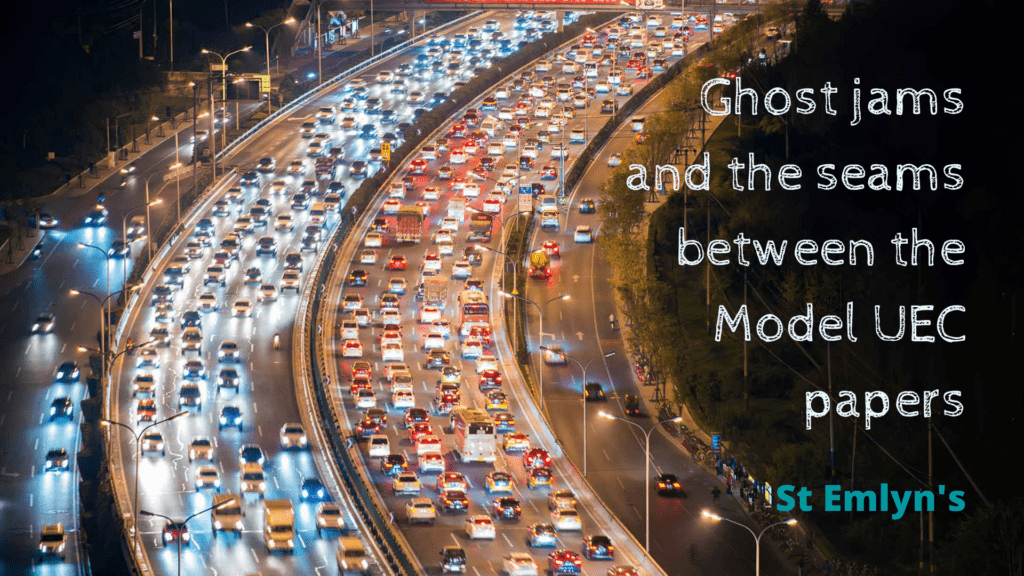
The ghost jam
Have you ever noticed how a traffic jam can form on a motorway despite no breakdowns, accidents or road closures?
A small perturbation downstream, such as a driver braking slightly too hard, propagates backwards through the coupled queue, as each following driver reacts with a slight lag. In turn, the next vehicle slows down slightly more than the one in front of it. Until about 20 vehicles on, the queue comes to a complete stop.
The resulting jam is the product of this progressive, coupling lag. It occurs despite no breakdowns, accidents or road closures. Traffic engineers refer to this phenomenon as a ghost jam.
The gaps between the Model UEC papers
There are now three Model UEC papers describing the urgent and emergency care (UEC) journey. Model Emergency Department (ED) covers the ED, the Model Acute Pathway covers the first 72 hours from referral, and Model Discharge covers exit from hospital. Each is careful, evidence-informed and largely complete for the stretch it describes.
Together, they appear to cover the whole UEC pathway. And yet, even though each Model UEC paper describes the seams in its own pathway, overall the seams between them are not unpacked in any meaningful detail.
A coupled care pathway, such as Model UEC, has the same property as the motorway we described. Lag from one seam is not limited to that seam. It propagates through all the joins, produced by the coupling, rather than by any one programme, service or department’s failure. I’m not referring to the measurable differences between existing UEC services and Model UEC recommendations.
I am suggesting that a perfectly implemented set of Model UEC recommendations may still produce ghost jams. Especially where the unmeasured seams between them remain wide.
The seams hiding in the data
Technically the seams are not unmeasured.
In ED, it is absorbed inside the 12-hour count. On the wards, it is absorbed inside the seven-, 14- and 21-day length-of-stay figures, and the no-criteria-to-reside returns. In each case the seam time sits inside the number, but is not separable from it. Nobody can say with certainty how much of that 14-hour stay was waiting for a bed, or how much of that 21-day stay was waiting for a package of care.
In ED, separating it out would mean relying on decision-to-admit (DtA) timestamps, clinically ready to proceed (CRtP) entries and referral times. These are fields that are inconsistently completed and without the scrutiny that improves data quality. DtA is probably the most complete of the three, since it feeds a publicly published measure. But it marks a decision, not an arrival; the hours spent in ED before DtA is reached become invisible at the point of DtA.
My own analysis of the first national corridor care dataset against public ECDS data found that the further into the ED length-of-stay distribution you look, the stronger the correlation with corridor care becomes. Long stays in ED track a downstream burden. That is a coupling lag, observed from the ED side of the seam.
The argument that the seam matters is well made. But it is not sufficiently separated in data collections. In addition, ED remains the well-lit end of the data pathway. Further downstream, the data picture dims rapidly. This makes both the seam and the coupling lag difficult to identify in our data.
The seam widens out-of-hours
The Royal College of Emergency Medicine’s 2024 workforce census found average weekday consultant presence in English EDs of 15.9 hours, and 15.2 hours at weekends, against a recommended minimum of 16 hours. Between midnight and eight am, only 12 EDs reported consultant presence on the shop floor on weekdays. Just 12% of EDs include night shifts in the consultant job plan.
The Model Acute Pathway standard recommends that all admitted patients should be assessed by an expert clinical decision-maker, normally a consultant, within a maximum of six hours during the day and 14 hours overnight. But the Society for Acute Medicine’s (SAM) benchmarking audit found that patients first assessed in the ED were far less likely to receive timely consultant review than those seen in an acute medical unit or same-day emergency care (42% against 60% and 87%). SAM attributes this to access block shifting medical care into the ED.
Model Discharge asks for seven-day working and seven-day workforce arrangements, but sets no hours for the care transfer hub at all. There is no stated overnight expectation to fall short of. And the dimension it does specify is the one where the shortfall is most visible, the well-recognised drop in discharge activity across weekends.
In each case the weaker out-of-hours position is built into the standard. Two papers write a reduced expectation for the night (which is not currently met). The third writes none at all. But demand does not thin on the same curve as available service capacity (recommended or recorded).
Reconciliation of impaired sequencing between emergency medicine, acute medicine and care transfer hubs still has to happen around a 24-hour clock, seven days a week.
Who owns the seams?
Model ED has the emergency physician in charge (EPiC). The Model Acute Pathway designates a consultant in charge of the acute take, explicitly mirroring the EPiC role. And Model Discharge names an executive director accountable for discharge performance, supported by a care transfer hub.
Model ED states leadership across departments, trust and the wider system must accept responsibility for ED flow, without agency to act anywhere but ED. The Model Acute Pathway states the standards are aimed at what happens after ED has completed its care, despite insufficient data quality to count specialty patients that increasingly spend larger portions of their first 72 hours in ED. Model Discharge tells trusts to compare delayed inpatient discharges against these same patients waiting more than 12 hours in ED for admission, and those receiving care in corridors.
Each paper reaches across its boundary in general, describing who should own the seams in broad terms. But none of the papers specifically names who owns the seams.
Who then owns the seams?
In practice, the seam falls to whoever is holding the hospital together when it frays. That is bed and site management.
Davina Allen’s ethnography of UK hospital bed and site management (open access) describes work at the seams as match-making. She calls it the continuous reconciliation of patients to beds under time pressure and uncertain information. Allen found it to be a form of micro-level rationing that was not informed by explicit criteria. Nor did it hinge on clearly identifiable decisions to grant or deny access. And although it is embedded in everyday practice, it is largely invisible.
Phil Wilson’s doctoral study of the 24-hour bed manager (open access) in a large English acute trust puts the same finding in present-tense NHS terms. His participants describe the bed and site manager as the hospital’s 24-hour clinical leader-responder, brokering clinical risk, making what one general manager called the least bad choices in difficult circumstances. As one nursing manager put it, out-of-hours everything is their problem. Bed and site managers reported taking on safety concerns across the entire UEC pathway, from both ED and the wards.
Like Allen, Wilson also points out that despite the importance of the role, bed and site management carries no national framework and no recognised specialist status. The role of reconciling the UEC seams at three am, when the capacity across the three Model UEC papers is at its thinnest remains nationally undefined.
The work as done
Notwithstanding the measurable gaps with Model UEC, bed and site management is exactly the design as repair work we’ve previously described on St Emlyn’s. The intelligence and workarounds that exist outside policy documents.
The premise of design as repair is that every system has two versions of itself. The one in the documents, and the one on the floor. In this post, the three Model UEC papers are an example of the first version. The bed and site manager at three am is an example of the second.
It is a feature of any complex system that someone has to close through repair, continuously, shift after shift. Where that distance is invisible, as it is at the Model UEC seams, the repair may happen unmanaged and unsupported. Or not at all.
A fourth Model paper won’t close it
The obvious response would be to write the seam down: commission a fourth Model UEC paper. I don’t think this would be the right approach.
Under-specification of the seam is not caused by a shortage of guidance. The three detailed, cross-referencing Model UEC papers already name the interface, instruct measurement across it, and still left the reconciliation to whoever is holding the site at three am.
A fourth paper would arrive with its own clock, its own named controller, and new seams of its own. That is why writing more guidance will probably not close the gap.
What the seam most likely needs
The three Model UEC papers describe three stretches of the UEC journey. Each names the interface between them and then appoints someone on its own side of it. Between them lie multiple seams, held together by work that is skilled, continuous and almost entirely undescribed. It is currently performed by people in a role with no national framework, in the hours when demand from all three is most likely to outstrip capacity.
The seam does need writing down. Not as a fourth Model UEC paper describing a fourth stretch, but as a recognised operational function. Wilson argues this directly: a role with national status and a professional framework. And Allen’s work shows why it is crucial for the invisible reconciliation that already holds the pathway together.
That work is what stands between an efficient, coupled Model UEC pathway and more ill-defined ghost jams. It is the repair that closes the distance between the work as described and the work as done. What closes the gap is not more guidance, but recognition of the people and the role already holding the seam together.
