
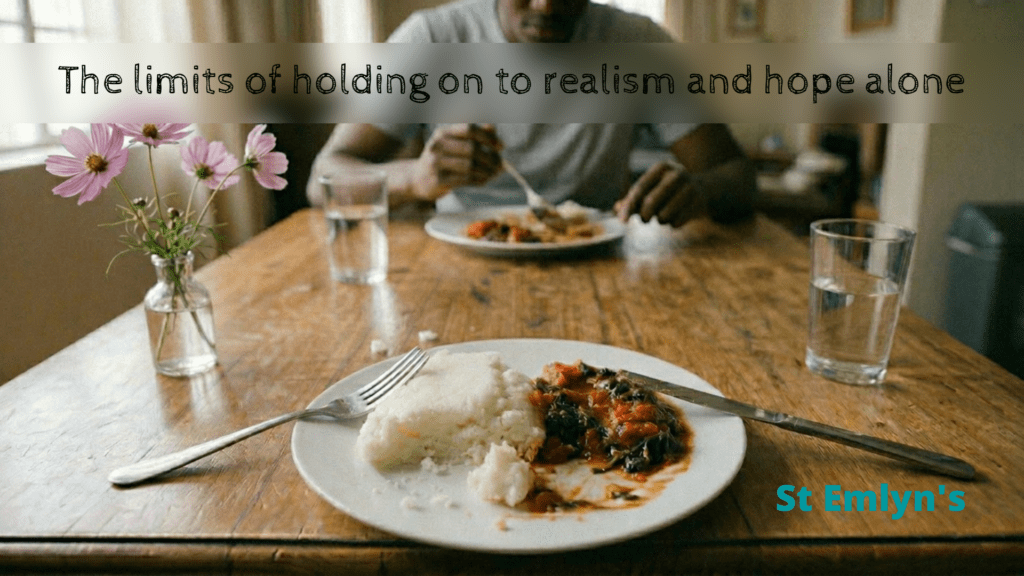
A reflection on the Stockdale paradox, and what it costs to hold on in emergency medicine.
One reality, three perspectives
It’s been one of those shifts.
Several patients have already waited over 12 hours for a bed. Both walk-in and ambulance queues are building. With limited access to majors and resus, use of the corridor has become inevitable. The resident, emergency physician in charge (EPiC) and a senior manager meet on the emergency department (ED) shop floor to discuss the situation.
The resident says they appreciate the support, but this is just another crowded shift. The EPiC agrees that crowding is pushing the team to the limit, yet believes it will eventually settle. The senior manager says it has gone far enough, and promises some moves within the hour. Then very little changes. Moves don’t happen, patients continue waiting, queues keep building, and majors and resus access remains strained.
Three people, three perspectives, on the same reality. The resident has resigned themselves to this as simply how things are. The senior manager is certain things will turn around. The EPiC holds both at once, clear about how bad it is, yet unwilling to believe it will stay this way.
The Stockdale paradox
Admiral James Stockdale was the most senior United States military officer taken prisoner during the Vietnam War. For seven and a half years his captors tortured him repeatedly. He survived, while many others did not.
Stockdale did not credit optimism for his survival. On the contrary, he believed the optimists were less likely to make it out; those who said they would be home by Christmas, then watched Christmas pass, then Easter, then another Christmas. Stockdale, in contrast, stayed unflinching about how bad things were. And at the same time held an absolute conviction that he would get out.
Jim Collins described this in his book, Good to Great (2001): the Stockdale paradox is a way of holding two opposing truths at once. Brutal honesty about a severe reality, and an unwavering faith in a better outcome.
A system in difficulty
The Stockdale paradox offers one of the clearer reflections of current NHS staff attitudes. Performative optimism often sits at the top. Those holding the paradox sit in the middle. And a third group, holding neither, sits at the bottom.
Let me explain.
For the 2025 NHS Staff Survey, not one measure improved. Engagement fell, and morale was at or near record lows. Some 30% of staff reported feeling burnt out, 35% that their work is emotionally exhausting, and 42% that they felt worn out at the end of a shift. Only 55% reported their organisation taking positive action on health and wellbeing, the lowest this metric has ever been. Work-related stress rose to 41%. Unsurprisingly, only 58% said that they would recommend the NHS as a place to work.
Narrow the lens to emergency medicine (EM), and it gets more depressing. The 2025 GMC training survey placed EM trainees at the highest risk of burnout of any specialty, for a fourth consecutive year. More than twice as many EM trainees described their workload as heavy or very heavy, compared with trainees overall. More than a quarter described hesitation to escalate a patient to a senior.
The language of care and abandonment
Bell et al. suggest that moral injury involves an erosion of trust on three levels: loss of trust in others, in yourself and in authority. Each erodes the foundation on which a sustained belief in a better outcome depends. That is the same belief Stockdale credited for his survival.
The erosion of trust in authority is worth singling out. Performative optimism and performative support are the same act. Both perform hope in the presence of a reality that contradicts it. Support offered but never reachable does not relieve the injury. It deepens it by pairing the language of care with the experience of abandonment.
Fewer than half of the NHS workforce responded to the survey, and participation fell against the previous year. Still, many trusts framed their survey results as achievements. “Above average on the People Promise.” “Highest scores in five years.” “Fourth consecutive year of improvement.” Yet when an average is this low, it takes a particular wilful optimism to call being just above it a success.
These surveys provide a brutal but honest reflection of a very challenging reality. Thankfully, this is not the entire reality.
Unassuming leadership
The best results in the staff survey related to immediate managers. Some 70% of staff reported that their manager takes effective action to help them with any problem they face. A further 71% said their manager works with them to understand problems. I suspect this is because many of these managers hold the Stockdale paradox. Although the survey shows this benefits the team, holding the paradox carries a tension.
This tension is that a conviction you hold because you need to, is difficult to reliably sustain. An unwavering faith in a better outcome is not rational. And beliefs that are not rational are hard to pass on. Holding the Stockdale paradox therefore requires intention to maintain, and effort to share.
Without naming it, St Emlyn’s has broken ground on the paradox before, but in very different contexts. We previously shared an anonymous post about the cost of leadership under very challenging circumstances. Simon recently wrote about what sustained excellence in leadership looks like. These posts sit at opposite ends of the Stockdale paradox, and many of us will recognise aspects of ourselves in both.
Sadly, the NHS staff survey and GMC training survey suggest too many will lean towards the anonymous post. Part of the reason for this, I think, is that we carry our burden alone.
Kingdom of fear
We are not good at asking for help. The evidence is consistent and slightly damning. We present late, often at the point of crisis, and would rather treat ourselves than be treated. We cite confidentiality, our careers and our regulators. But underneath the catalogue of barriers sits something simpler. We believe a good healthcare professional is one who copes. To admit otherwise is to fail a test we set ourselves.
This plays out at every scale. The individual who won’t speak to a colleague or a psychologist. The specialty that won’t put its own crisis on the programme. Crowding is the defining operational reality of EM, yet it barely features at our conferences. Only a handful of us argue about working conditions nationally. Collectively, we are doing exactly what we do individually: saying we’re great, and then looking away.
This is the territory of Cameron Whitcomb’s 2026 single, Kingdom of Fear. It’s a young man’s song about putting on a brave face, and it has stayed with me more than I expected. ‘Ask me how I’ve been, I’ll say I’m great. But under my skin, I’m not okay.’ It touches familiar ground: biting your tongue, the lie told in self-defence, the fear of what the mirror shows.
The part that lands hardest for me is the refusal to be a burden. The refusal to be the one who calls when they’re hurting, even when admitting they need someone at their back.
I confess, I also lean more towards the anonymous post. I did not choose to lead my department during the pandemic, I stepped up when our clinical lead fell ill. Then my father died 8,000 miles away. People were kind about my leadership. But they did not see the rest. The version of me who could only fall asleep by drowning out the noise in my head with Alanis Morissette’s Jagged Little Pill. Like many, I was the clinician who could not let go. Fluent at giving, not so much at receiving. Determined not to be a burden.
Not a solo endeavour
Nelson Mandela was the highest-profile political prisoner of apartheid South Africa. He survived 27 years of terrible conditions on Robben Island. Whether he would have credited the Stockdale paradox I cannot say. But his account is very similar: a clear perspective of an unrelenting challenge, and a long conviction of eventual success.
The key difference is that Stockdale’s account is largely solitary. Mandela’s is not.
Mandela credited the people around him, who made his ordeal survivable. This distinction is important, and draws on the Southern African tradition of Ubuntu: I am because we are. Ubuntu describes how humans face sustained pressure under conditions they have limited control over. We are not built to hold the hardest things alone.
It is worth noting that neither Stockdale nor Mandela held the paradox to make their incarceration acceptable. They held it to stay intact until they could leave their prison. When we acknowledge that we hold the paradox, we also acknowledge that we are still in a prison of sorts. Unlike them, we can leave, and some do. Yet most of us stay, largely for reasons we believe in. This is important, because the evidence on where to intervene is fairly clear.
A lever out of reach
The levers that change the system are mostly organisational: safe staffing, rotas, rest, etc. In other words, the basics of a working environment. Teoh et al. specifically show that individual interventions, such as resilience training, largely fail. This is because these aim at the person rather than the system (implying that the problem lies with the individual, rather than the conditions).
The difficulty is not that these levers aren’t known. The difficulty is that these levers sit beyond our reach. We can see them, but we cannot pull them. So when I say Ubuntu is how we survive the wait, that relational framing does not let the system off the hook.
What evidence remains, points to belonging, peer trust and having someone at your back. Just like those who had Mandela’s back. They do not fix the system, but instead keep us intact when the system fails to.
Three versions, one truth
Like many others, I put on a brave face during the pandemic. I would not speak to anyone, let alone a psychologist. Then my immediate manager arranged an appointment with our staff psychologist. It was voluntary in the way a child’s trip to the dentist is voluntary: I was going. The only thing left to decide was how much I protested along the way.
I figured if they wanted me to talk, that is what I would do. So I did. And they listened. I won’t pretend it undid everything. But it loosened enough for me over about six sessions to open up to a peer. One who now knows the full weight of it, asks real questions, and does not judge me for real answers. And whilst the system hasn’t shifted much, our regular coffee meet-ups have become an important lifeline.
Three people stood on the shop floor, holding three versions of the same, stubborn reality. The Stockdale paradox suggests that only the person holding realism and hope would eventually make it out. Although that perspective isn’t wrong, it is also not complete. Mandela teaches us that the paradox is only sustained when we do not have to hold it alone. When someone has our back.
Postscript
If anything in this post lands too close to home, you do not have to sit with it alone. Some of the people to reach out to:
- Family, friends, trusted colleagues, supervisors or mentors
- Your trust’s staff wellbeing team
- NHS Practitioner Health: free, confidential mental health and addiction support for doctors and dentists in England, and for other healthcare staff who cannot safely access care locally
- Laura Hyde Foundation: independent mental health support for all healthcare and emergency services staff, including nurses, paramedics and AHPs
- BMA Wellbeing Support Line: 24/7 confidential counselling for doctors and medical students
- Samaritans: 116 123, free, any time, for anyone
- Shout: text SHOUT to 85258 for 24/7 crisis text support
