
Learning strategies
Spaced repetition: remembering what we teach
Why coming back to a topic helps, what to do when you return, and how mixing cases can make revision more demanding.
Original article: Simon Carley · 2015-11-04
Updated 21 October 2026 · 5 min read
How much of last month’s teaching could you explain now, without looking at the slides? It’s a slightly uncomfortable question, especially if you were the person doing the teaching. We spend a lot of time getting information across in the first place. We tend to spend rather less time arranging what happens to it afterwards.
Spaced repetition gives us a reason to return. Instead of doing all our work on a topic in one sitting, we spread encounters with it over time. That’s the basic idea. What we do during those encounters matters too, which is where retrieval practice and interleaving come in.
Familiar isn’t quite the same as remembered
Think about revising an ECG topic. You read the explanation, look back at the trace and it all seems obvious. Tomorrow, someone gives you a similar trace without the explanation. Suddenly there’s rather more work to do.
We can build some of that work into teaching. Ask the learner to describe the findings and suggest an interpretation before revealing the answer. Give them time to think, then discuss the explanation together. This is retrieval practice: trying to bring something back from memory. Reading the answer again and recognising it won’t tell us whether we could have produced it ourselves.
Roediger and Karpicke’s experiments make that distinction rather well. Repeated study helped when participants were tested almost immediately. When the test was delayed, those who had practised retrieving the material remembered more. The repeated-study group could feel confident without having the better long-term result.
There’s medical education evidence too. Larsen and colleagues compared repeated testing with feedback against repeated study of two topics taught to residents. More than six months later, the testing condition produced better knowledge scores. We still need to observe how people use knowledge with patients, but this gives us a good reason to include recall in the teaching programme.
That needn’t mean putting someone on the spot in front of the department. Everyone can jot down an answer, or discuss it with a colleague, before you reveal yours. If an answer is wrong, find out why and correct it. Leaving the error hanging there does very little for anyone.
When should we come back?
Before finishing a session, decide when the topic will reappear. Perhaps the next departmental teaching begins with two questions from this week. Perhaps a supervisor brings back a case at the next meeting. If it belongs in next week’s teaching, put it on next week’s plan. Otherwise it is easily displaced by the next interesting topic.
Cepeda and colleagues studied the interval between learning encounters and the delay before a final test. The interval that worked best depended on how far into the future the material needed to be remembered. So a prescribed sequence of review days won’t be right for every subject and learner.
You could begin by returning within a few days and again in a later week, then adjust according to what people remember. If they’re repeatedly unable to answer, look at the teaching and the question as well as the timetable. They may need another explanation before more retrieval is going to help.
Flashcards work well for questions with fairly focused answers. For an interpretation or a decision, a short case may give you more to discuss. The software can organise the reminders, but someone still has to write sensible questions and keep the answers up to date.
Why mix the cases?
A run of ten ECGs from the same diagnostic category tells you quite a lot before you’ve looked at the first trace. You know what the teacher is expecting. Real patients rarely arrive with the title of the teaching session attached.
Interleaving means mixing related types of problem during practice. The learner has to decide which approach applies. Once you’ve introduced several ECG patterns, put examples together and ask what distinguishes them. Why does this interpretation fit here? What makes the alternative less likely?
Rohrer and Taylor found benefits from mixed practice in mathematics. We can draw on that when designing clinical teaching, while recognising that the study didn’t test ECG interpretation. Start with a few comparisons that make sense. If learners haven’t yet understood the individual patterns, mixing them may simply leave them confused.
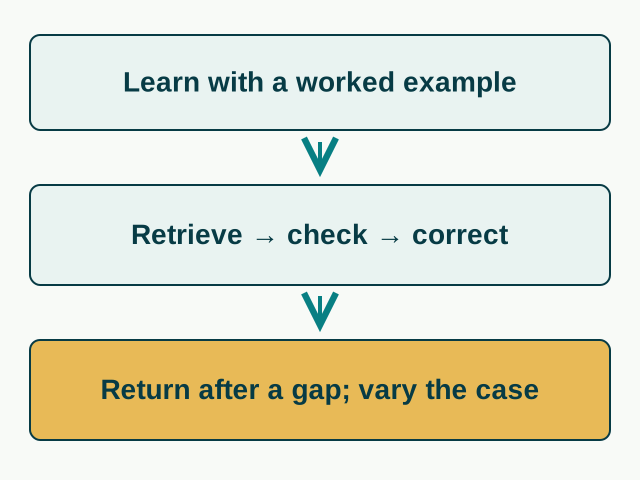
These terms describe different choices. Revisiting the same notes on separate days is spacing. Trying to explain them before opening the notes adds retrieval. Mixing related cases introduces interleaving. A session can include all three.
Suppose your learner can now answer the original ECG question. Bring a different example later and listen to their reasoning. Do they recognise the relevant features, or have they memorised the appearance of one card? That discussion will help you decide what to teach next.
There will also be shifts when nobody has the headspace for a quiz. Pick the moment. If an immediate clinical decision needs a reference or a second opinion, use it; you can return to the educational question once the work is done.
For a teaching programme, the practical change is fairly modest: leave room to revisit earlier material. That means giving up a little of the next session’s new content. Given how much effort went into teaching the earlier material, it seems worth finding out what survived.
The original page by Simon Carley, published on 4 November 2015, pointed readers to Chris Nickson’s LITFL introduction to spaced repetition. It remains part of the further reading for this expanded article.
References and further reading
- Roediger and Karpicke (2006). Test-enhanced learning: taking memory tests improves long-term retention.
- Larsen, Butler and Roediger (2009). Repeated testing improves long-term retention relative to repeated study: a randomised controlled trial.
- Cepeda et al. (2008). Spacing effects in learning: a temporal ridgeline of optimal retention.
- Rohrer and Taylor (2007). The shuffling of mathematics problems improves learning.
Keep exploring
Be a better learner, part 2 · Cognitive load theory · Back to educational theories