
Practice and curriculum design
Getting better with deliberate practice
We do plenty of things repeatedly in emergency medicine. How do we make that repetition improve our work, and where does mastery learning fit?
Original article: Simon Carley · 2015-11-04
Updated 21 October 2026 · 5 min read
Think about something you do regularly at work. Cannulation, referral, explaining a difficult decision. Are you getting better at it? How would you know?
It’s tempting to assume that experience will take care of this. We do the job, accumulate cases and eventually become very good. Sometimes we improve along the way. We can also become quite efficient at repeating the same mistakes.
Deliberate practice asks us to look more closely at how improvement happens. There’s more to it than booking another session or adding another procedure to the logbook.
Three weeks on one note
Simon’s example in the original article came from learning the flute. At thirteen, he went to George Galway, who thought his tone needed work. That meant months concentrating on individual notes, including three weeks on top E. There was feedback, experimentation and plenty of repetition, directed at a difficulty his teacher had identified.
Most of us can see why that might work. Playing a whole piece again would give plenty of practice to the bits that already sounded fine. Stopping at the difficult note creates the opportunity to change it.
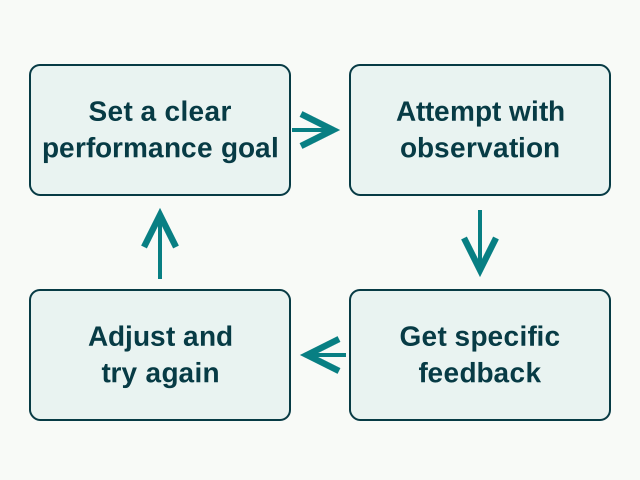
Ericsson’s description of deliberate practice brings those features together: particular tasks chosen to improve performance, feedback, time to evaluate the attempt and opportunities to repeat it. Teachers and coaches help select the work and judge how it’s going. The difficulty should stretch the learner enough to require attention, with guidance that lets them make progress.
And the 10,000-hour rule? It’s an appealingly simple number, but it isn’t a universal threshold at which expertise arrives. Hours tell us very little about what happened during them. Equally, practice isn’t the only influence on someone’s development. Opportunity, support and the particular task all deserve attention.
What are we asking them to change?
Imagine listening to a trainee’s referral. The history is thorough, but you don’t hear their main concern until the end. You say, “Good effort. Try to be more concise.” They nod. The next referral sounds much the same.
What would you ask them to do differently? Perhaps begin with the concern and the help they’re requesting. Demonstrate how that might sound, then let them rehearse it with another case. Listen to the opening. Did it give you the information you needed? What would make it clearer?
There’s enough there for a short conversation and another attempt. We don’t have to rehearse the whole consultation each time. The paired practice cards offer ways to arrange that kind of work with a colleague.
Procedures lend themselves to this too. We can spend time on a difficult part using a task trainer, then put it back into the complete sequence. What happens to that improvement when the equipment changes, or when the learner has to coordinate with another person? Those are things to try as the task becomes more familiar. With a patient, the patient’s needs determine whether another attempt is appropriate; the simulation room gives us much more freedom to stop and repeat.
Where mastery learning comes in
A well-run practice session doesn’t, by itself, make a mastery-learning programme. Mastery learning adds a requirement: learners must demonstrate an agreed standard before progressing. We set the standard in advance and allow the time and support needed to reach it to vary.
In Wayne and colleagues’ resuscitation study, residents practised in simulation and were assessed against minimum passing scores. Those who needed more training received it. Eventually, all reached the specified simulator standards. It was a small, single-centre before-and-after study without a control group, so it tells us more about what the programme achieved than which component produced the improvement.
There are practical consequences. We need to agree what counts as a good enough performance and use an assessment capable of judging it. We also need teaching time for those who haven’t reached it yet. If the timetable only allows everyone exactly the same amount of practice, we’ve made that second part rather difficult.
Extra practice should be expected within the programme. A learner who needs it shouldn’t have to negotiate it as a personal favour, or feel that needing another attempt has exposed some fundamental inadequacy.
Will it make a difference outside simulation?
That’s the question that matters to our patients. Barsuk and colleagues reported fewer needle passes during subsequent central-line insertions among residents who had completed simulation-based mastery training. The comparison wasn’t randomised and the clinical information came from surveys, which limits how confidently we can attribute the difference to training.
A separate observational ICU study reported lower catheter-related bloodstream infection rates after a mastery programme. Encouraging, certainly, although the before-and-after design leaves other explanations in play. It would be a stretch to say that deliberate practice alone caused the change.
For our own teaching, we should look beyond the successful attempt at the end of a session. Arrange to see the skill again, with supervision appropriate to the clinical task. Can the learner still do it later? Can they adapt when the circumstances change? The answers may send us back to practise something we thought we’d finished.
If you’re planning a session, leave enough time for that second attempt after feedback. It’s easy to spend the whole slot explaining what could have been better, then send everyone back to work without a chance to try it.
Originally published by Simon Carley on 4 November 2015. The original further-reading acknowledgements to Cliff Reid and Scott Weingart are retained. Simon returned to the subject in The pursuit of mastery through deliberate practice in 2016.
References and further reading
- Ericsson (2008). Deliberate practice and acquisition of expert performance: a general overview.
- Wayne et al. (2006). Mastery learning of advanced cardiac life support skills by internal medicine residents using simulation technology and deliberate practice.
- Barsuk et al. (2009). Use of simulation-based mastery learning to improve the quality of central venous catheter placement in a medical intensive care unit.
- Barsuk et al. (2009). Use of simulation-based education to reduce catheter-related bloodstream infections.
Keep exploring
The pursuit of mastery through deliberate practice · Paired practice cards · Spacing and retrieval · Back to educational theories