
Social learning theory
Communities of practice
Much of what we learn at work happens between the teaching sessions. Lave and Wenger help us think about how people join in, learn from colleagues and become part of a group.
Original article: Simon Carley · 2015-11-04
Updated 21 October 2026 · 5 min read
How do you learn your way around a new emergency department? Induction will explain some of it. Colleagues will fill in quite a lot more: who can help with an unfamiliar referral, how to get involved in simulation, or where people go to discuss a case that is still bothering them. Some of that knowledge never reaches a slide.
Now imagine joining a department where everyone else seems to know these things already. You attend the formal teaching and work hard on your shifts, but the interesting conversations always seem to be happening somewhere else. Being employed by the same organisation doesn’t necessarily mean that you’ve found your way into its learning community.
What makes a community of practice?
The idea is associated with Jean Lave and Etienne Wenger’s work on situated learning. It asks us to look at learning through participation in shared activities, including how newcomers gradually become more involved. Etienne and Beverly Wenger-Trayner’s introduction describes three things that need to come together:
- A domain: something the members care about and want to understand or do better.
- A community: people who interact and learn together over time.
- A practice: the experience and resources they develop and use in that work.
Think about a group of colleagues trying to improve their simulation debriefing. They discuss sessions, compare approaches and gradually develop resources they can use. The work gives them something to talk about, and the conversations feed back into what they do. Simply putting the same people on a mailing list wouldn’t achieve all of that.
Our original article used the related terms mutual engagement, joint enterprise and shared repertoire. The language differs, but it directs attention to how people work together, negotiate what matters and build things they can share. Some groups grow informally. Others receive time and support from their organisation. Formal support doesn’t disqualify a group from being a community of practice.
Getting beyond the edge of the room
Imagine the student standing just outside the resus team. They’ve been told to watch, but they don’t understand much of the conversation and aren’t sure when they can ask. There may be plenty happening in front of them, yet very little opportunity to join in.
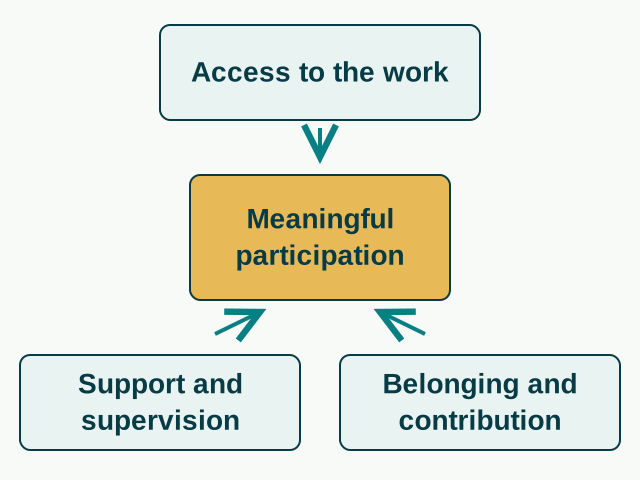
What could we change? Find out what they can already do and give them an appropriate part in the work, with supervision. Explain how that contribution fits. Afterwards, ask what puzzled them and introduce them to someone who can help them follow it up. That creates a route into the conversation which watching from the doorway may never provide.
New staff need routes in too. It’s easy for access to depend on happening to meet a particularly welcoming colleague. We can be more deliberate about introductions, explain the unwritten rules, and invite new members to contribute a question or help review a resource. Some people will become very active. Others will participate occasionally, particularly when rotas or other commitments make regular attendance difficult.
And #FOAMed?
The original article made a strong connection with #FOAMed, and it’s easy to see why. Clinicians discuss shared problems across departments and countries, develop resources, and come back to question them. Those relationships can continue when shift work makes meeting locally difficult.
We should still be specific about which community we mean. Listening to a podcast is a learning activity, but it doesn’t by itself establish a community of practice. A smaller group which repeatedly discusses how an idea works in their own settings may have much more of the shared practice that the term describes.
If you’re trying to encourage a local community, start with something people want to work on. Then make it reasonably easy to meet or exchange ideas. The original article drew on Wenger and colleagues’ advice about allowing a group to evolve, welcoming different levels of participation and establishing a rhythm. A regular discussion that people find helpful is a good start. The new online platform can wait.
Leave room for private conversations as well as public ones, and for people outside the usual group to contribute. In clinical discussions, use approved channels and appropriate anonymisation. A familiar group can make it easy to forget how far an online conversation might travel.
What is the group actually teaching?
Belonging can feel good while the group passes on some fairly questionable habits. When a newcomer asks why something is done a particular way, do we explain it or close the conversation down? Which people never seem to get invited? The department’s learning culture matters here, because participation includes learning what you are allowed to question.
The research doesn’t let us assume that naming a group a community of practice will improve outcomes. Ranmuthugala and colleagues found it difficult to separate the effects of communities from the complex interventions around them. Noar and colleagues’ 2023 review reported encouraging healthcare findings, but most evidence was non-randomised and medical-education studies were excluded. It can’t directly tell us how well our teaching group will work.
We can still ask whether newcomers are finding support, whether criticism changes the resources, and whether members are using what they discuss. It’s also worth talking to the people who stopped attending. They may have a rather different account of the community from those of us who feel at home in it.
References and further reading
- Wenger-Trayner E, Wenger-Trayner B. Communities of practice: a brief introduction. 2015.
- Ranmuthugala G, et al. How and why are communities of practice established in the healthcare sector? A systematic review of the literature. BMC Health Services Research. 2011;11:273.
- Noar AP, Jeffery HE, Subbiah Ponniah H, Jaffer U. The aims and effectiveness of communities of practice in healthcare: a systematic review. PLoS ONE. 2023;18:e0292343.
Keep learning with St Emlyn’s
- Building a learning culture in the ED
- Constructivism and social constructivism
- Back to the educational theories collection
Series history: first published by Simon Carley on 4 November 2015 as part of the St Emlyn’s educational theories collection.