
Motivation theory
Maslow's hierarchy of needs
The learner who turns up to teaching brings a great deal more than a gap in their knowledge. Maslow reminds us to pay attention to the rest.
Original article: Simon Carley · 2015-11-04
Updated 21 October 2026 · 5 min read
Think about the registrar who comes to teaching straight from a night shift. They haven’t eaten, they’re still thinking about a difficult patient and they don’t know most of the people in the room. You may have prepared a fabulous session. Whether they are in a position to get much from it is another question.
This is why Maslow keeps appearing in discussions about education. We can spend hours working on our slides and scarcely any time thinking about the person who is supposed to learn from them. A hierarchy of needs gives us somewhere to start that conversation, although we need to be a little careful about what the hierarchy actually says.
About that pyramid
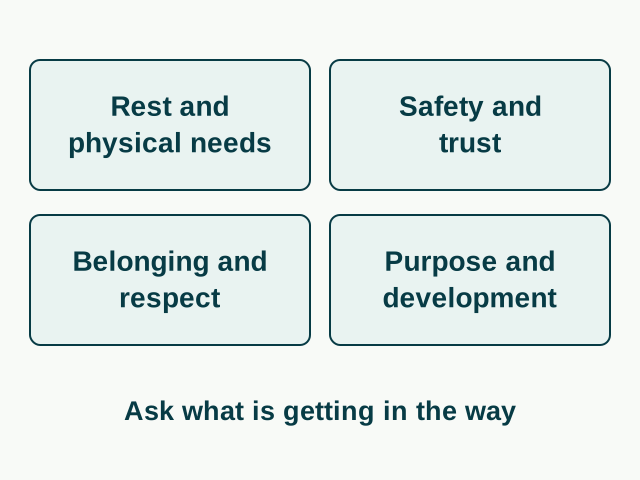
Maslow’s 1943 paper was a theory of human motivation. He described physiological needs, safety, love and belonging, esteem, and self-actualisation. That last term is often the one that loses people: think of it as the desire to develop your abilities and become what you are capable of becoming. Your version of that may look quite different from mine.
The familiar pyramid suggests a tidy progression. Sort out the bottom, climb to the next level, eventually reach the top. Our original article presented it rather too firmly in those terms. Maslow himself allowed for partial satisfaction, overlapping needs and exceptions. He didn’t draw the pyramid in that paper either.
Does being hungry make learning impossible? Clearly we can learn things while hungry. It may, however, make it harder to concentrate on your excellent explanation of acid-base physiology. The sensible educational response is to notice the distraction and do something about it where we can. We don’t need to decide which level someone has reached before offering them a book.
Food, bears and belonging
The practical stuff is easy to overlook. Can people hear? Is there somewhere to sit? Will anyone cover the learner so they can actually attend? If you’ve organised lunchtime teaching, the lunch part deserves some consideration. In the ED, helping someone get a break might do more for their afternoon’s learning than another email about mandatory education.
Safety needs are a little less straightforward. As the original article observed, a bear attack is unlikely during most of our teaching. Being made to feel foolish in front of colleagues is rather more plausible. We can explain why we’re observing a task, ask about reasoning without turning it into an interrogation, and respond reasonably when someone admits they don’t know. There is a wider discussion here about building a learning culture. Psychological safety has its own research tradition; Maslow is an entry into that conversation rather than its entire explanation.
Love and belonging is the part we often abbreviate to belonging. That’s a shame. There is something rather good about an educational theory which asks us to consider whether people feel cared for. Emergency medicine makes this difficult: we work shifts, teams change, and a new colleague can spend weeks surrounded by people without feeling that they belong to any of them.
Introductions help, particularly when they extend beyond name and grade. Find out what the student hopes to do, explain how they can get involved, and remember them when an opportunity comes along. #FOAMed also gives us ways of maintaining relationships across rotas and geography. It can be a place to find people who share an interest that nobody on your current shift happens to share.
Does everyone need a confidence boost?
Esteem includes both how we see ourselves and how we think other people see us. Recognition matters, but telling a learner that everything was brilliant is a poor substitute for paying attention. Explain what they did well. If something needs work, help them understand it. We can respect someone and still have a fairly direct conversation about their performance.
Self-actualisation takes the discussion beyond fixing deficiencies. What does this person want to become good at? Perhaps they have an interest in ultrasound, teaching or communicating with families. There may be room to support that ambition alongside the list of things they must achieve for their placement. It’s a more generous view of education than treating every learner as a collection of missing competencies.
How much weight should we put on it?
Quite a lot as a reminder to look around us; rather less as a universal sequence. Tay and Diener’s study across 123 countries found associations between needs being met and subjective well-being, with individual needs contributing largely independently of whether other needs were fulfilled. That doesn’t fit a simple staircase. It also measured well-being, rather than learning, so it cannot tell us how much better our registrar will understand the teaching after breakfast.
Later versions add cognitive, aesthetic and transcendence needs. They invite interesting conversations about curiosity, the appeal of a well-made resource and helping others develop. Adding more layers doesn’t settle the evidence about the hierarchy, though.
For us as educators, the point is to look beyond our own performance at the front of the room. Ask the learner what would help rather than deciding for them. And if the answer is that nobody ever gets a break or feels able to ask for help, we have some work to do outside the teaching session.
References and further reading
- Maslow AH. A theory of human motivation. Psychological Review. 1943;50:370–396.
- Tay L, Diener E. Needs and subjective well-being around the world. Journal of Personality and Social Psychology. 2011;101:354–365.
Keep learning with St Emlyn’s
- Building a learning culture in the ED
- Teaching and learning in stretched environments
- Back to the educational theories collection
Series history: first published by Simon Carley on 4 November 2015 as part of the St Emlyn’s educational theories collection.