
Family of learning theories
Constructivism and social constructivism
What we teach meets what the learner already believes. Constructivism helps explain why a clear explanation can still leave two people with quite different ideas.
Original article: Simon Carley · 2015-11-04
Updated 21 October 2026 · 5 min read
Imagine a student presenting a patient. They have a confident explanation for what is going on, you explain why you think something else is more likely, and they nod along. A little later you hear them describe the case to someone else. The original explanation is still there, apparently untouched by your contribution.
It’s tempting to conclude that they weren’t listening. Perhaps. But they may have listened carefully and fitted what you said into an understanding quite different from yours. Constructivism asks us to think about that process. Learners come with knowledge and experience already in place, and new information has to find a home somewhere.
We rarely start from nothing
When we encounter a new idea, we interpret it through what we already know. If it fits, the job can be fairly easy. If it contradicts something we’ve relied on for years, there is more work to do. We might change our explanation, decide the new information is an exception, or quietly set it aside. Educators are learners too, so it’s worth remembering that this applies to us.
The original article compared beliefs with buildings. Some are rather flimsy; others have substantial foundations. Telling someone that their concrete building ought to be somewhere else is unlikely to move it. Before we start pushing, it helps to understand how it got there. What experience made the idea convincing? Who taught it? Has it appeared to work repeatedly?
This is more than an attractive metaphor. How People Learn II describes how prior knowledge helps us organise information and reason, but can also introduce bias and lead us to make inappropriate assumptions. Experience gives us something to build on. It doesn’t guarantee that the existing structure is sound.
Find out what they think
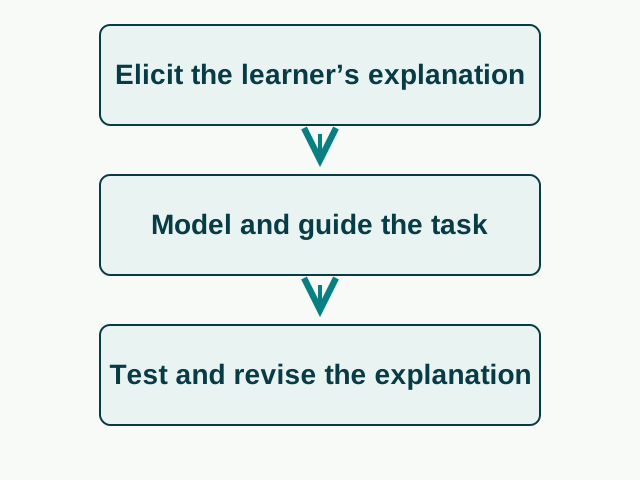
Go back to our student. Before giving the same explanation a little more loudly, try asking how they reached their conclusion. Which part of the history mattered most to them? What did they make of the finding that you thought was important? Give them time to answer. Otherwise we risk conducting both sides of the conversation ourselves.
Perhaps they’ve connected this patient with a memorable previous case. Perhaps a word means something different to them. Perhaps they’ve never encountered the explanation you’re offering. Those are different teaching problems, and another run through the same slides may miss all of them.
Once you understand the difficulty, you can teach to it. Explain the missing concept, show how it changes your interpretation, and invite them to try it with a slightly different case. If they can explain why the idea applies there, you have learnt rather more about their understanding than you would from another nod.
This doesn’t require a long tutorial. In a stretched clinical environment, even a short exchange about one decision can reveal something worth working on. We need to leave enough space for the learner’s account to emerge.
What does the social bit add?
Social constructivism places particular emphasis on how understanding develops through interaction, language and the setting in which we learn. In a case discussion, we hear other people’s explanations and compare them with our own. Someone asks a question we hadn’t considered. A colleague points out an assumption. We go away with an idea that has changed during the conversation.
You can see why this interests those of us involved in #FOAMed. A discussion can bring together clinicians whose everyday practice looks quite different. Something that seems obvious in one department may need quite a lot of explanation elsewhere. That can be uncomfortable, but it gives us a chance to examine what we’ve taken for granted.
Of course, a group can also agree on something wrong. Constructing understanding doesn’t mean that every explanation deserves equal weight. We still need to check the evidence and work out where an argument fails.
So what happens to the teacher?
The original article said that a teacher facilitates rather than dictates. There’s a useful challenge there, but it can be taken too far. Constructivism isn’t an instruction to stop explaining things. A novice may need a clear demonstration before they have much to contribute to a discussion about technique. They are still interpreting that demonstration through what they know.
Cognitive apprenticeship offers a helpful connection. Collins, Brown and Holum describe making the expert’s thinking available to the learner through modelling and coaching, with support gradually withdrawn. When you explain why you sought a particular piece of information, the learner gets access to a part of your work that watching alone might conceal. Ask them to explain their thinking in return and you can begin to see where the two accounts differ.
We can’t put our own understanding directly into someone else’s head, however good the explanation. We can find out what they already think and help them work on it. The next time a learner seems unmoved by something you’ve taught, it may be worth hearing their version before trying yours again.
References and further reading
- National Academies of Sciences, Engineering, and Medicine. How People Learn II. Chapter 5: Knowledge and reasoning. 2018.
- Collins A, Brown JS, Holum A. Cognitive apprenticeship: making thinking visible. American Educator. 1991.
Keep learning with St Emlyn’s
- Teaching and learning in stretched environments
- Communities of practice
- Back to the educational theories collection
Series history: first published by Simon Carley on 4 November 2015 as part of the St Emlyn’s educational theories collection.