
Significant pelvic fractures can cause life-threatening haemorrhage. Recognise that risk early, but don’t assume the pelvis is the only source of bleeding.
Management often requires input from emergency medicine, orthopaedics, surgery, anaesthetics, radiology and interventional radiology. Get senior decision-makers involved early and in the room for these difficult decisions. The flow chart here is a guideline to help decision making, but there will be times when an expert team may deviate from this.
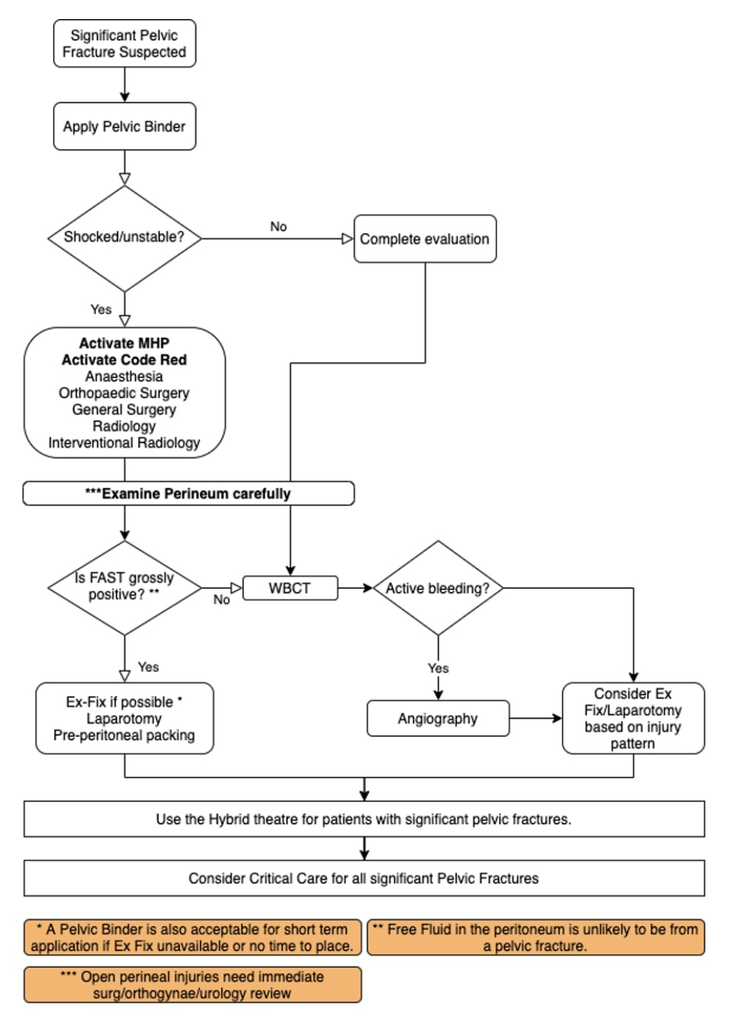
Deciding whether to prioritise interventional radiology, surgical haemorrhage control or external fixation can be challenging. These interventions may be complementary, but different specialties may have different views about the sequence and urgency.
One of your key skills as TTL is supporting those specialist teams to reach a consensus. Make the competing priorities explicit, keep the patient’s immediate needs central and help the team agree a timely, coordinated plan.
Keep the conversation focused: what needs to happen next, where will it happen, and who is making it happen? Agree what you will do if the patient deteriorates or the planned intervention is delayed.
For a patient with ongoing haemorrhage, resuscitation must happen alongside progress towards bleeding control. Don’t let repeated discussions or uncertainty about ownership leave the patient waiting in resus (and slowly bleeding to death. Often the worst possible decision is no-decision or a very delayed one.
Use your local major trauma and pelvic haemorrhage pathways to guide care, adapting the plan to the patient’s physiology, associated injuries and available expertise.
LITFL’s pelvic trauma overview is useful background reading to support that discussion.
