social media

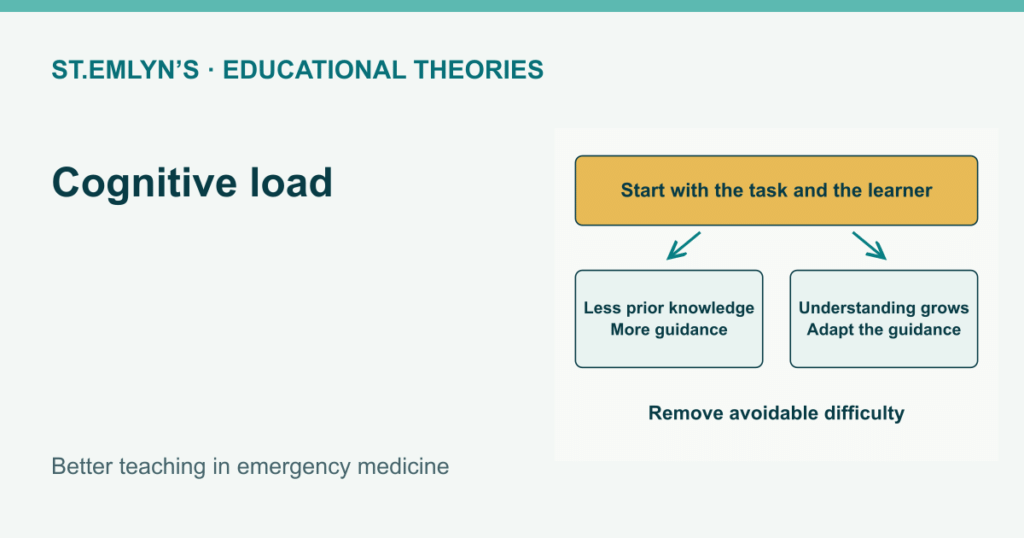
The task and learner lead to two prompts: more guidance when there is less prior knowledge, and adapted guidance as understanding grows.

Cognitive load: why teaching can be hard to follow

How can cognitive load theory help us teach? Nick Smith introduces the relationship between attention, working memory and prior knowledge, then considers its practical implications for presentations and clinical education. The discussion explores reducing unnecessary complexity, managing distractions and using questions and discussion to support learning.

Cognitive load: why teaching can be hard to follow Read More
So Unsexy – Why We Shouldn’t Use The Word Sexy in Clinical Medicine #FIX18

Does describing clinical work as ‘sexy’ matter? In this FemInEM Ideas Exchange 2018 talk, Natalie May challenges the language of medicine through gender stereotypes, colleagues’ experiences and patients’ perspectives. She also reflects on the social media response and how curiosity and respectful conversation can help us reconsider familiar words.

So Unsexy – Why We Shouldn’t Use The Word Sexy in Clinical Medicine #FIX18 Read More

JC: Cricoid Pressure and RSI, do we still need it? St Emlyn’s

Does cricoid pressure still have a place in rapid sequence induction? Simon Carley appraises a large 2018 randomised trial, weighing aspiration outcomes against difficulties with laryngoscopy. He also considers the limits of applying operating-theatre evidence to emergency department patients and groups excluded from the study.

JC: Cricoid Pressure and RSI, do we still need it? St Emlyn’s Read More

Scroll to Top