

In January 2020 I sat the Diploma in Immediate Medical Care (Dip IMC) and thought I would share some of the things I learned along the way and the resources I used. These Dip IMC revision tips are a very personal reflection, and are not endorsed by the Faculty of Pre-Hospital Care in any way. I’ve tried to make the information as accurate as possible, but would always recommend you check the Faculty website for the official guidance.
Jump to the mock questions and PDF downloads
Update: 18 October 2026. You’ll find updated exam details, the corrected NATO alphabet and revised mock questions below, along with newer reading and video resources. I’ve kept my original revision photos too: they’re part of the story, although the notes in them are from 2020. As ever, check the current RCSEd regulations and clinical guidance when preparing for your own sitting.
Introduction
The Diploma in Immediate Medical Care is a postgraduate examination for doctors, nurses and paramedics. It tests prehospital emergency care knowledge, skills and behaviours, with performance expected at Level 6 of the Skills for Health Career Framework.
The exam is usually held twice a year. Check the RCSEd exam calendar for dates and venues. Part A remains a 180-question single best answer (SBA) paper lasting three hours. Part B is an objective structured practical examination (OSPE), normally with 14 stations: twelve lasting eight minutes and two lasting 16 minutes. Under the May 2026 regulations, the parts can be taken in either order or at the same sitting; a pass in one part remains valid for the next three available examination diets.
I sat this exam after some time working in prehospital care with my local air ambulance. Candidates come from medical, nursing and paramedic backgrounds, but should have sufficient prehospital clinical experience to cover the relevant curriculum. Check the current eligibility requirements before applying, including the profession-specific registration and experience requirements.
I hope this post gives you a useful starting point for your own revision. If you’re still deciding whether the exam is for you, the Faculty of Pre-Hospital Care (FPHC) has published an excellent review of both PHEM exams (there is also a Fellowship exam). It’s well worth a read.
Application
My first bit of advice would be to apply early. The Faculty exam page has the application information. Check the RCSEd calendar for current fees and closing dates, and read the regulations and application documents carefully. When I applied, things were fairly quiet after sending off the form. The College team were always utterly delightful on the phone when I did speak to them (I think the accent helps).
What’s in the Exam?
The exam is blueprinted against phase 1(a) or 1(b) of the current UK PHEM curriculum. I found the curriculum really pretty dense and have to admit that, particularly for the SBA, I used the ABC of Prehospital Emergency Medicine as my template for revision. I used the 2013 edition at the time; a second edition was published in 2023. The book helped me organise things, but I’d still use the curriculum to check what you need to cover and current guidance for the clinical detail.
Planning your Dip IMC revision
The ABC of Prehospital Emergency Medicine remains a useful starting point. I’d also make time for the Faculty consensus statements and position statements, checking their dates and any newer guidance. There was at least one OSPE station on a Faculty statement when I sat the exam.
I made a chart of the topics and ensured I’d read (and made notes) on them all. I really did go back to A-Level/Undergraduate type revision with different coloured pens and flash cards!
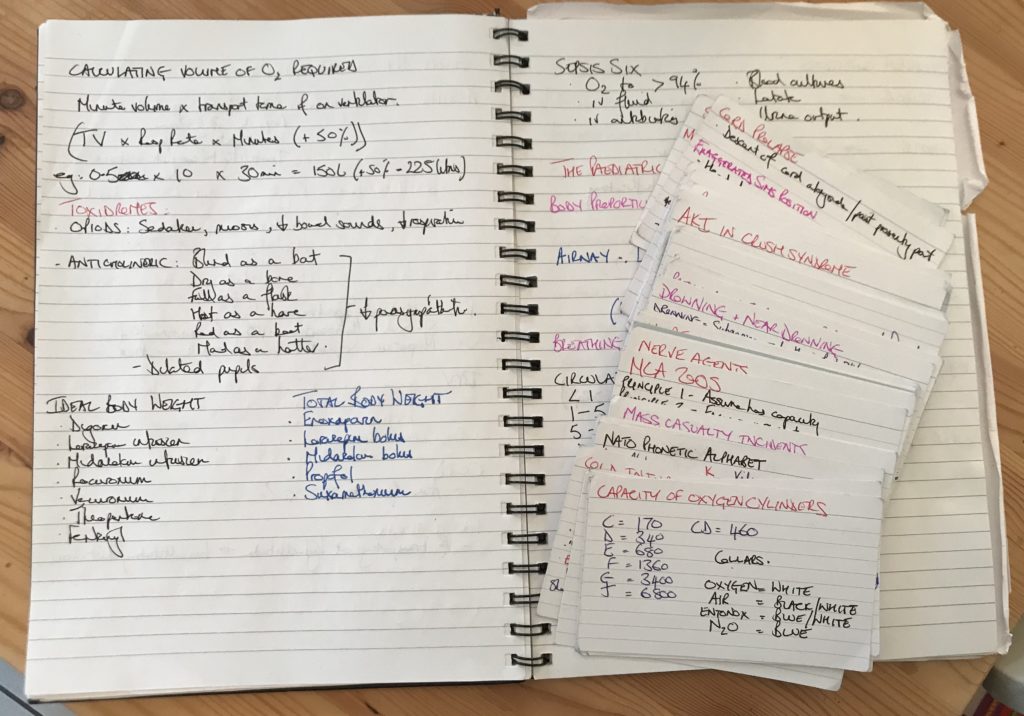
The photos show how I organised things back in 2020. If you like this sort of approach, the updated checklists below should help you make your own plan. One thing I’d suggest is putting the source and review date on each flashcard: it makes it much easier to spot when a favourite note needs updating. For drug doses and weight conventions, use your service’s current formulary; for oxygen supplies, use the specifications of the cylinder and equipment you actually have.

Dip IMC revision checklist
Here’s a checklist to help you get started. Use it alongside the current IBTPHEM curriculum and downloadable syllabus, which the GMC currently lists as the 2022 curriculum. It’s a starting point for organising your reading, rather than an official exam blueprint, so check the diploma requirements and expected level in the RCSEd regulations too.
| Area | Topics to include |
|---|---|
| Systems and scene safety | Activation, dispatch, PPE, dynamic risk assessment, emergency driving and working with other services. |
| Assessment, airway and breathing | Primary survey, airway plans, oxygenation, ventilation, waveform capnography, monitoring and safe escalation. |
| Circulation and resuscitation | Haemorrhage control, shock, vascular access, cardiac arrest and post-resuscitation care. |
| Trauma | Head, neck, chest, abdominal, pelvic and limb injuries; burns; spinal motion restriction; penetrating, ballistic and blast injury. |
| Medical emergencies | Cardiac, respiratory, neurological and metabolic emergencies; sepsis; anaphylaxis; poisoning and toxidromes. |
| Pregnancy, newborns and children | Obstetric emergencies, maternal resuscitation, newborn transition and age-appropriate paediatric assessment and treatment. |
| Environment and rescue | Heat and cold illness, drowning, diving, altitude, suspension, crush injury and extrication. |
| Patient-specific needs | Frailty, bariatric care, disability, mental health, safeguarding and end-of-life decisions. |
| Equipment and medicines | Sandpiper equipment, splints, binders, tourniquets, oxygen supply, device checks, drug calculations and the relevant formulary. |
| Transfer and handover | Packaging, monitoring, transport risks, destination decisions, structured handover and documentation. |
| Major incidents | JESIP, communication, current triage tools, CBRN and mass-gathering planning. |
| Professional and team practice | Human factors, leadership, consent and capacity, ethics, clinical governance, evidence appraisal and debriefing. |
For the SBA I also found writing my own questions (and answers) helped me focus on the type of things that could be asked. You’ll find the revised versions of those questions further down the post.

Faculty statements: updated reading checklist
My old list has needed a few additions! The table below brings it up to date, but keep an eye on the Faculty consensus index and position-statement index as you revise. Some older documents are still listed, so check the date as well as the title.
| Document or topic | Edition or status |
|---|---|
| Penetrating neck injuries | February 2026 |
| Critically ill or injured pregnant patient | November 2025 |
| Crush injury | 2025 |
| Prehospital ultrasound | April 2025 |
| Traumatic cardiac arrest | 2024 position statement |
| Exertional heat illness | November 2024 |
| Extrication following a motor vehicle collision | Read with the 2024 interim cervical-collar statement. |
| Tourniquet application | 2017 statement remains listed; use alongside RCUK 2025 bleeding-control guidance and device instructions. |
| Burns and pelvic fractures | Both are marked under review on the Faculty consensus page. Check for replacement statements and use current clinical guidance and service protocols. |
Operational topics and major incidents
As well as the “usual” medical topics, don’t forget the practicalities of prehospital care, such as emergency response driving. Some of this may be familiar from your day job. Use current legislation, your service’s current driving policy and approved training materials for your revision.
For major incidents, revise JESIP Joint Doctrine and your service’s current plans. In England, the Major Incident Triage Tool (MITT) replaced the triage sieve, triage sort and paediatric triage tape; also understand the role of Ten Second Triage (TST). Use the arrangements applicable to the UK nation and service in which you work.
Radio communication and the NATO alphabet
It’s worth practising the NATO phonetic alphabet out loud, along with clear radio communication for the OSPE. The exact stations vary between sittings, but this is a useful skill to have ready. The corrected alphabet is below, including the official spellings Alfa, Juliett and Whiskey.
| Letter | Code word | Letter | Code word |
|---|---|---|---|
| A | Alfa | N | November |
| B | Bravo | O | Oscar |
| C | Charlie | P | Papa |
| D | Delta | Q | Quebec |
| E | Echo | R | Romeo |
| F | Foxtrot | S | Sierra |
| G | Golf | T | Tango |
| H | Hotel | U | Uniform |
| I | India | V | Victor |
| J | Juliett | W | Whiskey |
| K | Kilo | X | X-ray |
| L | Lima | Y | Yankee |
| M | Mike | Z | Zulu |
FOAMed resources for Dip IMC revision
There are loads of free open access medical education (FOAMed) resources to help with revision. Podcasts are a useful way to fit some learning into your day, and these are two of my favourites. Pick episodes that fit the topics you’re revising, and check the date in case the guidance has moved on.
DipIMC Ninja
Run by a paramedic lecturer at Keele, this free to use site generates questions based on the exam. Some are based on our St Emlyn’s content (so they must be good). Here’s the link.
https://exam.ninja/dipimc
The Resus Room
The Resus Room has plenty to help with emergency and prehospital care, from Roadside to Resus episodes to discussions of recent research. The episodes on the “rarer stuff”, such as drowning, are particularly useful for revision.
Browse The Resus Room podcasts
The Resus Room on MedPod Learn
PHEMCast
PHEMCast goes into depth on prehospital and retrieval medicine, sometimes well beyond diploma level. If you’re doing the exam, though, I think you’ll find plenty that helps put the reading into context.
Browse PHEMCast
PHEMCast on MedPod Learn
You can also find both podcasts on MedPod Learn. Browsing and listening are free in the app. If you’d like to take the learning a bit further, the optional Premium tools add structured notes, self-test questions, reflection and exportable learning records. The podcasts themselves remain freely available.
Dip IMC mock questions and answers
I’ve put together two documents with SBAs below. One contains the questions and the other includes the answers, explanations and references.
PDF versions
Word versions
About these questions
Writing these questions helped me think about what the examiners might ask, and I thought they were worth sharing.
The downloads are the October 2026 revised editions: all 75 questions have been reviewed, with outdated or ambiguous items corrected or replaced within their original topics. The answer document includes explanations and linked sources. You’ll notice the numbering still jumps from 24 to 35, just as it did in the original. Some answer letters have changed, so please use the two matching editions together.
The usual caveats apply: these are revision aids, not official examination papers. Follow current guidance and your service protocols, and use the RCSEd sample SBAs alongside them.
If you’re revising on your phone, the PDFs should be easier to open and read. I’ve kept the Word versions here too, so you can choose whichever works best for you. Both formats contain the same updated questions and answers.
Videos and practical preparation
Videos can be a really useful way to see how something is done before you have a go yourself. The links below are a starting point, but use them alongside current written guidance and supervised practice with the equipment you’ll actually be using.
Capnography: current teaching
Start with the RCoA teaching on sustained exhaled CO₂, including Professor Tim Cook’s 2025 presentation. The College has retired “no trace, wrong place” in favour of the more precise PUMA criteria. If sustained exhaled CO₂ is not demonstrated, actively exclude oesophageal intubation; a small or transient trace is not sufficient reassurance.
For use during cardiac arrest, read the RCUK 2025 ALS guidance on waveform capnography. A rise in end-tidal CO₂ alone is not a reason to interrupt compressions, and a low value alone must not determine when resuscitation stops.
Equipment demonstration videos
Tourniquets: the North American Rescue C-A-T application video provides device-specific instruction. Use it with current RCUK bleeding-control guidance, the supplied instructions and your service protocol.
Pelvic binders: SAM Medical’s Pelvic Sling II training page includes one-person and two-person application videos, an AUTOSTOP buckle demonstration and the instructions for use. These techniques apply to that device; use the relevant manufacturer’s material for other binders.
Make sure you’re familiar with the Sandpiper bag equipment listed by RCSEd and the instructions for your sitting. Get some supervised practice with equipment checks, traction splints, pelvic binders, tourniquets and haemostatic dressings. Watching a demonstration helps, but you need time with the actual kit and its current instructions too.
Even my children got involved in the splint revision back in 2020 (and could put a Kendrick Traction Device on in under two minutes!).
It almost goes without saying that you’ll need to know the current Resuscitation Council UK guidelines and algorithms (2025), including adult, paediatric and newborn resuscitation (yes, newborns too!). Find a helpful Resuscitation Officer at work and ask them to go through them with you.
And one last tip: get into the habit of thinking about scene safety, appropriate PPE and how you’ll call for help at the start of a station. Then respond to the scenario in front of you and ask for the resources you actually need.
Good Luck!
All best,
Iain

Hi,
I am eager to take the exam to learn more about pre-hospital medicine but I am really struggling to get any pre-hospital experience. Having had a look at the application form it suggests I am very unlikely to be accepted to undergo the diploma. I was just wondering if you can advise how much pre-hospital experience is necessary? I would really appreciate your opinion.
Thanks
Pete
Pingback: March Podcast Round Up • St Emlyn's
While this might be too late for you, it might be of interest to others. You do not require pre-hospital experience to sit the DipIMC.
The other thing I’d add to useful documents to read and learn was this: https://naru.org.uk/wp-content/uploads/2019/06/NARU-COMMAND-AND-CONTROL-GUIDE-V3.0-03.2019-WEB-210619.pdf
Hi Iain,
Thank you for producing an excellent blog post detailing your experience with the DIMC. I am a paramedic currently studying for the January 2022 diet and this page has been a saviour for knowing where to start my prep!
I hope you don’t mind me asking a question, I am struggling to find the answer to a question regarding the landing site for HEMS aircraft and I think the “ABC” definition may be outdated as it does not match the FIMC sample paper answer on the College website.
As a HEMS physician and recent DIMC graduate, would you class D = “the maximum length of the aircraft with rotor blades turning” in the D2 equation?
I always thought that D stands for the diameter of the rotors which I thought also meant disc but a bit of digging brought up this article which says “We require an area that has a minimum ‘2D’ during daylight, where D is the distance from the tail to the front of the rotor disc, about 14m for the H145.”
https://www.pilotweb.aero/flying/day-in-the-life-of-air-ambulance-pilot-8113788
Hope that’s helpful. (Was good for me to clarify this too)
I hope the St Emlyn’s team won’t mind but I’ve put together my experience of doing the DipIMC here to try to add to the fantastic work done by Iain Beardsell above.
https://twitter.com/EBezant/status/1506653889004777478?s=20&t=JtgDlBFK-SC4-unNKq56kA
Really good tips Ed! Congratulations!
The nato phonetic alphabet chart is wrong.
Hi Rowan, Thanks for pointing that out! I’ve also been through and made sure the whole post is up to date and appriopriate. Good luck with the exam!. Iain