Featured

JC: Getting Chilly Quickly 4. Doing It For The Kids

Does therapeutic hypothermia improve outcomes after cardiac arrest in children? This 2015 journal club examines a trial comparing cooling with active temperature control after out-of-hospital arrest, exploring neurological outcomes, confidence intervals, study limitations and why a non-significant result does not establish that two treatments are equivalent.

JC: Getting Chilly Quickly 4. Doing It For The Kids Read More
Neurocritical care in Manchester NASGBI and St.Emlyn’s

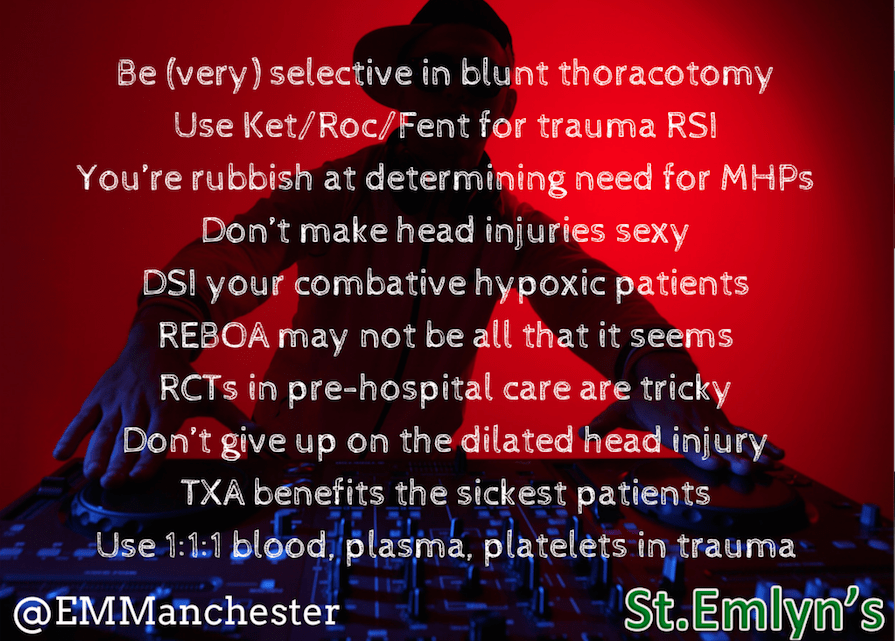
Highlights from the 2015 neuroanaesthesia and critical care meeting in Manchester, with a focus on collaboration around traumatic brain injury. Dan Horner reflects on variation in practice, fatigue and situational awareness, specialist intensive care, tracheostomy safety and communication with patients who experience awareness during anaesthesia.

Neurocritical care in Manchester NASGBI and St.Emlyn’s Read More

JC: Are typical chest pain symptoms predictive of outcome? St.Emlyn’s

How much does describing chest pain as ‘typical’ tell us about the final diagnosis? Simon Carley reviews a 2015 observational study of clinician judgement, questioning the value of experience alone and examining how patient selection, specificity and the presentation of diagnostic performance affect interpretation.

JC: Are typical chest pain symptoms predictive of outcome? St.Emlyn’s Read More

JC: One Benzo Fits All? Lorazepam vs Diazepam for Paediatric Status Epilepticus

This 2015 journal club examines a trial comparing intravenous lorazepam and diazepam for children with convulsive status epilepticus. Alongside seizure control and adverse effects, the appraisal explores blinding, per-protocol analysis and why failing to demonstrate superiority does not prove that the treatments are equivalent.

JC: One Benzo Fits All? Lorazepam vs Diazepam for Paediatric Status Epilepticus Read More

The Art of War

What might emergency clinicians learn from Sun Tzu’s The Art of War? This reflective essay applies ideas about preparation, self-awareness, teamwork and adaptability to the pressures of emergency care, treating organisational challenges as the adversary and explicitly rejecting the idea that patients are enemies.

The Art of War Read More

Scroll to Top