CC23

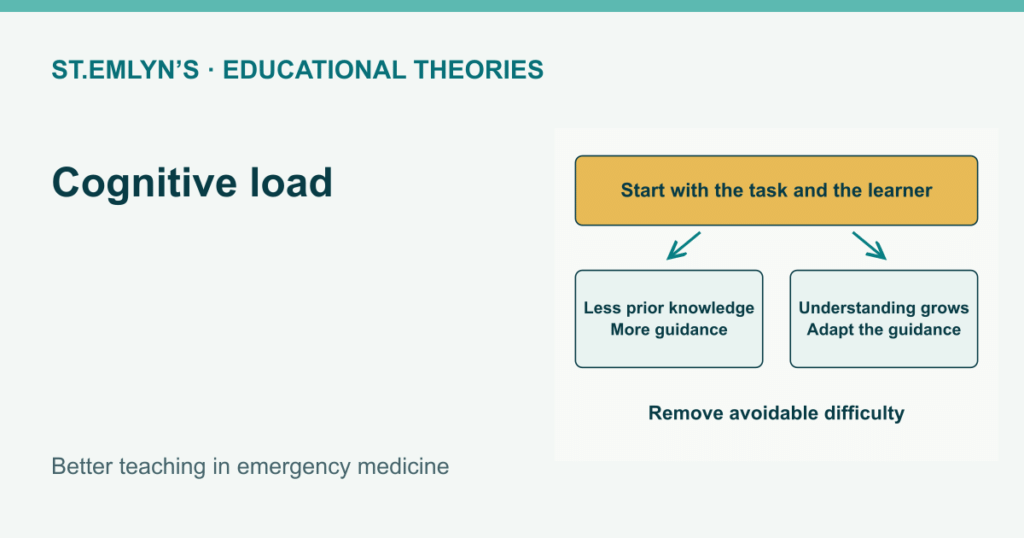
The task and learner lead to two prompts: more guidance when there is less prior knowledge, and adapted guidance as understanding grows.

Cognitive load: why teaching can be hard to follow

How can cognitive load theory help us teach? Nick Smith introduces the relationship between attention, working memory and prior knowledge, then considers its practical implications for presentations and clinical education. The discussion explores reducing unnecessary complexity, managing distractions and using questions and discussion to support learning.

Cognitive load: why teaching can be hard to follow Read More
JC: Cricoid Pressure and RSI, do we still need it? St Emlyn’s

Does cricoid pressure still have a place in rapid sequence induction? Simon Carley appraises a large 2018 randomised trial, weighing aspiration outcomes against difficulties with laryngoscopy. He also considers the limits of applying operating-theatre evidence to emergency department patients and groups excluded from the study.

JC: Cricoid Pressure and RSI, do we still need it? St Emlyn’s Read More

Teaching and Learning in Stretched environments. RSM 2018. St Emlyn’s

How can teaching fit into a busy emergency department? Simon Carley’s 2018 RSM presentation explores ways to make learning part of clinical work, including Post-it pearls, tailored FOAMed resources and structured hot debriefs. The emphasis is on preparation and practical approaches that need little time or money.

Teaching and Learning in Stretched environments. RSM 2018. St Emlyn’s Read More

St Emlyn's Cliff Reid Simulated patient

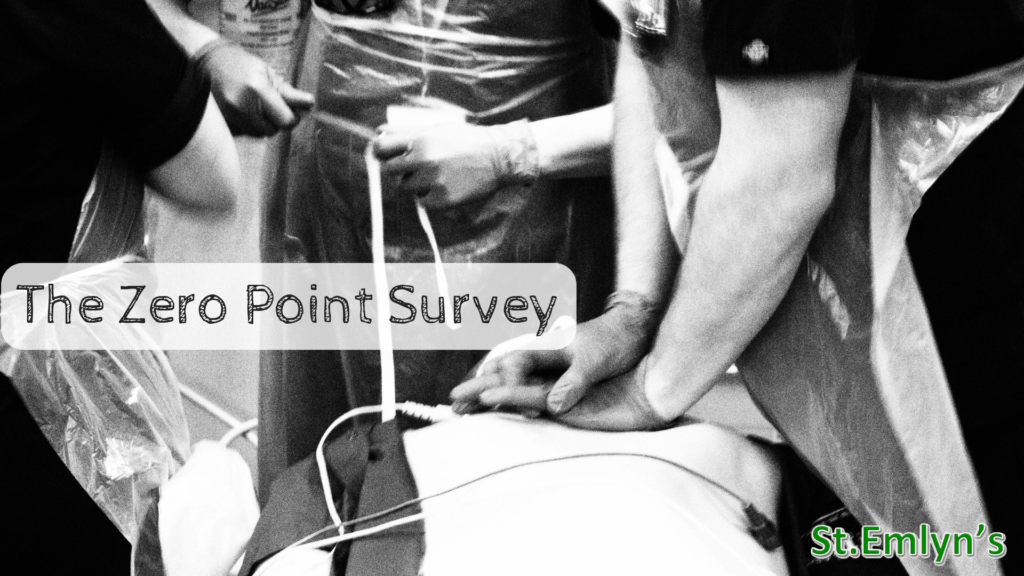
JC: The Zero Point Survey. Optimising resuscitation teams in the ED. St Emlyn’s

Resuscitation begins before the patient arrives. Simon Carley introduces the Zero Point Survey and its focus on the clinician, team and environment, explaining how shared preparation and mental models can be practised in simulation. He also reflects on role allocation and integrating the approach into everyday resuscitation training.

JC: The Zero Point Survey. Optimising resuscitation teams in the ED. St Emlyn’s Read More

Using narrative learning and story telling in Emergency Medicine. St Emlyn’s

Why do clinical stories help learning stick? Simon Carley explores narrative learning in emergency medicine, from patient perspectives and the hidden curriculum to digital teaching. He considers confidentiality, the risks of reinforcing professional stereotypes and practical ways to build purposeful stories around evidence and learning goals.

Using narrative learning and story telling in Emergency Medicine. St Emlyn’s Read More

Podcast – Moral Injury in Emergency and Pre-hospital care with Esther Murray

Psychologist Esther Murray joins the St Emlyn’s podcast to explore moral injury in emergency and prehospital care. The accompanying notes discuss research into medical students’ prehospital experiences and the psychological impact of witnessing traumatic events, while recognising the limits of the small study that prompted the conversation.

Podcast – Moral Injury in Emergency and Pre-hospital care with Esther Murray Read More

Scroll to Top