
Reference: Nehme Z, Mahony E, Nehme E, et al. A randomised controlled trial of defibrillation with manual pressure augmentation during out-of-hospital cardiac arrest. Resuscitation. 2026.
Background
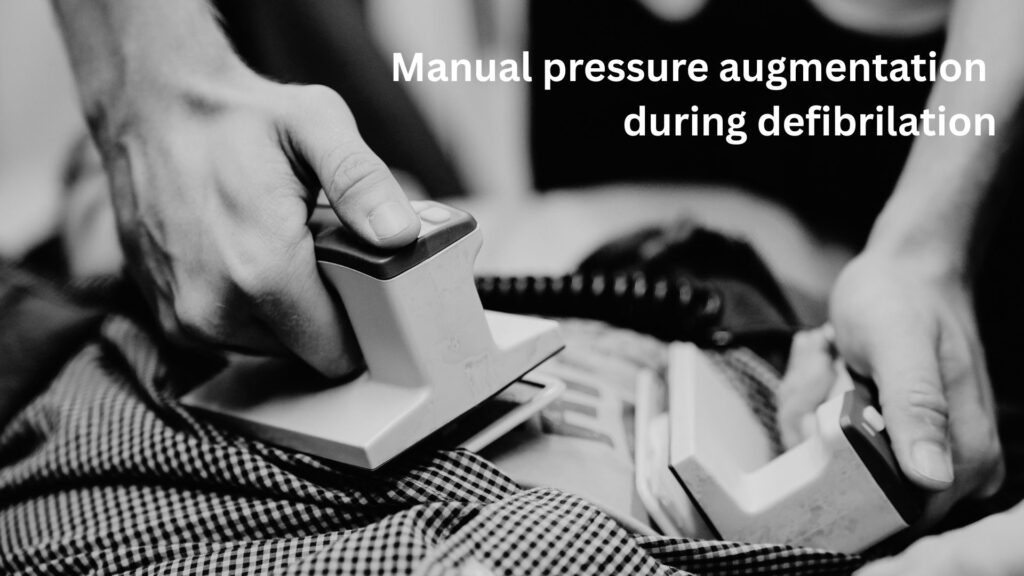
Manual Pressure augmentation – basically pressing down on the pads when you defibrillate makes physiological sense. By applying firm pressure over the defibrillation pads during shock delivery, transthoracic impedance should fall, allowing more current to pass through the myocardium. More current should increase the chance of successful defibrillation, and that ought to improve patient outcomes. It’s an attractive idea, particularly in patients with high impedance or obesity where successful defibrillation can be challenging. It also fits with how I originally defibrillated with hand held paddles, and jelly applied to the chest. it was a [pretty cool technique, but there were issues (see below).
Regular readers may remember that Emma Carley and I explored this topic in a BestBET a few years ago. At that stage the evidence consisted largely of physiological studies, case reports and small observational series. Our conclusion was that MPA appeared biologically plausible and probably reduced transthoracic impedance, but there simply wasn’t enough evidence to recommend routine use during cardiac arrest. This trial represents the first high-quality attempt to answer that question.
Abstract
Aim
To determine whether defibrillation with manual pressure augmentation (MPA) reduces transthoracic impedance and improves cardioversion and survival from initially shockable out-of-hospital cardiac arrest (OHCA) compared with standard defibrillation.
Methods
Investigator-initiated, open-label, two-arm, cluster-randomised controlled trial across 216 ambulance stations in Victoria, Australia (April 1, 2022–January 31, 2023). Adults (≥18 years) with OHCA and a shockable rhythm receiving an attempted resuscitation were eligible. Intervention clusters applied MPA during shock delivery using a choreographed sequence and safety protocols; control clusters performed standard defibrillation. All shocks were biphasic at 200 J with anterior–lateral pad position. Primary outcome was survival to hospital discharge.
Results
The intention-to-treat (ITT) population included 560 patients, (intervention, n = 279; control, n = 281). Survival to hospital discharge was 39.8% (111/279) in the intervention group vs 39.9% (112/281) in the control (absolute risk difference [AR] −0.1% [95% CI −8.2%, 8.0%]; adjusted odds ratio [AOR] 1.00 [95% CI 0.71, 1.40]; p = 0.99). Twelve‑month survival, favourable neurologic outcome, and quality of life were similar between groups. Transthoracic impedance was significantly reduced with MPA (AR −8.5 O [95% CI −12.9, −4.1]; p < 0.001), and larger in per‑protocol analyses (AR −15.0 O [95% CI −22.8, −7.2]; p < 0.001). Compliance with MPA was low (23.6%). Perceptible shocks were uncommon and comparable across groups (0.75 vs 0.71 per 1000 shocks delivered); no serious injuries occurred. The trial was prematurely terminated due to external safety reviews and operational delays, without outcome unblinding at the time of termination.
Conclusions
In this prematurely terminated RCT, MPA reduced transthoracic impedance but did not improve survival or other clinical outcomes in initially shockable OHCA.
What did they actually do?
The AUGMENT-VA investigators conducted a pragmatic, cluster-randomised controlled trial across 216 ambulance stations in Victoria, Australia. Adult patients with an out-of-hospital cardiac arrest due to an initial shockable rhythm (VF/pVT) were eligible provided resuscitation was attempted. Ambulance stations, rather than individual patients, were randomised to either standard defibrillation or manual pressure augmentation, with paramedics trained to apply approximately 10–15 kg of downward pressure over the defibrillation pads during shock delivery using a carefully choreographed safety protocol. All patients received standard biphasic shocks at 200 J using an anterior-lateral pad position. The primary outcome was survival to hospital discharge, with secondary outcomes including ROSC, neurological recovery, quality of life and transthoracic impedance.
Randomising ambulance stations avoided delays during resuscitation while allowing the intervention to be tested in real-world practice rather than under ideal laboratory conditions.
Tell me about the patients
A total of 560 patients were included in the intention-to-treat analysis, with 279 allocated to MPA and 281 to standard defibrillation. The median age was 64 years, almost 80% were male and the overwhelming majority had a presumed cardiac cause for their arrest. More than 80% of arrests were witnessed and bystander CPR rates were higher than we see in the UK. Median ambulance response times were around eight and a half minutes, with similar prehospital management across both groups. This is therefore a relatively favourable cohort of patients with shockable cardiac arrest. As with many Australian cardiac arrest studies, the baseline survival rates are higher than many services would expect, reflecting well-developed systems of care and excellent bystander response.
What were the measured outcomes?
The primary outcome was survival to hospital discharge. Secondary outcomes included survival and neurological recovery at 12 months, quality of life, ROSC, successful termination of ventricular fibrillation after the first shock, transthoracic impedance, CPR quality metrics and safety outcomes for both patients and rescuers. I like this choice of outcomes. The physiological measurements help us understand how the intervention works, but the primary endpoint remains something that matters to patients. As always prefer the neuro outcome at 6/12 for cardiac arrest studies or longer as we see here.
What are the main results?
Manual pressure augmentation did not improve survival. Survival to hospital discharge was virtually identical:
- MPA: 39.8%
- Standard defibrillation: 39.9%
There were no meaningful differences in ROSC, neurological outcome or 12-month survival. The really interesting thing is that the intervention appears to have achieved its intended physiological effect. Transthoracic impedance fell significantly in the intervention group, and the reduction was even greater in patients who actually received the intervention according to protocol. So the technique works, but that does not translate into more survivors.
ROSC and VF termination is worth a closer look as if anything were to change it would be these two elements. however, the differences in the per-protocol analysis are minimal and not significant. Interestingly the authors state that in the per-protocol group the differences were bigger (we don’t know how much, but stated that it was still not clinically or statistically significant)
- VF/VT termination after first shock 55.7% vs. 58.2%
- ROSC after first shock 24.6% vs. 25.5%
What does this paper add to the literature?
Until now, much of the enthusiasm for MPA has come from studies in elective cardioversion, animal models and observational work, and I’ll admit that I foudn the idea really interesting. However, although past studies consistently demonstrated reductions in transthoracic impedance and improvements in delivered current, that’s not the same as clinical practice and it was certainly not routinely used by myself or colleagues. This trial (AUGMENT-VA) confirms that it works physiologically as MPA lowers transthoracic impedance exactly as predicted, but that important outcomes don’t change. We see this a lot in medicine, and it’s why it’s so important that trials use patient centred outcomes.
What do I think about this paper?
Whilst this paper shows that reducing transthoracic impedance increases delivered current. The problem may be that successful defibrillation depends on much more than current delivery. Myocardial ischaemia, coronary perfusion, metabolic derangement, CPR quality, pad position, timing and the underlying arrhythmogenic substrate all contribute. Improving one component of that system may simply not be enough to alter the final outcome. Add in DSD and it gets even more complex.
The authors also deserve credit for being refreshingly honest about the limitations of their work. The trial was stopped early following operational delays and workplace safety reviews, leaving it underpowered for its planned sample size. Compliance with the intervention was also poor, with fewer than one quarter of patients receiving MPA according to protocol (and they do allude to doing a per-protocol analysis too). Compliance was clearly a huge issue, but perhaps not surprising as holding the pads on a live defib is something that we’ve been told not to do for years. Early trial pauses, negative media coverage and the practical realities of introducing a new intervention into an already cognitively demanding resuscitation all reduced adherence.
So some of the failure may be real, and some may be compliance.
Should we change practice?
Probably not, although I suspect most clinicians weren’t routinely using manual pressure augmentation before this study. The trial doesn’t support introducing MPA into standard cardiac arrest algorithms. At the same time, I don’t think it completely closes the door. The authors themselves suggest that future work might focus on patients with particularly high transthoracic impedance, obesity or refractory ventricular fibrillation, where the physiological benefit may be greater.
Bottom line
Manual pressure augmentation does exactly what it was designed to do. It reduces transthoracic impedance and increases delivered current during defibrillation. Unfortunately, that physiological improvement did not translate into better survival, neurological recovery or any other patient-centred outcome in this trial.
References and further reading
- Magliocca A, Merigo G, et al. Effect of manual pressure augmentation on transthoracic impedance: a real-time measurement during ventricular fibrillation in pigs and in healthy human volunteers. Resuscitation. 2025;215:110730.
- Nehme Z, Mahony E, Nehme E, et al. A randomised controlled trial of defibrillation with manual pressure augmentation during out-of-hospital cardiac arrest. Resuscitation. 2026;224:111121. doi:10.1016/j.resuscitation.2026.111121. PubMed
- Carley E, Carley S. Manual pressure augmentation to enhance defibrillation in cardiac arrest. Emergency Medicine Journal. 2025;42:553. doi:10.1136/emermed-2025-215019. (BestBET review) PubMed
- Soar J, Lott C, Olasveengen TM, et al. European Resuscitation Council Guidelines 2025: Adult Advanced Life Support. Resuscitation. 2025. (Section on manual pressure augmentation and defibrillation.) rescuecouncil.com
- Ferreira D, Mikhail P, Lim J, et al. Manual Chest PRESSURE During Direct Current Cardioversion for Atrial Fibrillation: A Randomized Control Trial (PRESSURE-AF). JACC: Clinical Electrophysiology. 2024;10:2207–2213. doi:10.1016/j.jacep.2024.05.037. PubMed
