
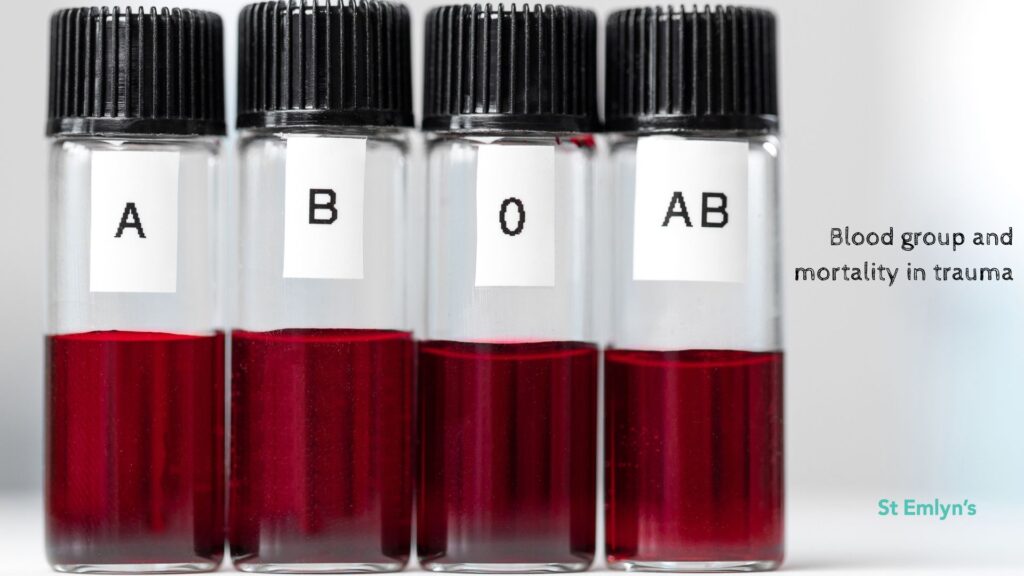
There are many things that we consider when assessing the likely outcome of a patient following major trauma. Age, physiology, anatomical injury, comorbidities and the presence of traumatic brain injury are all familiar to us, but I was surprised to see a paper this week suggesting that blood group may also be a factor. Obviously blood groups are an important issue in resuscitation and wherever possible we try and give cross matched blood. However, in major trauma we frequently give O+ or O- blood without knowing the patient’s blood group. Whilst this is standard practice it is not without risk.
This week we have a paper from colleagues in Cambridge, published this month in Injury, suggesting that the patient’s blood group may also influence prognosis.
As always, we would encourage you to read the original paper, which is open access. The abstract is below.
Background
ABO and RhD antigens are expressed on the surface of red blood cells; ABO antigens are also expressed on the surface of endothelial and some epithelial cells. Associations between ABO blood groups and disease have been reported in numerous areas of medicine (e.g. some cancers). Recently there have been conflicting reports of an association between blood group O and mortality following trauma, none of which examine a combination of ABO and RhD groups. The aim of our study was to identify associations between all ABO RhD groups and trauma mortality.
Methods
A retrospective analysis of trauma patients ≥ 16-years-old admitted to the East of England Major Trauma Centre, and who were included in the Trauma, Audit, & Research Network (TARN) database, 2016–2019. The primary outcome was a comparison of 30-day all-cause mortality between all eight ABO RhD groups. Secondary outcomes included injury pattern analysis on outcome.
Results
4188 patients were included; median age 59.3 [IQR 39.0–77.9] years old, and 2634 (62.9%) were male. The median injury severity score was 19.0 [10.0–25.0]. 30-day mortality was 9.3%, and there were significant differences in mortality across groups (p = 0.0094). O negative was associated with greater 30-day mortality compared to all other seven ABO RhD groups combined: 15.1% vs 8.8%; relative risk (RR) 1.7 (95%CI 1.3–2.2), p = 0.0002.
Conclusions
In this UK study we have demonstrated that blood group O negative is associated with a greater risk of 30-day all-cause mortality in undifferentiated trauma patients. Future trauma studies should consider including ABO RhD blood group as a baseline characteristic to ensure this does not confound results.
Is this biologically plausible?
You will all be familiar with ABO and Rhesus blood group systems from medical school in the context of transfusion medicine, but the biology is rather more interesting than simple matching. ABO antigens are also expressed on endothelial and some epithelial cells, and there are well-described associations between blood groups and a range of diseases, including cardiovascular disease, thromboembolism and gastrointestinal haemorrhage. In trauma, the observation that people with blood group O tend to have lower circulating levels of von Willebrand factor (vWF) and factor VIII is known. There are also differences in the interaction between platelets and vWF that might influence haemostasis.
So there are plausible effects that might influence outcome. Given what we know about the importance of haemorrhage and trauma-induced coagulopathy, it is not unreasonable to hypothesise that blood group might influence outcomes following injury. Previous studies have been conflicting and not necessarilly looking at both ABO and Rhesus components. In this study they have looked at the combination of these against mortality.
What did the authors do?
This was a retrospective observational study of adult trauma patients presenting to the East of England Major Trauma Centre between 2016 and 2019. Patients were identified through the Trauma Audit and Research Network (TARN) database, with additional information obtained from the hospital’s electronic patient record.
The primary outcome was a reasonable one; 30-day all-cause mortality, with secondary analyses looking at a range of clinical variables, including injury severity, coagulation parameters and patterns of injury.
Of 4530 potentially eligible patients, 4188 were included in the analysis. The median age was 59 years, the median Injury Severity Score (ISS) was 19 (so pretty sick), and roughly two-thirds of patients had an ISS greater than 15. So a decent sized cohort of injured patients and one that would be similar to those we see in Virchester
What did they find?
The overall mortality at 30 days was 9.3%, but there were differences between blood groups as shown below. Those patients with O-negative blood appear to be different.
| Blood group | Patients | 30-day mortality |
|---|---|---|
| A positive | 1416 | 9.3% |
| A negative | 301 | 6.6% |
| B positive | 335 | 9.0% |
| B negative | 64 | 6.2% |
| AB positive | 124 | 8.9% |
| AB negative | 13 | 15.4% |
| O positive | 1564 | 8.8% |
| O negative | 371 | 15.1% |
When patients with O-negative blood were compared with all other blood groups combined, mortality was 15.1% compared with 8.8%, giving a relative risk of 1.7 (95% CI 1.3–2.2). That’s an absolute difference in mortality of 6.3 percentage points, or a number need to harm of 15.9 which if true would be a very significant effect.
The authors also performed a logistic regression model that included age, sex, shock, injury severity and secondary transfer status, with an adjusted odds ratio of 1.91 (95% CI 1.39–2.63), so if anything even more of an effect. As the table shows above, the effect is really amongst the O- patients. O+ patients do not have the same association.
Is it all about bleeding?
Interestingly, they found the biggest effect amongst patients with head injury. This did not really suprise me as we have seen similar signals in PAMPER, iTacTIC and other papers looking at blood products in major trauma. None have been definitive but we keep seeing that head injured patients behave differently to blood product resuscitation (and perhaps more so than others). Why this may be is uncertain, but effects on the glycocalyx have been suggested as a possible mechanism. The authors also discuss the possibility that microvascular bleeding following traumatic brain injury might contribute to poorer outcomes, potentially through mechanisms that are not readily apparent on conventional CT imaging.
In patients with significant isolated head injury, mortality was 21.6% in the O-negative group compared with 11.3% in the other blood groups. In those with significant head and torso injuries, the figures were 43.6% and 20.0% respectively. There was also a difference in patients with torso injuries alone, although this was not statistically significant.
There were no statistically significant differences in routine coagulation tests (PT and aPTT) between the groups, but we should be cautious about interpreting that as evidence as coagulation is far more complex than that. Neither test tells us very much about platelet function, clot strength, fibrinolysis or the complex interactions between the endothelium and the coagulation system that occur following major trauma. It would have been great to see TEG/ROTEM data but it was not available for all.
All of these ideas are hypotheses and history reminds us that observational data is often contradicted in trials, so let’s hope that we see some of those in development soon (I’ve been advocating for a trial in head injured patients of FFP/coagulation factors for years).
What is unclear is why this appears to be specific to O-negative patients. The biological rationale for differences between ABO groups is reasonably well established, but the mechanism by which Rhesus D status might modify that association is much less clear. Also, in trauma it’s O- that we give to the patients in the early phases of resuscitation, so if anything you’d think the match would be better?
How much should we believe this?
I think we need to consider this study really interesting, but only hypothesis generating. It is a retrospective observational study from a single centre, and there are a number of reasons to be cautious. There are positives though, for example the use of a relatively large UK trauma cohort and a patient-orientated outcome. The authors have also taken account of the problem of multiple statistical comparisons, which is important when comparing eight different blood groups.
Roughly 7.5% of potentially eligible patients had no recorded blood group and were therefore excluded. These patients were not necessarily similar to those included in the study, being older and more likely to have head or chest injuries. We don’t know what effect their exclusion might have had on the results.
We also lack information on a number of potentially important variables, including anticoagulant and antiplatelet medication, transfusion, tranexamic acid administration and ethnicity. Although blood group is an inherited characteristic, that does not make this equivalent to a randomised study. Blood group distributions vary between populations, and there may be other genetic, demographic or clinical factors associated with outcome.
From an EBM perspective we need to remember that when we divide a population into multiple groups, identify an interesting association and then explore that association further, we really need to see whether it can be reproduced in an independent population. Statistical adjustment and correction for multiple comparisons help, but they are not a substitute for external validation.
In summary – great hypothesis generation, but can we see this repeated in another population? (someone reading this please do that).
What does this mean for trauma research?
If, and it’s a big if, this association is shown in other studies then we would need to include ABO/Rhesus variables in future transfusion studies (and perhaps even retrospectively to past trials). However we are not there yet. Given that blood group is routinely established in many of our major trauma patients, there may be relatively little additional work involved in collecting these data in future studies.
Will this change my practice?
Whether O-negative blood group really is an independent risk factor for poor outcome following trauma remains to be established so no, not at this time as it’s an unproven association and realistically I can’t do anything about it. However, it’s a good reminder that there is potentially interesting research projects in routinely collected data. I think there is a reasonable rationale for collecting ABO and Rhesus D blood group data in future trauma studies and for exploring this association in existing datasets.
vb
S
References
- Li J, Bell R, Basheer B, Boyle A, Barnard E, Bowman J, Barrett L. The association of ABO Rh blood groups with 30-day mortality following traumatic injury – A retrospective observational study in the East of England. Injury. 2026. doi:10.1016/j.injury.2026.113856.
- Lubkin DT, Gent JV, Cotton BA, Brill JB. Mortality and outcomes by blood group in trauma patients: a systematic review and meta-analysis. Vox Sanguinis. 2023;118:421–429. doi:10.1111/vox.13427.
- Takayama W, et al. The impact of blood type O on mortality of severe trauma patients: a retrospective observational study. Critical Care. 2018;22:100. doi:10.1186/s13054-018-2022-0.
- Esnault P, et al. ABO blood type and functional neurological outcome in patients with severe traumatic brain injury. Journal of Trauma and Acute Care Surgery. 2023;95:737–745. doi:10.1097/TA.0000000000004041.
- Dunne E, et al. Blood group alters platelet binding kinetics to von Willebrand factor and consequently platelet function. Blood. 2019;133:1371–1377. doi:10.1182/blood-2018-06-853408.
- Simon Carley, “JC: Early plasma use in traumatic brain injury. St Emlyn’s,” in St.Emlyn’s, October 30, 2020, https://www.stemlynsblog.org/jc-early-plasma-use-in-traumatic-brain-injury-st-emlyns/.
- Association of Prehospital Plasma With Survival in Patients With Traumatic Brain Injury https://www.ncbi.nlm.nih.gov/pmc/articles/PMC7563075/
- Sperry JL, Guyette FX, Brown JB, et al. ; PAMPer Study Group . Prehospital plasma during air medical transport in trauma patients at risk for hemorrhagic shock https://pubmed.ncbi.nlm.nih.gov/30044935/
- Dan Horner, “CRYOSTAT-2 @ St Emlyns,” in St.Emlyn’s, October 18, 2023, https://www.stemlynsblog.org/cryostat-2-st-emlyns/.
- Association of Prehospital Plasma With Survival in Patients With Traumatic Brain Injury https://www.ncbi.nlm.nih.gov/pmc/articles/PMC7563075/
- Natalie May, “JC: Blood Products in Trauma – What’s the Best (I)TACTIC?,” in St.Emlyn’s, October 22, 2020, https://www.stemlynsblog.org/jc-blood-products-in-trauma-whats-the-best-itactic/.
