
Instructional design theory
Cognitive load: why teaching can be hard to follow
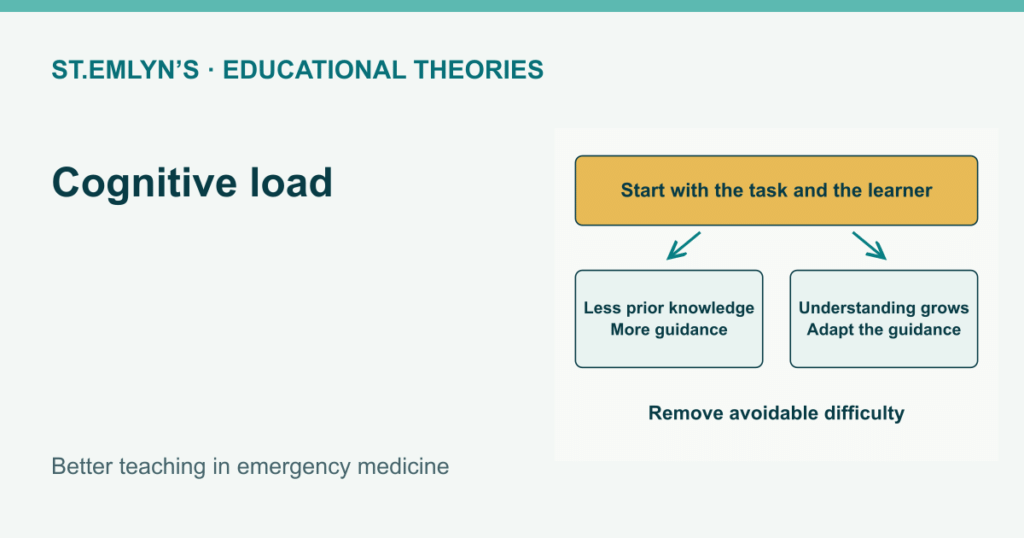
What is the learner trying to think about, and what else are we asking them to do at the same time?
Original article: Nick Smith · 2018-11-14
Updated 21 October 2026 · 5 min read
“Sorry, this is a busy slide.” It’s an odd introduction to something we’re hoping people will understand. The apology acknowledges the problem, then we carry on and ask the audience to solve it.
The same thing happens away from the lecture theatre. Imagine trying to follow an explanation of an unfamiliar ECG while finding the trace on a computer and working out what the abbreviations mean. The educator may be explaining perfectly clearly. There are still several other things competing for your attention.
Cognitive load theory helps us think about those demands. It starts with the limited amount of unfamiliar information we can handle in working memory, and asks what that means for the way we teach.
What do you see in these letters?
Try reading this:
FB CUR EAC REA TNA KGL UCL FT
Now move the spaces:
FBC UREA CREAT NA K GLUC LFT
If those abbreviations are familiar, the second version is much easier to make sense of. Nick Smith used this example in the original article. We’ve changed nothing about the letters, but knowledge we already hold lets us organise them into recognisable groups. Someone without that background may still be looking at a collection of letters.
This is why “working memory holds seven things” is a poor rule for designing a lesson. What counts as a thing? Cowan’s account of memory capacity discusses the conditions under which capacity can be estimated, including how items are grouped into chunks. The task and the learner’s knowledge matter.
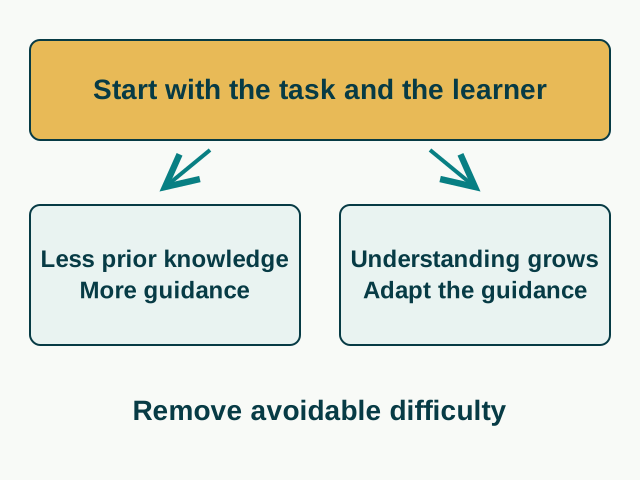
For us as teachers, that means finding out what someone understands before adding more. Ask them to explain an example. Their answer may reveal a missing piece that we’d assumed was already there. Seniority won’t reliably tell us this; an experienced clinician can still be new to the particular task we’re teaching.
Which part is making it difficult?
The terminology gets a little cumbersome here, but the distinction helps. Intrinsic load concerns the elements that have to be considered together to understand the task, given what the learner already knows. Interpreting an unfamiliar ECG requires several observations to be connected. We can’t make that difficulty disappear simply by tidying the slide.
Extraneous load comes from the way the task is presented. A blurred trace, unexplained shorthand or labels on a separate page make the learner work harder to get at the explanation. Sweller describes this in terms of element interactivity: which relationships belong to the task itself, and which demands have been added by the teaching?
Consider what you can change. You could make the trace readable immediately. If the learner doesn’t yet understand the features you’re asking them to connect, you’ll need to teach those first, work through an example together or tackle the task in stages. Eventually, those parts need to come back together.
At the bedside, some demands are unavoidable. There may be a better place for the longer explanation once you’ve examined the patient. A quieter discussion afterwards can be easier to follow than a running tutorial interrupted by every other job in the department.
And germane load?
If you’ve read about this before, you may remember a third category called germane load, often shown as the good effort involved in learning. Older diagrams add it to intrinsic and extraneous load, rather like three weights on a scale.
The theory has developed. In their 2019 review, Sweller and colleagues describe resources devoted to dealing with the intrinsic aspects of the task, rather than germane load contributing a separate extra amount. You’ll still encounter both explanations.
We don’t have to resolve every theoretical argument before improving a lesson. We should, though, avoid treating that scale as a measurement. There’s no bedside calculation that tells us exactly how much capacity is left for learning. Asking someone how demanding a task felt can open a discussion; it doesn’t establish why they struggled.
How much help should we give?
For someone starting out, try working through an example aloud. Explain what you notice and how it affects your next decision. Then leave part of a similar example for them to complete. Listen to how they approach it before deciding whether to offer more help.
As understanding grows, the same detailed guidance can become unnecessary. The expertise reversal effect describes how teaching that helps novices can lose its benefit, and sometimes become counterproductive, for more knowledgeable learners. Someone who can already explain the basics may learn more from comparing alternatives or tackling an unfamiliar variation.
Simulation makes this particularly apparent. When a learner first encounters equipment, extra alarms and interruptions may get in the way of learning how to use it. When a team is practising coordination under pressure, competing demands may be part of what we want them to handle. We need to look at the objective and the people in the room before deciding how complicated the scenario should be.
We should also leave room for the learner’s explanation. Where did they lose the thread? Was a term unfamiliar? Were they worrying about something else? A pause is easy to interpret as a knowledge gap when we haven’t asked.
When you next look through a teaching session, follow it from the learner’s position. Work out what they have to know already and where they have to divide their attention. Then watch someone use it. The part that needs changing may be a slide, an explanation or an assumption you hadn’t realised you were making.
Originally published by Nick Smith on 14 November 2018 following an education conference in Virchester. This revision retains his abbreviation example and concern with the demands our teaching places on learners.
References and further reading
- Cowan (2001). The magical number 4 in short-term memory: a reconsideration of mental storage capacity.
- Sweller (2010). Element interactivity and intrinsic, extraneous, and germane cognitive load.
- Sweller, van Merriënboer and Paas (2019). Cognitive architecture and instructional design: 20 years later.
- Kalyuga et al. (2003). The expertise reversal effect.
Keep exploring
Dual coding and useful visuals · Deliberate practice and mastery · Back to educational theories

Pingback: LITFL Review 354 • LITFL Medical Blog • FOAMed Review
Pingback: LITFL Review 354 • LITFL Medical Blog • FOAMed Review - Case Root
Pingback: Cognitive load theory • LITFL Medical Blog • SMILE2 CCC
Pingback: Educational theories you should know: Dual-Coding • St Emlyn's