
Emergency department (ED) crowding is the operational challenge of a generation. With every G7 economy having documented ED crowding as a significant public health problem, it is not unique to the National Health Service (NHS). And as with most public health problems, an association with harm was always likely.
St Emlyn’s recently published a JC post on the Howlett paper (EMJ 2026), which converged with two earlier studies (Jones 2022 and the Office for National Statistics (ONS) analysis 2025) on this harm signal in the UK context: medical boarding in the ED is associated with a measurable increase in 30 day mortality. Since then, the ONS analysis has been peer-reviewed and formally published as Aston et al. in Annals of Emergency Medicine.
The correlation between long ED stays and increased mortality is now considered established in academic literature. This post is a walk through the evidence base as it stands, across every level of the NHS and its regulators.
Academic evidence
Jones et al. (2022) (also covered in a St Emlyn’s JC at the time) examined 5.2 million admitted patients from every English Type 1 (major) ED between April 2016 and March 2018. Standardised 30-day mortality begins to rise from 5 hours after arrival. For patients waiting 8 to 12 hours, the number needed to harm is 72: one additional death for every 72 patients delayed.
The ONS analysis, first released in 2025 and now peer-reviewed and published as Aston et al., examines 30-day mortality following an ED visit in 6.7 million adults attending Type 1 EDs in England between March 2021 and April 2022. Adjusted odds ratios, relative to two hours in the ED, are 1.6 at six hours, 1.9 at nine hours, and 2.1 at twelve hours. The signal begins to climb from around two hours. The paper is jointly authored by ONS statisticians, Royal College of Emergency Medicine (RCEM) emergency physicians, and a Department of Health and Social Care civil servant. That authorship crosses statistical, professional and governmental boundaries in a way that itself signals the maturity of the evidence base.
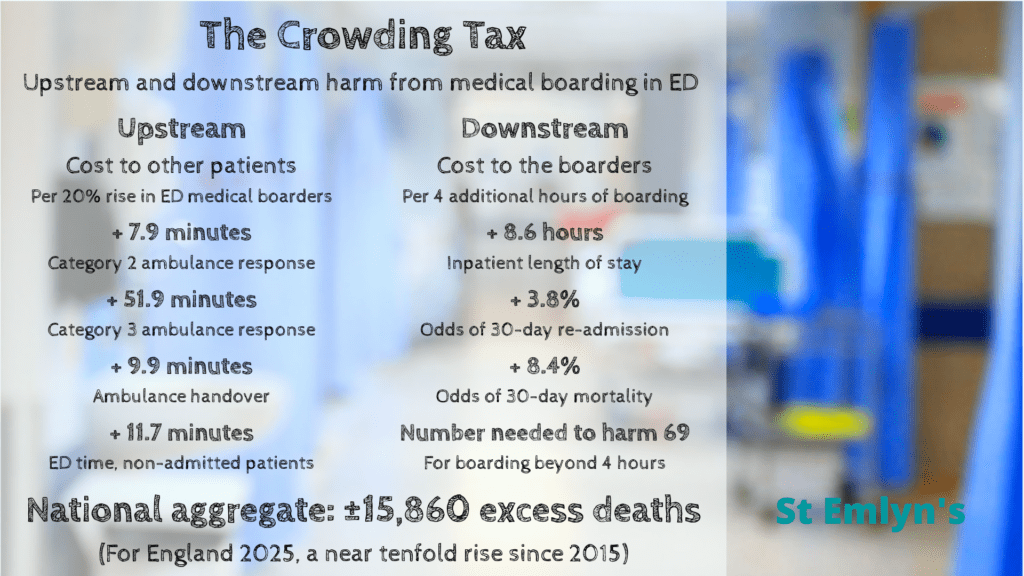
Howlett et al. (2026) quantified the harm specific to boarding (the delay between decision to admit and inpatient transfer). In essence a crowding tax: each additional four hours of boarding associated with an 8.4% increase in the odds of 30-day mortality, 8.6 hours of extra inpatient stay, and a 3.8% increase in the odds of 30-day re-admission. The number needed to harm for boarding beyond four hours was 69 (more of their findings in the image).
Rizer et al. (2026) extended the picture beyond the UK, examining over 173,000 admissions to a five-hospital US academic health system between January 2018 and June 2024. Rizer measured observable clinical deterioration events during boarding (escalation from floor to intermediate or intensive care within 48 hours of an admission order) and their downstream mortality. 3.6% of boarders experienced early deterioration, with every excess hour of boarding increasing the relative risk of early deterioration by 0.8%. Among those who deteriorated, 28-day mortality was 13.0% versus 3.9% among those who did not. Care at academic safety-net hospitals and overnight boarding were among the independent predictors.
Using Jones et al., the RCEM’s State of Emergency Medicine in England report (June 2026) estimated 15,860 excess deaths in England in 2025 associated with long emergency care waits (see image). A near tenfold rise from 1,657 in 2015. The RCEM described this as a “conservative estimate”.
These three UK papers span nearly a decade of NHS operating conditions. Jones from 2016 to 2018, before the pandemic; ONS from 2021 to 2022 data during the recovery period; and Howlett from July 2023 to May 2025, the most contemporary available. Rizer adds a fourth, non-UK paper covering roughly the same period.
The sobering part is the global scale. ED crowding has been documented in health systems across every continent, so aggregated harm and its cost are likely substantially larger.
Statutory and professional-body evidence
The Royal College of Nursing’s (RCN) On the Frontline of the UK’s Corridor Care Crisis (January 2025), drew on responses from over 5,000 nurses. Around two thirds said they were delivering care in “inappropriate settings” daily. The RCN declared it a “national emergency”.
A Royal College of Physicians (RCP) snapshot survey (February 2025) found that 78% of 961 physicians had provided care in a “temporary environment” in the past month, and 90% reported that patient privacy and dignity had been compromised.
The Health Services Safety Investigations Body (HSSIB), the statutory patient safety investigator for the NHS in England, published Patient care in temporary care environments (January 2026). It found that pressures around patient flow are “constant” and that “temporary care environments” are “used throughout the year and not just during winter pressures”.
Its report stated that there is no agreed definition of the practice, and that these environments pose patient safety risks “more challenging to manage”. HSSIB concluded that “the impact of temporary care environments on patient safety may be poorly understood” and issued a Safety Observation, calling for agreed national definitions and enhanced information gathering.
A British Medical Journal investigation (December 2025) established that 79% of NHS trusts in England were providing care in “non-designated areas”.
Coronial evidence
An ITV News investigation (March 2026) identified 27 Prevention of Future Deaths reports issued by coroners in England between 2020 and 2026, relating specifically to corridor care, overcrowding or lack of hospital beds. These are individual, legally-formal findings by coroners that a death has occurred in circumstances liable to recur.
Twenty-seven such findings, addressed to the incumbent Health Secretary, NHS England and hospital trusts, is not a fringe pattern. The specific coroner concerns raised include the observation that a death in corridor care conditions was “clearly a risk of death”, that beds were unavailable and “almost a daily occurrence”, that a patient had been left in a corridor for “22 hours in a corridor despite suffering from an infection”, and that the problem was one requiring “improvement at a national level”.
Trust governance evidence
The BBC reported (July 2026) that a Kent Hospital had recorded 1,315 twelve hour ED waits in May, and 963 occasions of patients spending more than 45 minutes in an ED corridor. The trust’s board meeting noted that their Summary Hospital-level Mortality Indicator was running approximately 30% higher than expected for comparable patients elsewhere in the NHS.
The board’s own minutes drew an explicit link between the delays being recorded and the mortality being observed. Jones, Aston, Howlett and Rizer suggest their finding is not isolated, but the local presentation of the crowding tax that the wider evidence base describes. Given the scale of the practice reported across the NHS, other trusts examining their own data are very likely to find similar patterns.
The national response
NHS England issued corridor care guidance in September 2024, updated it in December 2025, formally defined corridor care in March 2026 (as any patient spending 45 minutes or more in a clinically inappropriate area), and issued further updated guidance in June 2026 (previously covered in St Emlyn’s).
The Health and Social Care Committee held a one-off oral evidence session on corridor care in March 2026 in response to the HSSIB report. The House of Commons held a Backbench Business general debate on corridor care on 8 July 2026.
At government level, Wes Streeting, then Secretary of State for Health and Social Care, publicly committed in early 2026 to eradicate corridor care by 2029. Streeting departed the role in May 2026. His successor, James Murray, held the brief for only two months. Most recently, Yvette Cooper was appointed on 20 July 2026, inheriting the 2029 commitment.
Has there been an inquiry?
No statutory public inquiry, independent review or formal Parliamentary select committee inquiry has been convened to examine the pattern. The Committee’s engagement to date has been a single evidence session, without terms of reference, without evidence-gathering across multiple sittings, and without a published report or government response.
And yet, statutory public inquiries and independent reviews have been convened in response to comparable patterns of harm elsewhere in the NHS. Maternity services have been examined through the Ockenden and Kirkup Reviews. Mental health inpatient care has been examined through the Lampard and Edenfield inquiries. The Infected Blood Inquiry reported in 2024. The Covid Inquiry is currently running.
Each was convened because a pattern of preventable harm had been identified at a scale and consistency that warranted statutory examination. The Ockenden Review at Shrewsbury and Telford examined 1,486 families and 1,592 clinical incidents, predominantly between 2000 and 2019. The Infected Blood Inquiry identified approximately 3,000 UK deaths from infected blood products administered during the 1970s and 1980s.
The RCEM’s estimate for excess deaths associated with long emergency care waits in England in 2025 alone is 15,860. The difference perhaps is that the RCEM figure is a modelled excess mortality estimate, rather than a coroner-level count of individually attributable deaths. That is a real distinction that any inquiry would need to address as a first order of business. That estimate has, however, been independently supported by several studies, including one by the ONS.
What is left
The current evidence base makes formalised examination not only defensible but necessary. Academic literature, professional colleges, statutory patient safety bodies, coroners, trust boards, media investigations and NHS England’s own guidance strongly converge on the same finding. The response has been proportionate at each of those layers, with the exception of a statutory inquiry.
The commitment to eradicate the practice by 2029 has passed through three Health Secretaries in six months without visible change in the underlying figures. The question this raises is whether the pattern warrants formal examination at the level the state has reserved for other patterns of comparable harm.
On the current evidence base, the answer is not obviously no.
References and further reading
- Govind Oliver, “JC: Emergency Department Delays and Mortality,” in St.Emlyn’s, March 9, 2022.
- Stevan Bruijns, “JC: Boarding, the crowding tax and a fixable problem,” in St.Emlyn’s, June 29, 2026.
- Association between time spent in emergency care and 30-day post-discharge mortality, England. Office for National Statistics. March 2021 to April 2022.
- Jones S, Moulton C, Swift S, Mann C. Association between delays to patient admission from the emergency department and all-cause 30-day mortality. Emerg Med J. 2022;39:168–173.
- Aston L, et al. Thirty-day mortality following emergency department attendance in England: a national observational study. Ann Emerg Med. 2026. (Formerly released by the Office for National Statistics in 2025; peer-reviewed publication). (Add volume/pages once available.)
- Howlett N, Cameron J, Wood R, et al. Medical patient boarding in the emergency department as a source of crowding and delay-related harm, impacting patient outcomes and the efficiency of urgent and emergency care. Emerg Med J. 2026. doi:10.1136/emermed-2025-214983.
- Rizer NW, Klein E, Copenhaver MS, Zhao X, Kelen GD, Hinson JS. Early clinical deterioration among emergency department boarders: a retrospective analysis. Ann Emerg Med. 2026;87(6):681–693. doi:10.1016/j.annemergmed.2026.01.023.
- Royal College of Emergency Medicine. State of Emergency Medicine in England 2026. London: RCEM; 2026.
- Royal College of Emergency Medicine. ‘How many deaths will it take before we see a meaningful plan to end the crisis?’: Deaths associated with long ED waits surge almost tenfold over a decade. London: RCEM; 2026.
- Royal College of Nursing. On the Frontline of the UK’s Corridor Care Crisis. London: Royal College of Nursing; 2025.
- Royal College of Physicians. Temporary care environments: snapshot survey of physicians. London: Royal College of Physicians; 2025.
- Health Services Safety Investigations Body. Patient care in temporary care environments. York: HSSIB; 2026.
- British Medical Journal. Investigation: non-designated areas used for patient care across NHS trusts in England. BMJ. 2025.
- ITV News. Corridor care: Prevention of Future Death reports reveal repeated coroners’ concerns. ITV News. 2026.
- BBC News. Kent hospital board links prolonged emergency department delays with increased mortality. BBC News. 2026.
- NHS England. Principles for providing patient care in corridors. London: NHS England; 2026.
- NHS England. Corridor care: worked examples and updated operational guidance. London: NHS England; June 2026.
- UK Parliament Health and Social Care Committee. Oral evidence: Patient care in temporary care environments. London: House of Commons; March 2026.
- UK Parliament. Backbench Business Debate: Corridor Care. House of Commons; 8 July 2026.
