
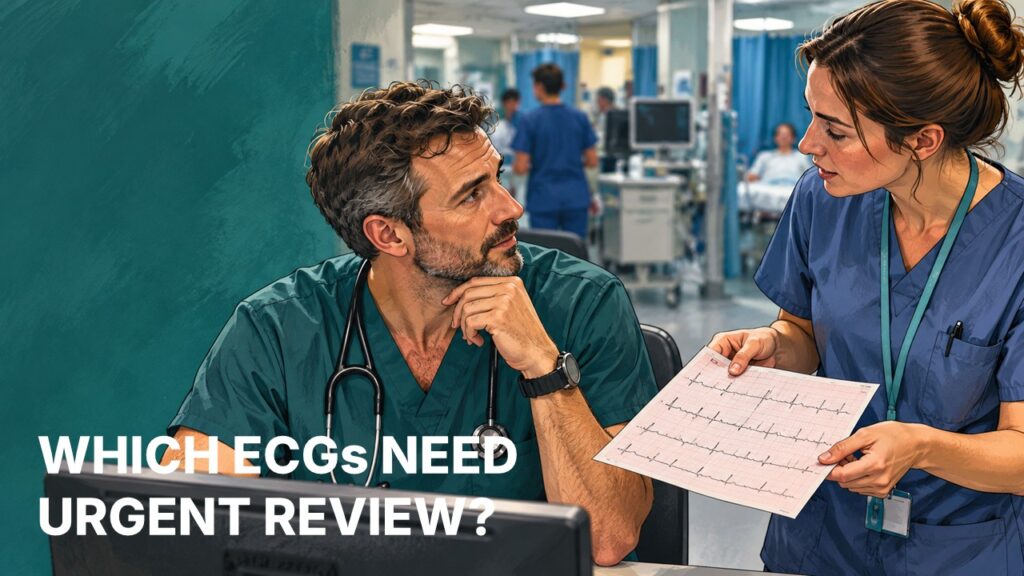
You’re halfway through assessing a patient in the Emergency Department when somebody appears beside you holding an ECG.
“Could you sign off this ECG for me?”
It’s a familiar experience for almost everyone working in Emergency Medicine. Sometimes that ECG contains something that needs immediate action. Sometimes it doesn’t. But whichever it is, you’ve stopped what you were doing to look at it.
Which findings do you think warrant urgent senior review? That’s the question behind CUES-ED, a five-minute survey for Emergency Medicine specialists and trainees practising in Australia, New Zealand, the USA, Canada or the UK. Take part in the survey.
Back in 2022, I wrote about this on St Emlyn’s in a post called The ECG Thrust. I questioned why we perform so many ECGs on patients arriving in our departments, and whether interrupting clinicians to review every one of them is always the best way to deliver safe care.
Could technology help?
In 2024, I had a fascinating conversation with Steve Smith about occlusive myocardial infarction, ECG interpretation and artificial intelligence. You can listen to that podcast here.
For me, the major question has always been whether AI might help us review the low risk ECGs that just need ‘signing off’. But before we can investigate that possibility properly, there’s a more fundamental question – Which ECG findings actually warrant an interruption for urgent medical review?
That might sound straightforward, but I suspect that clinicians working in different departments, and perhaps different countries, may have quite different views. And that’s where you can help.
The CUES-ED international survey
Professor Louise Cullen and colleagues in Australia are undertaking a research study called Consensus on urgent ECG screening in the Emergency Department (CUES-ED). They’re asking Emergency Medicine clinicians to share their views on which ECG findings warrant urgent senior medical review. The aim is to help establish an international consensus that can inform future research and the development of clinical decision-support tools.
This survey isn’t about deciding whether a particular AI tool is safe or effective. It’s about understanding what clinicians believe should happen when an ECG is recorded in the ED. Agreement between clinicians would not, by itself, establish that delaying ECG review is safe; that would need separate clinical validation.
Could you take part?
The researchers are looking for Emergency Medicine specialists and trainees currently practising in Australia, New Zealand, the United States, Canada or the United Kingdom. The anonymous, voluntary survey takes approximately five minutes to complete. No identifiable information is collected.
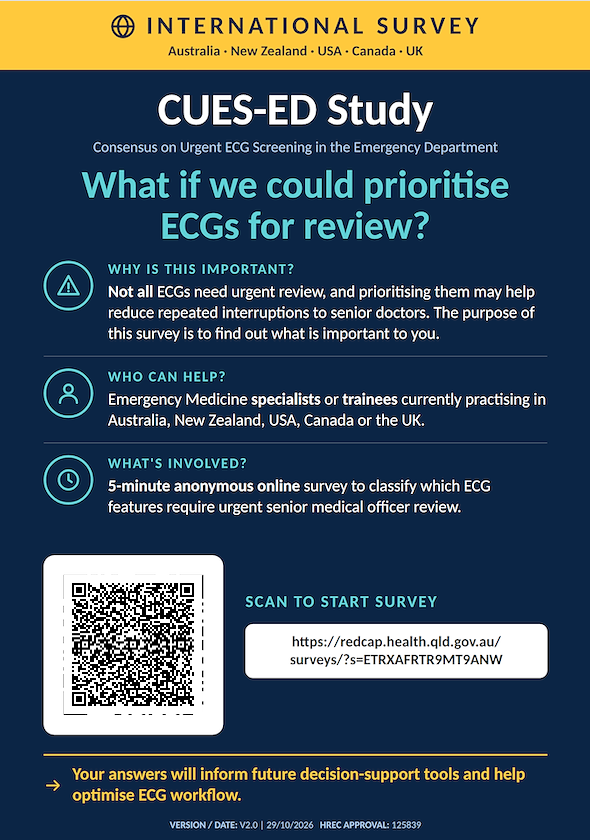
If you meet those criteria, I’d really encourage you to contribute. And whether or not you’re eligible yourself, please share the invitation with colleagues who are.
Back to the ECG Thrust
I’ve always felt that we should be trying to make the work we do in Emergency Departments safer and more effective, for both our patients and the clinicians looking after them. Perhaps AI will have a part to play in helping us decide which ECGs need our attention most urgently. Perhaps improvements to our existing processes will prove just as important. But we need to understand the clinical problem before we can start designing and testing the solutions.
So please consider taking part. Your experience might help shape how we review ECGs in the future.
Take part in the CUES-ED survey
The CUES-ED study has ethical approval from the Metro North Human Research Ethics Committee (HREC/2026/MNH/125839). For questions about the study, contact Professor Louise Cullen at [email protected].
Transparency: St Emlyn’s received sponsorship from PMcardio until April 2025, and I have been involved in discussions about a proposed evaluation of this technology. This article invites participation in research; it does not endorse any clinical tool or recommend a change to current ECG-review practice.
