
Learning framework
Self-regulated learning and metacognition
A learning plan needs more than a topic and a reading list. How do we work out what needs to change, and find out whether our efforts have helped?
Iain Beardsell
Published 21 October 2026 · 5 min read
“I need to get better at ECGs.” Suppose that comes up at an educational supervision meeting. It sounds like a reasonable learning need, and there’s certainly no shortage of material we could recommend. We could agree a reading list, record the goal and move on to the next box.
But what does “better” mean here? Does the learner miss findings, recognise them without understanding their significance, or struggle to bring the ECG together with the rest of the clinical picture? We could recommend quite a lot of reading without getting any closer to the problem.
Self-regulated learning asks the learner to take an active part in working this out and checking what happens as they learn. It’s useful for supervisors too, especially when we’ve started to suspect that another learning plan isn’t quite what the trainee needs.
What are we trying to regulate?
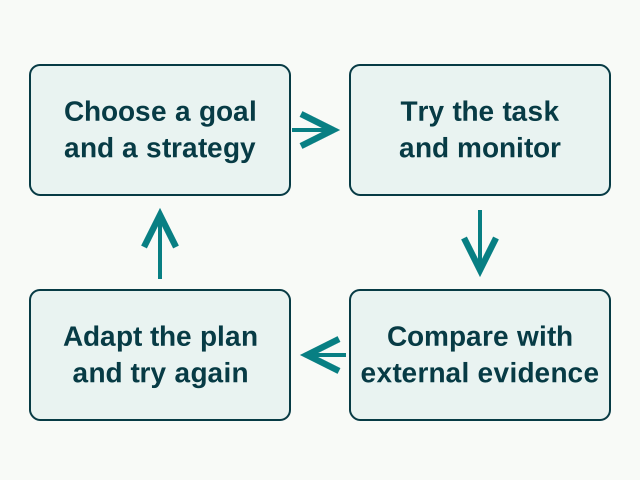
Zimmerman’s account describes a cycle with three phases: forethought, performance and self-reflection. Before a task, we think about our goal and how to approach it. While doing it, we use our chosen approach and pay attention to how it’s going. Afterwards, we judge the result and decide what to do with that information. What we learn from one attempt affects how we approach the next.
Metacognition is part of this. It concerns what we know about our own thinking and how we monitor and regulate it. We might notice, for example, that we’ve read a paragraph several times without being able to explain it. Recognising that is useful; deciding to close the page and try an explanation from memory gives us a way to investigate the problem.
Self-regulated learning takes in more than thinking about thinking. Motivation matters, as do our study habits and the conditions we arrange for learning. Knowing we need to practise is of limited use if we never find an opportunity to do it.
The word “self” can be misleading. Seeking help is part of managing our learning. A supervisor who watches a task or helps interpret feedback can be central to the process. We haven’t failed to become self-regulated learners because we need another person’s opinion.
Give the goal some detail
Back to ECGs. Our learner and supervisor might discover that the difficulty starts with an incomplete description: the trainee moves quickly to a diagnosis and leaves out findings that would have made them reconsider. That gives us something more specific to work on.
They could arrange ten minutes with a few teaching ECGs. The learner describes each one before offering an interpretation, using an agreed approach. The supervisor listens and checks the account against the tracing. This gives both of them a chance to see where the omissions occur, without waiting for the perfect patient to arrive at a convenient time.
If the description turns out to be sound, they’ll need to look elsewhere. Perhaps it’s the explanation of the findings that needs attention. A learning plan should be allowed to change when we discover that our first account of the problem was wrong.
Does writing it down help?
A study involving 36 medical students examined sharing individual learning goals with the people giving feedback. The written feedback was more likely to address those goals, but its quality didn’t improve on the measure the researchers used. Sharing a goal can help direct the conversation; it doesn’t ensure that the conversation will be useful.
For our ECG exercise, we still need someone who can spot the difficulty and help the learner work on it. We also need to let the learner know what we saw. A completed form won’t do either of those jobs for us.
Check the impression against the attempt
Ask the trainee how complete they think their description was, then compare that with the tracing and your own observations. They may be confident despite leaving something out. Equally, they may be doing well and remain very unsure. Either finding is worth discussing. The learner’s feeling about an attempt is one source of information, and it can disagree with the performance.
This is easier to explore in a teaching exercise than in the middle of a resuscitation. We don’t need to run a continuous commentary on our own thinking while trying to do urgent clinical work. Choose a suitable point for review, or practise with teaching material where there’s time to stop.
Afterwards, try to get beyond “that went badly”. If the same part of the description was missed several times, what might explain that? A short prompt could help on the next attempt. Later, repeating the task without the prompt would let us see whether the approach has become more secure.
And then we need to come back to it
The part that’s easy to lose is the return visit. The shift ends, the next supervisor takes over and the carefully discussed strategy never gets tried again. Agree when the learner will revisit it and who can help. Keep a short note of what needs checking, without identifiable patient information. If the planned opportunity disappears, make another arrangement.
There is some encouraging research on supporting this process. A 2024 pilot involving 23 students reported better monitoring and clinical skill performance after feedback focused on self-regulation. It was a small before-and-after study, so we can’t separate the effect of that feedback from other reasons students might improve. Whether the findings carry over to routine clinical work is another question. Our accounts of both studies here are based on their published abstracts.
For the next supervision meeting, it may be useful to bring something you’ve already tried and found difficult. That could be a teaching case you’ve worked through, or an explanation you struggled to give. Work through what happened with your supervisor and decide what you’d try differently. That gives the learning plan something concrete to refer back to when you meet again.
References and further reading
- Zimmerman BJ. Becoming a self-regulated learner: an overview. 2002.
- Kiger ME et al. Use of individualized learning plans to facilitate feedback among medical students. 2020.
- Cecilio-Fernandes D et al. Self-regulated learning microanalysis feedback for developing clinical skills: a pilot study. 2024.
Keep exploring
Be a better learner: Part 1 · On reflection · How to coach and give feedback with your team