
Motivation theory
Motivation and self-determination in the ED
Why do learners put the work in, and what can a supervisor do when enthusiasm is hard to find? Self-determination theory gives us somewhere to start.
Iain Beardsell
Published 21 October 2026 · 5 min read
We ask a lot of our learners. Studying for examinations has to fit around clinical work, and the portfolio seems to acquire new requirements while nobody is looking. Somewhere in there we hope they’ll want to find out more about the things they encounter and become better clinicians.
When that doesn’t happen, it’s easy to reach for the word “unmotivated”. Before we do, it might be worth asking what we mean. Is the learner doing very little, or doing what we’ve asked without appearing interested? They might be interested in something quite different from the thing we want to teach.
Self-determination theory helps us examine those questions. It also turns some attention back on the teacher, which is probably healthy.
Why are they doing it?
In Ryan and Deci’s account, intrinsic motivation means doing an activity for the interest or satisfaction in the activity itself. Extrinsic motivation involves a separate outcome. Studying a subject because it fascinates you differs from studying it to pass an examination.
That distinction is useful, but extrinsic motivation covers quite different reasons for working. A learner might prepare because they fear being criticised on the ward round. Another might prepare because they value being able to contribute to a patient’s care, even though the subject itself leaves them cold. Both have a reason beyond enjoyment of the activity. The second has accepted its value for themselves.
This is an important part of Kusurkar’s discussion of autonomous motivation in medical education. We don’t have to make every task entertaining. Helping someone understand why a task matters can also help them find a reason to work at it.
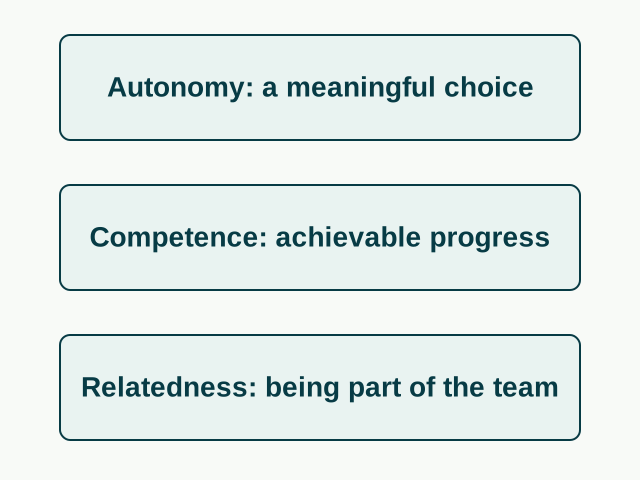
The theory describes three psychological needs: autonomy, a sense that we have some choice and ownership of our actions; competence, feeling able to deal with a task and develop our abilities; and relatedness, feeling connected to other people. They can all matter at the same time. There’s no pyramid to climb here.
How much choice can we offer?
Quite a lot, sometimes. Imagine a trainee who needs to work on explaining investigation plans to patients. You could tell them you’ll watch the next conversation. You could also ask whether they’d prefer to rehearse an example with you first. The learning need is the same, but the trainee has some influence over how you tackle it.
They might have a better suggestion. Perhaps they find it easy to explain what an investigation involves but struggle when someone asks why you’re considering it at all. Asking what they find difficult could save both of you from spending ten minutes on something they can already do.
Autonomy in this sense doesn’t mean independent clinical practice. Supervision and clinical standards still apply, and an emergency may leave very little room for negotiation. We can explain our reasoning afterwards. Even when a requirement is fixed, it’s possible to acknowledge that it’s frustrating and discuss how to make the learning useful. Pretending every portfolio task is irresistibly interesting is unlikely to convince anyone.
Can they see themselves getting better?
Think about how we respond when a learner struggles. If the task is far beyond them, another unsuccessful attempt may tell them very little. We may need to demonstrate part of it and reduce the difficulty before asking them to have another go.
For our trainee, that might mean practising the opening explanation without also having to manage several interruptions. After feedback, let them try again. You can then discuss what changed: perhaps this time the patient would understand the reason for the investigation before hearing about its possible results.
A general “well done” is pleasant enough, but it gives the learner little to use. Tell them what improved and what still needs work. Feeling more capable is part of the theory; deciding whether someone is ready to practise independently requires evidence of their performance. We shouldn’t confuse the two.
Being part of the department
Now imagine joining a department halfway through a rotation. Nobody has introduced you, you don’t know who to ask for help and teaching seems to happen somewhere else. You might look rather quiet in that environment. Calling you disengaged would let the rest of us off the hook fairly easily.
Introductions and a named person to approach are a useful start. So is including the learner in a discussion and taking their question seriously. If we’ve offered to watch something or give feedback, we should try to follow through. When the shift gets in the way, acknowledge it and make another arrangement.
We also need to make room for people who don’t share our interests or enjoy the same social activities. Feeling part of a clinical team shouldn’t depend on coming to the pub.
Does this improve learning?
In a study of 383 medical students, Kusurkar and colleagues examined how motivation, study strategies, effort and academic performance related to each other. More autonomous motivation was associated with better academic performance through the relationships in their model. They weren’t testing an intervention in an emergency department, so the study can’t tell us whether offering a trainee a choice during a shift improves their clinical work.
The examples here are ways to try the theory in our teaching. We still need to find out whether they help. Ask the learner what made a session useful, and be prepared for the answer to differ from the bit you were most pleased with.
Of course, none of this creates time or staff. If someone repeatedly misses teaching because they’re covering the department, we already have a fairly obvious problem to address. Before writing “needs to show more motivation” in a report, have a conversation about the opportunities they’ve actually had.
References and further reading
- Ryan RM, Deci EL. Self-determination theory and the facilitation of intrinsic motivation, social development, and well-being. 2000.
- Kusurkar RA. Autonomous motivation in medical education. 2019.
- Kusurkar RA et al. How motivation affects academic performance: a structural equation modelling analysis. 2013.
Keep exploring
Maslow and the conditions for learning · How to coach and give feedback with your team · Wellbeing at work